
A Question Most Sellers Wonder But Rarely Ask
When you walk out of a gold buyer’s branch with cash in your hand, your inherited chain or family bangles do not vanish into a vault. They begin a journey that ends, often within a few weeks, as new jewellery on someone else’s body, or as a 999-fineness bullion bar in an exchange vault, or as electrical contacts in a microchip. The journey from your old gold to its next form is one of the most efficient recycling cycles in the global economy – and understanding it explains exactly why the best gold buyer can pay so close to the live spot rate. Behind every transparent quote is a refining-and-resale infrastructure that turns your jewellery back into raw gold within weeks.
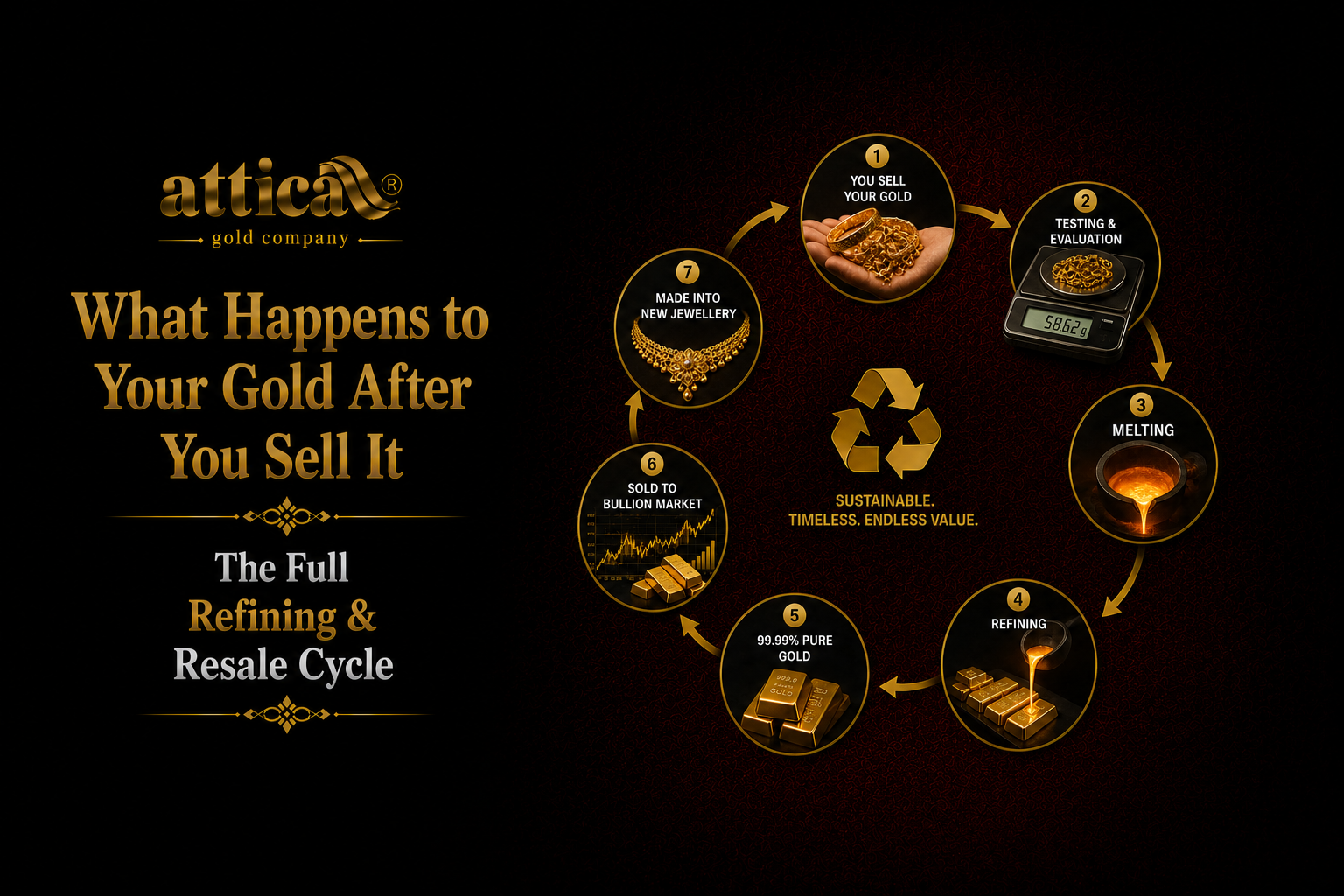
This guide walks through the full cycle – from the moment your piece is logged at the buyer’s counter, through melting, assaying, refining, casting, and back to the retail jewellery or bullion market. We cover the technology used, the time it takes, the cost structure that determines your sale price, and the environmental footprint of recycled gold compared to mined gold. By the end, you will see exactly where every rupee of the buyer’s margin goes, and why the maths leaves enough room to pay you the full live rate.
The Cycle at a Glance
| Step 1 | Buyer counter – XRF test, weighing, KYC, payment |
| Step 2 | Branch consolidation – pieces aggregated daily |
| Step 3 | Refinery transfer – sealed batch shipment to BIS-licensed refinery |
| Step 4 | Melting – pieces melted in an induction furnace at ~1100°C |
| Step 5 | Assaying – fire assay confirms the exact gold content of the melt |
| Step 6 | Refining – chemical or Miller chlorination process to 999.5+ fineness |
| Step 7 | Casting – refined gold cast into bars, biscuits, or grain |
| Step 8 | Resale – back to jewellers, banks, or commodity exchanges |
Today’s Rate: The Number That Drives the Whole Cycle
Every step in the cycle is priced against today’s live IBJA rate. The buyer pays you live rate × tested purity, the refiner charges a small margin to convert your jewellery to bullion, and the bullion sells back to jewellers and banks at live rate × purity. The whole system is anchored to one number – the international gold spot price translated into rupees through the LBMA fix and IBJA. Use the widget below to confirm today’s 24K reference, the same number that anchors every transaction in the recycling chain.
Step 1–2: At the Branch
When you hand your gold over the counter, the buyer logs each piece against your KYC, runs the XRF test, weighs the items, and issues your invoice. The pieces are placed in a tamper-evident sealed pouch with your reference number printed on it. At the end of each day, branch-level pouches are consolidated into a sealed batch – typically several kilograms across all sellers – and stored in the branch vault overnight. There is no melting at the branch. The piece you sold today is sitting in a sealed pouch, with your reference still attached, until it ships to the refinery.
Step 3: Refinery Transfer
Within 1–7 working days, the sealed batch is transported by armoured carrier to a BIS-licensed bullion refinery. Most large organised buyers in India work with one of a handful of certified refineries – MMTC-PAMP, Augmont, Rajesh Exports, Kundan Gold Refinery and a few others. The refinery is the only point in the chain where actual melting happens, and they operate under tight chain-of-custody documentation. Each pouch is logged on arrival, weighed by an independent assayer, and queued for processing. Your reference number stays attached to the pouch through the gold refining process until the actual melt happens.
Step 4: Melting in the Induction Furnace
Once the pouch reaches the gold melting process queue, the actual melting begins. Modern Indian refineries use induction furnaces – high-frequency electromagnetic coils that heat the gold without combustion gases or carbon contamination. The pouch contents are tipped into a graphite crucible and heated to about 1100°C (gold melts at 1064°C). Within 10–20 minutes, the entire batch reduces to a liquid pool of mixed-purity gold alloy – your old chain plus thousands of other sellers’ pieces, all merged. From this point,t the gold is no longer “yours” individually; it is part of a melt batch that will be assayed and refined together.
The melt is poured into ingot moulds to form intermediate bars of 90–95% purity. These are then sampled for assay before refining proceeds.
Step 5–6: Assaying and Refining to 999.5+
The fire assay is the gold standard for measuring purity (literally). A small sample of the melt is taken, weighed precisely, melted with lead in a cupellation furnace, and the resulting beads are weighed again. The ratio gives the exact gold content to 0.01% accuracy. Modern refineries also use ICP-OES (inductively coupled plasma optical emission spectroscopy) for cross-confirmation. The assay determines the value of the batch and the refining-yield calculation.
Refining itself uses one of two processes – chemical (aqua regia, where gold is dissolved in nitric and hydrochloric acid, then precipitated back as pure metal) or Miller chlorination (chlorine gas removes silver and base metals from molten gold). Both produce 999.5+ fineness – i.e. 24K bullion-grade gold. The cost of refining is roughly ₹15–25 per gram regardless of starting purity, which is why high-volume processing (gold recycling in India at scale) is the only economic path. The refining cycle takes 3–10 working days end-to-end.
💰 Get the Best Price for Your Gold Today
Instant valuation • Transparent pricing • 100% secure & trusted
Step 7: Casting Back into Useful Forms
Refined 999.5+ gold is cast into one of three product forms based on what the downstream market is asking for:
- Investment bars – 1g, 5g, 10g, 50g, 100g, 1kg sizes for retail and institutional sale.
- Coins and biscuits – 0.5g to 50g, often hallmarked with the refiner’s logo.
- Grain – small pellets of pure gold sold to jewellery manufacturers as raw material for new jewellery.
Most household jewellery gold ends up as grain that is then alloyed back to 22K (with copper and silver) or 18K (with copper, silver and palladium) at jewellery manufacturers. Within roughly 4–8 weeks of your original sale, the gold from your old chain is on a jeweller’s shelf as a new chain – possibly even at the same brand. This is what happens to old gold in the modern Indian gold economy: it is recycled, not destroyed.
Step 8: Back to the Market
The refinery sells the cast products to its three main customer types: jewellery manufacturers (the largest consumer in India), banks issuing gold deposit and bullion services, and commodity exchanges (MCX) that store bullion as the underlying for ETFs and futures. The pricing is again anchored to the day’s IBJA rate, with refining margins built in. The jewellery manufacturer alloys the pure gold to 22K, fabricates new pieces, applies BIS hallmarking, and ships to retail jewellers. Within 60 days of your original sale, your gold is potentially being purchased by a new bridal customer in a different city.
Why This Cycle Lets the Best Gold Buyer Pay Live Rate
The volume economics are what make the system work for sellers. A how gold buyers refine gold model that processes thousands of grams per day per buyer means refining margins drop to 1–2% of transaction value. The buyer’s gross margin is the gap between the live IBJA rate they pay you and the live IBJA rate they receive from the refinery for refined bullion – typically 1–3%. From this gross margin, they cover XRF equipment, branch operating costs, KYC infrastructure, banking fees and a small profit. The system works because the volume is high enough to absorb fixed costs into a thin per-transaction margin.
Small local shops cannot replicate this. They sell to wholesalers at a 5–10% discount instead of refining at 1–2%, and they have to recover that gap from sellers. This is the structural reason why the best gold buyer at scale pays close to the live IBJA rate while a corner shop pays 5–15% below – the maths runs through the refining cycle, not through anyone’s goodwill.
The Environmental Footprint of Recycled Gold
A largely unspoken benefit of the gold refining process at scale is environmental. Mining new gold produces an estimated 38,000 kg of CO2 equivalent and millions of litres of cyanide-contaminated water for every kilogram of pure gold extracted. Refining recycled gold produces a tiny fraction of those emissions – typically 95–98% lower carbon footprint per gram. India recycles roughly 250–350 tonnes of gold per year (vs total demand of around 800 tonnes), most of it through household sales like yours feeding back into the jewellery cycle. Selling old gold is, in a real sense, supplying the cleanest gold the system produces.
Why Choose Attica Gold for Transparent Recycling
Understanding the cycle helps you spot which buyers operate inside it cleanly. A reputable buyer is connected to a BIS-licensed refinery, processes daily volume that justifies XRF and live-rate pricing, and issues invoices that hold up in any audit. A small operator is disconnected from the refining infrastructure, sells at wholesale discounts, and pushes that gap onto sellers via touchstone testing and exchange-rate quoting.
Attica Gold runs the same protocol at every one of its 200+ branches across Karnataka, Tamil Nadu, Andhra Pradesh, Telangana and Pondicherry – calibrated XRF in your presence, today’s live IBJA rate displayed openly, written line-by-line invoice, KYC at the counter, and instant settlement through cash, UPI, IMPS or RTGS. ISO 9001:2015 certification means the same standard at every branch, every day. The pieces you sell move through the same audited refining cycle described above, ending up as new bridal jewellery or 999 bullion within weeks. If you have been wondering what happens to your gold after the counter, your wait is over. Walk in, watch the test, take the cash – and know exactly where your gold is going next.
Frequently Asked Questions
What happens to old gold after you sell it at the best gold buyer?
Your old gold goes through a multi-step recycling cycle: branch consolidation (1 day), sealed transport to a BIS-licensed refinery (1–7 days), melting in an induction furnace (10–20 minutes), fire assay for exact purity (same day), chemical or chlorination refining to 999.5+ fineness (3–10 days), and casting into bars, coins or grain. Within 4–8 weeks of your sale, the gold is back on a jeweller’s shelf as new bridal jewellery or in a bank vault as bullion.
How does the gold refining process actually work?
After melting at 1100°C in an induction furnace, the molten gold goes through one of two refining processes: aqua regia (gold dissolved in nitric/hydrochloric acid, then precipitated back as pure metal) or Miller chlorination (chlorine gas removes silver and base metals from molten gold). Both produce 999.5+ fineness – bullion-grade 24K. The refining cost is ₹15–25 per gram irrespective of starting purity, which is why volume-based recycling is essential for economic viability.
Is Gold Recycling India a real industry?
Yes – India recycles roughly 250–350 tonnes of gold annually, around 30–40% of the total domestic demand of ~800 tonnes. Most of this comes from household sales of inherited and outdated jewellery flowing back into the manufacturing cycle. The recycling industry is anchored by 7–10 BIS-licensed refineries and serviced by organised gold buyers across major cities. The cycle is highly efficient and reduces the need for new mined gold imports.
How long does it take from selling my gold to it being made into new jewellery?
The full cycle typically takes 4–8 weeks. Branch consolidation: 1 day. Refinery transport: 1–7 days. Melting and assay: 1 day. Refining: 3–10 days. Casting: 1–2 days. Manufacturer order to fabrication: 2–4 weeks. Hallmarking: 1–3 days. Distribution to retail jewellers: 1–2 weeks. So a piece you sell on 5 May 2026 is likely back on a retail shelf as new jewellery by mid-July 2026.
Why does the best gold buyer pay so close to the live spot rate?
Because the refining cycle behind them operates at 1–2% gross margin, not 8–15% like local wholesalers. Daily volume across many branches lets the buyer absorb fixed costs (XRF equipment, branch staff, banking, compliance) into a thin per-transaction margin. The gap between what they pay you (live IBJA × tested purity) and what they receive from the refinery (live IBJA × refined fineness) is just 1–3%. That is the entire profit pool, and it leaves enough room to pay sellers the full live rate.
How do gold buyers refine gold at scale?
They do not refine in-house at the branch. Instead, the buyer aggregates daily collected jewellery into sealed batches and ships to a partner BIS-licensed refinery. The refinery handles melting, assaying, chemical refining and casting under a chain-of-custody protocol. The buyer’s margin comes from the difference between the live retail rate and refinery wholesale rate, not from refining themselves. This division of labour is what allows the best gold buyer to maintain transparent pricing and same-day settlement.
Is recycled gold lower quality than newly mined gold?
No – refined recycled gold is identical to newly mined gold at the molecular level. Both are 999.5+ fineness pure metal after refining. The difference is environmental: mined gold produces ~38,000 kg of CO2 equivalent per kg of pure gold extracted, while recycled gold produces 95–98% less. Most jewellery brands today use a mix of recycled and mined gold without distinguishing them, because the chemistry is the same.
Can I track what specifically happens to my old gold piece?
Up to the refinery, yes – your sealed pouch retains your reference number through branch consolidation and transport. After the melt batch (typically 5–20 kg of mixed gold), individual identity is lost; your gold becomes part of a refined bullion batch. The buyer’s invoice records the chain-of-custody at sale, but tracking is not maintained beyond the melt point. Most sellers do not need this level of trace; the audit value comes from the buyer’s receipt and KYC documentation.
{ “@context”: “https://schema.org”, “@type”: “FAQPage”, “mainEntity”: [ { “@type”: “Question”, “name”: “What happens to old gold after you sell it at the best gold buyer?”, “acceptedAnswer”: { “@type”: “Answer”, “text”: “Your old gold goes through a multi-step recycling cycle: branch consolidation (1 day), sealed transport to a BIS-licensed refinery (1–7 days), melting in an induction furnace (10–20 minutes), fire assay for exact purity (same day), chemical or chlorination refining to 999.5+ fineness (3–10 days), and casting into bars, coins or grain. Within 4–8 weeks of your sale, the gold is back on a jeweller’s shelf as new bridal jewellery or in a bank vault as bullion.” } }, { “@type”: “Question”, “name”: “How does the gold refining process actually work?”, “acceptedAnswer”: { “@type”: “Answer”, “text”: “After melting at 1100°C in an induction furnace, the molten gold goes through one of two refining processes: aqua regia (gold dissolved in nitric/hydrochloric acid, then precipitated back as pure metal) or Miller chlorination (chlorine gas removes silver and base metals from molten gold). Both produce 999.5+ fineness – bullion-grade 24K. The refining cost is ₹15–25 per gram irrespective of starting purity, which is why volume-based recycling is essential for economic viability.” } }, { “@type”: “Question”, “name”: “Is gold recycling in India a real industry?”, “acceptedAnswer”: { “@type”: “Answer”, “text”: “Yes – India recycles roughly 250–350 tonnes of gold annually, around 30–40% of total domestic demand of ~800 tonnes. Most of this comes from household sales of inherited and outdated jewellery flowing back into the manufacturing cycle. The recycling industry is anchored by 7–10 BIS-licensed refineries and serviced by organised gold buyers across major cities. The cycle is highly efficient and reduces the need for new mined gold imports.” } }, { “@type”: “Question”, “name”: “How long does it take from selling my gold to it being made into new jewellery?”, “acceptedAnswer”: { “@type”: “Answer”, “text”: “The full cycle typically takes 4–8 weeks. Branch consolidation: 1 day. Refinery transport: 1–7 days. Melting and assay: 1 day. Refining: 3–10 days. Casting: 1–2 days. Manufacturer order to fabrication: 2–4 weeks. Hallmarking: 1–3 days. Distribution to retail jewellers: 1–2 weeks. So a piece you sell on 5 May 2026 is likely back on a retail shelf as new jewellery by mid-July 2026.” } }, { “@type”: “Question”, “name”: “Why does the best gold buyer pay so close to live spot rate?”, “acceptedAnswer”: { “@type”: “Answer”, “text”: “Because the refining cycle behind them operates at 1–2% gross margin, not 8–15% like local wholesalers. Daily volume across many branches lets the buyer absorb fixed costs (XRF equipment, branch staff, banking, compliance) into a thin per-transaction margin. The gap between what they pay you (live IBJA × tested purity) and what they receive from the refinery (live IBJA × refined fineness) is just 1–3%. That is the entire profit pool, and it leaves enough room to pay sellers full live rate.” } }, { “@type”: “Question”, “name”: “How do gold buyers refine gold at scale?”, “acceptedAnswer”: { “@type”: “Answer”, “text”: “They do not refine in-house at the branch. Instead, the buyer aggregates daily collected jewellery into sealed batches and ships to a partner BIS-licensed refinery. The refinery handles melting, assaying, chemical refining and casting under a chain-of-custody protocol. The buyer’s margin comes from the difference between the live retail rate and the refinery wholesale rate, not from refining themselves. This division of labour is what allows the best gold buyer to maintain transparent pricing and same-day settlement.” } }, { “@type”: “Question”, “name”: “Is recycled gold lower quality than newly mined gold?”, “acceptedAnswer”: { “@type”: “Answer”, “text”: “No – refined recycled gold is identical to newly mined gold at the molecular level. Both are 999.5+ fineness pure metal after refining. The difference is environmental: mined gold produces ~38,000 kg of CO2 equivalent per kg of pure gold extracted, while recycled gold produces 95–98% less. Most jewellery brands today use a mix of recycled and mined gold without distinguishing them, because the chemistry is the same.” } }, { “@type”: “Question”, “name”: “Can I track what specifically happens to my old gold piece?”, “acceptedAnswer”: { “@type”: “Answer”, “text”: “Up to the refinery, yes – your sealed pouch retains your reference number through branch consolidation and transport. After the melt batch (typically 5–20 kg of mixed gold), individual identity is lost; your gold becomes part of a refined bullion batch. The buyer’s invoice records the chain-of-custody at sale, but tracking is not maintained beyond the melt point. Most sellers do not need this level of trace; the audit value comes from the buyer’s receipt and KYC documentation.” } } ] }Curious how the cycle works in practice?
Visit your nearest Attica Gold branch – XRF testing in your presence, live IBJA rate, transparent invoice.
Get Instant Valuation
Free evaluation · No obligation · Instant offer
🔒 Your details are safe and confidential