A Question Worth Asking Before You Walk Into Any Buyer
Every Indian neighbourhood has the corner pawn shop or the small jeweller who has bought gold from local families for thirty years. The owner knows your father, the shop is two minutes from home, and the convenience is real. So is the small but consistent gap in price compared to a dedicated organised buyer – typically 5–15% on every transaction. The question worth asking before any sale is: where does that gap come from, and which side keeps it? The honest answer is that most of the gap is structural, not personal – it reflects the difference between a refining-and-recycling business operating at scale and a small shop running a 1990s-era estimation model. Understanding this maths puts the decision firmly back in the seller’s hands.
This guide explains why the best gold buyer in any city is typically a dedicated, organised player rather than a local jeweller or pawn shop. We walk through the volume-based refining-margin economics, the IBJA rate access that big buyers have but small shops do not, the XRF accuracy gap, and the trust-and-transparency layer that comes from ISO certification and audited processes. Read it once before your next sale, and you will know which questions to ask any buyer to confirm whether they pay the live rate or the local rate.
Big Buyer vs Local Shop – At a Glance
| Pricing Benchmark | Big buyer: live IBJA rate; local shop: estimated rate |
| Purity Testing | Big buyer: calibrated XRF; local shop: acid touchstone |
| Refining Margin | Big buyer: 1–2%; local shop: 8–15% |
| Documentation | Big buyer: written invoice + KYC; local shop: often verbal |
| Section 269ST Compliance | Big buyer: Yes (banking channel above ₹2 lakh); local shop: variable |
| Branch Network | Big buyer: 200+ branches with the same protocol; local shop: 1 location |
| ISO Certification | Big buyer: ISO 9001:2015; local shop: typically none |
| Today’s 24K Reference Rate | ₹14,962 per gram (5 May 2026, IBJA) |
Today’s Rate: The Number Both Should Start From
Whether you are at a chain branch or a corner pawn shop, today’s live IBJA rate is the same number across India. The difference shows up in how each buyer translates that rate into your final price. A trusted gold buyer near me with IBJA membership applies the rate within ₹50 per gram of the published figure. A local shop operating on estimation may quote ₹300–₹500 per gram below, and rarely shows you the IBJA rate at all. Use the live widget below to anchor the rate in your mind before walking into any buyer.
The Volume Maths: Why Refining Margin Is the Biggest Gap
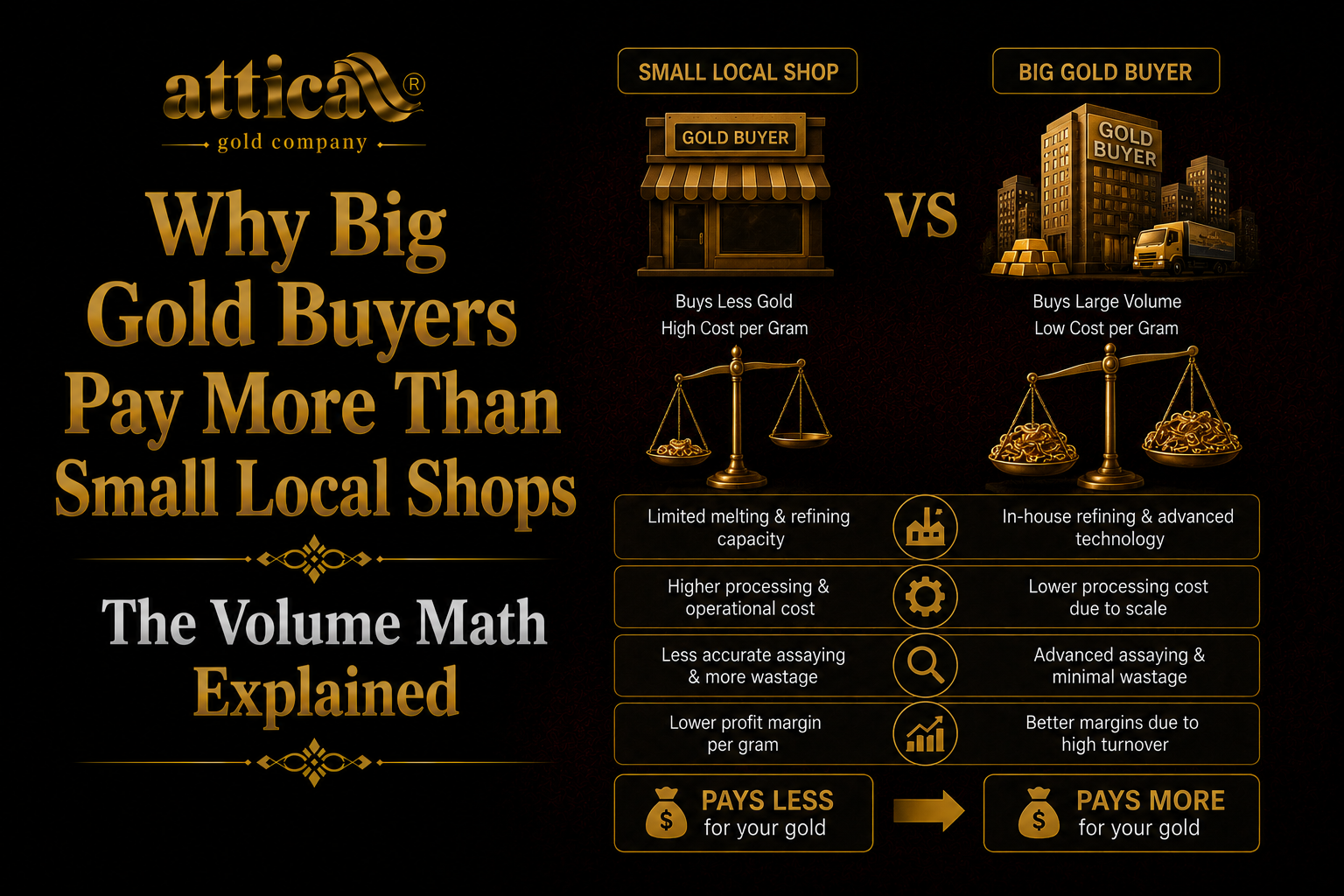
When a buyer purchases your gold, the piece eventually goes through a refining cycle to be turned back into bullion-grade 999 gold and sold to refiners or jewellers as raw material. The cost of refining per gram is roughly fixed – about ₹15–25 per gram, regardless of how much gold passes through the system. A big, organised buyer that processes thousands of grams per branch per day operates close to that fixed cost; the refining margin is 1–2% of the transaction value. A small local shop processing a few grams a day either pays a wholesale refiner with a higher per-gram fee, or sells the piece to a middleman jeweller at a markdown of 5–10%.
In both cases, the small-shop owner has to recover the higher operational cost from the seller – i.e. you. That is the structural reason why an organised gold buyer in India pays 5–15% more on the same piece, not because they are charitable but because their volume lets them absorb the refining cost into a thinner margin. The seller benefits from the buyer’s scale.
IBJA Rate Access: A Membership-Level Difference
The India Bullion and Jewellers Association (IBJA) publishes the morning and evening reference rates that every reputable Indian buyer uses as the benchmark. Membership is restricted, requires audited compliance, and gives the member buyer real-time access to the day’s rate as it moves. Branded gold buyer chains with IBJA membership update their internal rate every 2–3 hours during market hours. Small local shops without IBJA access typically quote the previous day’s newspaper rate (already 24 hours stale) or a simplified “today’s rate” that may be ₹100–₹500 below the live figure.
The rate gap alone – between live IBJA and previous-day estimation – accounts for 1–4% of the price difference between organised buyers and local shops. Combine that with the refining margin gap and the XRF accuracy gap, and the total spread reaches the 5–15% range that retail sellers see consistently across Indian cities.
XRF vs Touchstone: The Purity Testing Gap
Calibrated XRF spectrometers cost ₹6–10 lakh new and require periodic calibration. They read elemental composition non-destructively in 15–30 seconds at ±0.1% accuracy. Most small local shops cannot justify the equipment cost on their volume and rely on the older acid touchstone method – rubbing the piece against a black stone, applying nitric acid, and judging purity by colour change. Touchstone is cheaper but accurate only to ±2–3%, depends heavily on operator skill, and is biased toward under-reading purity (because operators err conservatively to protect their own margin).
On a 22K piece (theoretical 91.6% purity), a calibrated XRF reads 91.4–91.6%; a touchstone test by an experienced operator reads 88–90%; an inexperienced touchstone test can read as low as 85%. That difference of 3–6 percentage points translates directly into 3–6% of price difference on the final invoice. The local jeweller vs gold buyer gap on purity alone explains roughly half the total price spread.
💰 Get the Best Price for Your Gold Today
Instant valuation • Transparent pricing • 100% secure & trusted
Documentation and Compliance: The Hidden Premium
A gold buyer comparison that focuses only on per-gram price misses the documentation premium. A reputable big buyer issues a written line-by-line invoice with weight, purity, applied rate, deductions, gross, net, payment mode and transaction reference. The invoice is a permanent audit trail – useful for income tax records (especially if the sale crosses the LTCG threshold), for insurance claims, and for proof of transfer if the gold is later disputed in family inheritance. A local shop running on verbal handshakes leaves you with no record at all.
Section 269ST compliance is another silent factor. A big buyer above the ₹2 lakh threshold settles only via banking channels (IMPS, RTGS, UPI, cheque), keeping you on the right side of income tax law. A small shop willing to pay cash above ₹2 lakh exposes both parties to a 100% penalty under Section 271DA – a risk you, the seller, may not realise you are taking. The compliance premium is worth the small per-gram difference even before factoring in the price gap.
A Worked Example: 30g of 22K Old Gold
| Line Item | Big Buyer (Attica) | Local Shop |
| Live IBJA rate (24K) | ₹14,962/g (today’s) | ₹14,500/g (yesterday’s estimate) |
| Tested purity | 91.5% (XRF) | 88% (touchstone, under-read) |
| Gross gold value | 30 × 0.915 × 14,962 = ₹4,10,747 | 30 × 0.88 × 14,500 = ₹3,82,800 |
| Refining margin | 0% (covered in IBJA spread) | ~₹15,000 deducted (4%) |
| Final cash payable | ~₹4,08,000 | ~₹3,67,800 |
| Difference | – | ₹40,200 less (~10%) |
On a routine 30g 22K sale, the gap between a big buyer and a local shop runs roughly ₹40,000 – about 10% of the transaction. Scale this up to a 100g family inheritance sale, and the gap becomes ₹1,30,000. The maths is consistent across cities and across price levels.
When a Local Shop Might Still Make Sense
There are narrow situations where a local shop is the right choice – usually around very small transactions where the absolute rupee gap is small, or in remote towns where no organised buyer has a branch. If you are selling a 2g chain (worth ~₹27,000), the 10% gap is ₹2,700 – still meaningful but possibly outweighed by the convenience of walking 200 metres. If you live in a Tier-3 town with no organised buyer within 50km, a trusted local shop with a clear-rate display and a written invoice is acceptable.
In all other cases – any sale above ₹50,000, any sale in a Tier-1 or Tier-2 city with multiple buyer options, any sale where you want documentation – the organised buyer is structurally superior. The 5–15% price gap is the seller’s share of the volume advantage, not a tip you leave on the counter.
Why Choose Attica Gold for Volume-Backed Pricing
The volume maths is straightforward: a buyer that processes thousands of grams per day across hundreds of branches has the economics to pay you closer to live rate, with calibrated XRF, IBJA membership and ISO-certified protocols. A small shop competing on convenience cannot match that pricing structurally – the gap is built into the cost base, not into anyone’s greed.
Attica Gold runs the same protocol at every one of its 200+ branches across Karnataka, Tamil Nadu, Andhra Pradesh, Telangana and Pondicherry – calibrated XRF testing in your presence, today’s live IBJA rate displayed openly, written line-by-line invoice, KYC compliance with Aadhaar and PAN where required, and instant settlement through cash, UPI, IMPS or RTGS. ISO 9001:2015 certification means the same standard at every branch, every day. If you have been weighing the convenience of a local shop against the price of an organised buyer, your wait is over. Walk in, watch the test, take the cash that the volume maths actually adds up to.
Frequently Asked Questions
Why does the best gold buyer pay more than my local jeweller?
The best gold buyer pays more for three structural reasons: (1) volume-based refining margins of 1–2% versus 8–15% at small shops, (2) direct IBJA membership giving real-time access to live rates rather than yesterday’s estimates, and (3) calibrated XRF testing that reads exact purity rather than the touchstone method’s 2–3% under-reading. The combined effect is a 5–15% higher payout on the same piece of gold.
How do I find a trusted gold buyer near me?
Three checks: (1) does the buyer display today’s live IBJA rate openly on a board or screen, (2) does the buyer use a calibrated XRF spectrometer for purity testing in your presence, and (3) does the buyer issue a written line-by-line invoice with weight, purity, applied rate, deductions and net amount. All three “yes” indicate a trusted gold buyer near me. Two “yes” with one “maybe” is acceptable; three “no” means walk to the next branch.
What is an organised gold buyer in India, and why is it different?
An organised gold buyer in India is a registered company operating multiple branches under a single brand with standardised protocols – ISO certification, audited compliance, IBJA membership, calibrated XRF testing, and KYC procedures aligned with PMLA and Income Tax rules. The standardisation produces consistent pricing across branches, transparent documentation, and Section 269ST-compliant payment modes. Small local shops typically lack this infrastructure and operate on individual estimation.
Are branded gold buyer chains really safer than local shops?
Yes – for three reasons. (1) Branded buyers carry insurance and are PMLA-compliant; small shops may not be. (2) Branded buyers issue Section 269ST-compliant invoices and use banking channels above ₹2 lakh; small shops may pay illegal cash, exposing you to tax scrutiny. (3) Branded buyers operate calibrated XRF and follow audited protocols; small shops use a touchstone with operator bias. The safety premium is worth at least the same as the price premium.
How does the local jeweller vs gold buyer gap work in price terms?
On a typical 30g 22K sale at today’s rates, an organised gold buyer pays around ₹4,08,000 while a local shop pays around ₹3,67,800 – a gap of roughly ₹40,200 or 10%. The gap comes from three sources: yesterday’s rate vs live IBJA rate (~3%), touchstone under-reading vs XRF (~3–4%), and refining margin difference (~3%). Larger sales (100g+) widen the absolute gap but keep the percentage similar.
Do all big gold buyers have the same protocol?
No – even within the “branded” category, protocols vary. Some chains display IBJA rates openly and offer XRF testing; others operate exchange-rate models and acid touchstone. The minimum standard for a truly competitive best gold buyer is: live IBJA rate displayed, calibrated XRF in seller’s presence, written line-by-line invoice, ISO 9001:2015 certification, and Section 269ST-compliant payment modes. Verify each before committing.
When is a local shop acceptable for a gold sale?
In two narrow situations: very small transactions (under ₹30,000) where the absolute rupee gap is modest, and remote locations (Tier-3/Tier-4 towns) where no organised buyer has a branch within 50km. In both cases, look for a shop with a clearly displayed rate, a calibrated weighing scale (Department of Legal Metrology stamp), and a willingness to issue a written invoice. Avoid any shop that pays cash without a paper trail.
Why do small shops use acid touchstone instead of XRF?
XRF spectrometers cost ₹6–10 lakh new and require periodic calibration – economically viable only for buyers processing significant volume daily. A small shop processing a few grams a day cannot justify the capital cost. Touchstone testing requires only a stone and acid kit costing ₹5,000, but its accuracy is ±2–3%, and it is biased toward under-reading purity. The volume-based gold buyer comparison favours XRF whenever a buyer’s daily volume justifies the equipment.
{ “@context”: “https://schema.org”, “@type”: “FAQPage”, “mainEntity”: [ { “@type”: “Question”, “name”: “Why does the best gold buyer pay more than my local jeweller?”, “acceptedAnswer”: { “@type”: “Answer”, “text”: “The best gold buyer pays more for three structural reasons: (1) volume-based refining margins of 1–2% versus 8–15% at small shops, (2) direct IBJA membership giving real-time access to live rates rather than yesterday’s estimates, and (3) calibrated XRF testing that reads exact purity rather than the touchstone method’s 2–3% under-reading. The combined effect is a 5–15% higher payout on the same piece of gold.” } }, { “@type”: “Question”, “name”: “How do I find a trusted gold buyer near me?”, “acceptedAnswer”: { “@type”: “Answer”, “text”: “Three checks: (1) does the buyer display today’s live IBJA rate openly on a board or screen, (2) does the buyer use a calibrated XRF spectrometer for purity testing in your presence, and (3) does the buyer issue a written line-by-line invoice with weight, purity, applied rate, deductions and net amount. All three \”yes\” indicate a trusted gold buyer near me. Two \”yes\” with one \”maybe\” is acceptable; three \”no\” means walk to the next branch.” } }, { “@type”: “Question”, “name”: “What is an organised gold buyer in India and why is it different?”, “acceptedAnswer”: { “@type”: “Answer”, “text”: “An organised gold buyer in India is a registered company operating multiple branches under a single brand with standardised protocols – ISO certification, audited compliance, IBJA membership, calibrated XRF testing, and KYC procedures aligned with PMLA and Income Tax rules. The standardisation produces consistent pricing across branches, transparent documentation, and Section 269ST-compliant payment modes. Small local shops typically lack this infrastructure and operate on individual estimation.” } }, { “@type”: “Question”, “name”: “Are branded gold buyer chains really safer than local shops?”, “acceptedAnswer”: { “@type”: “Answer”, “text”: “Yes – for three reasons. (1) Branded buyers carry insurance and are PMLA-compliant; small shops may not be. (2) Branded buyers issue Section 269ST-compliant invoices and use banking channels above ₹2 lakh; small shops may pay illegal cash, exposing you to tax scrutiny. (3) Branded buyers operate calibrated XRF and follow audited protocols; small shops use a touchstone with operator bias. The safety premium is worth at least the same as the price premium.” } }, { “@type”: “Question”, “name”: “How does the local jeweller vs gold buyer gap work in price terms?”, “acceptedAnswer”: { “@type”: “Answer”, “text”: “On a typical 30g 22K sale at today’s rates, an organised gold buyer pays around ₹4,08,000 while a local shop pays around ₹3,67,800 – a gap of roughly ₹40,200 or 10%. The gap comes from three sources: yesterday’s rate vs live IBJA rate (~3%), touchstone under-reading vs XRF (~3–4%), and refining margin difference (~3%). Larger sales (100g+) widen the absolute gap but keep the percentage similar.” } }, { “@type”: “Question”, “name”: “Do all big gold buyers have the same protocol?”, “acceptedAnswer”: { “@type”: “Answer”, “text”: “No – even within the \” branded\” category, protocols vary. Some chains display IBJA rates openly and offer XRF testing; others operate exchange-rate models and acid touchstone. The minimum standard for a truly competitive best gold buyer is: live IBJA rate displayed, calibrated XRF in seller’s presence, written line-by-line invoice, ISO 9001:2015 certification, and Section 269ST-compliant payment modes. Verify each before committing.” } }, { “@type”: “Question”, “name”: “When is a local shop acceptable for a gold sale?”, “acceptedAnswer”: { “@type”: “Answer”, “text”: “In two narrow situations: very small transactions (under ₹30,000) where the absolute rupee gap is modest, and remote locations (Tier-3/Tier-4 towns) where no organised buyer has a branch within 50km. In both cases, look for a shop with a clearly displayed rate, a calibrated weighing scale (Department of Legal Metrology stamp), and a willingness to issue a written invoice. Avoid any shop that pays cash without a paper trail.” } }, { “@type”: “Question”, “name”: “Why do small shops use acid touchstone instead of XRF?”, “acceptedAnswer”: { “@type”: “Answer”, “text”: “XRF spectrometers cost ₹6–10 lakh new and require periodic calibration – economically viable only for buyers processing significant volume daily. A small shop processing a few grams a day cannot justify the capital cost. Touchstone testing requires only a stone and acid kit costing ₹5,000, but its accuracy is ±2–3%, and it is biased toward under-reading purity. The volume-based gold buyer comparison favours XRF whenever a buyer’s daily volume justifies the equipment.” } } ] }Ready to sell at the volume-backed live IBJA rate?
Visit your nearest Attica Gold branch – calibrated XRF testing, written invoice, instant settlement.
Get Instant Valuation
Free evaluation · No obligation · Instant offer
🔒 Your details are safe and confidential