Why a Gold Biscuit Is the Cleanest Form of Gold to Sell
A gold biscuit is the most resale-friendly form of gold an Indian household can hold. Unlike jewellery, it has no making charges, no wastage allowance, no stones to subtract, no purity guesswork – it is a stamped, hallmarked, 999-fineness rectangle of pure gold sold at the live IBJA rate minus a small refining margin. When you walk into a buyer to sell a biscuit, the entire transaction takes 10–20 minutes and recovers 97–99% of the live spot rate. By contrast, a similar weight of 22K jewellery typically realises 85–90% of live spot after stones, solder and tested-purity adjustments. The structural simplicity of biscuits is what makes them the preferred bullion format for investment-focused Indian buyers.
This guide is a practical walkthrough for anyone holding gold biscuits and wondering how to convert them to cash cleanly. We cover today’s biscuit price across all common weights (1g, 5g, 10g, 20g, 50g, 100g), the refining margin maths that determines your final realisation, the XRF testing protocol, the documentation needed and the payment-mode options. Read it once, and you will know exactly what to expect when you slide that biscuit across the counter.
Gold Biscuit Selling at a Glance
| Standard Purity | 999 (24K, 99.9% pure) or 995 (24K, 99.5% pure) |
| Common Weights | 1g, 2g, 5g, 8g, 10g, 20g, 50g, 100g, 1kg |
| Refining Margin | 1–2% of live rate (lowest in any gold format) |
| Hallmarking | BIS or refiner stamp (MMTC-PAMP, RBI, Augmont, etc.) |
| Verification | XRF test at the branch confirms 999 fineness in 30 seconds |
| Today’s 24K Reference Rate | ₹14,918 per gram (6 May 2026, IBJA) |
| Typical Settlement Time | 15–25 minutes (faster than a jewellery sale) |
| Documents Required | Aadhaar + PAN (mandatory above ₹2 lakh) |
Today’s Gold Biscuit Price by Weight
A gold biscuit price is calculated very simply – today’s 24K live IBJA rate × weight in grams, minus the refining margin (1–2%). Below are today’s indicative figures at the live ₹14,918/g 24K benchmark. Use the live widget for the precise current rate, and remember that the buyer will deduct only the refining margin, not making charges, wastage or any other line item.
| Biscuit Weight | Gross 24K Value | Indicative Cash Realisation (~98%) |
| 1 gram | ₹14,918 | ₹14,620 |
| 5 grams | ₹74,590 | ₹73,098 |
| 8 grams (1 sovereign) | ₹1,19,344 | ₹1,16,957 |
| 10 grams | ₹1,49,180 | ₹1,46,196 |
| 20 grams | ₹2,98,360 | ₹2,92,393 |
| 50 grams | ₹7,45,900 | ₹7,30,982 |
| 100 grams | ₹14,91,800 | ₹14,61,964 |
Why a Gold Biscuit Sells for Almost the Full Live Rate
The economics of biscuit resale are dominated by a single concept – the refining margin. Because biscuits are already pure 999 or 995 fineness, the refiner does not need to extract gold from a complex alloy; the only cost is re-melting and re-casting into bullion bars or grain for downstream resale. That cost lands at roughly 1–2% of value at scale, and reputable buyers absorb it as their primary margin. There is no making charge to recover (none was paid), no purity gap to bridge (it is already 999), no stones to weigh out, no solder to subtract.
Compare that to a 22K jewellery sale: live IBJA × 91.6% tested purity gives you ~91.5% of 24K value, and that is before deductions for stones, solder and any tested-purity gap below 91.6%. The end realisation is typically 85–90% of the live 24K rate. The same weight of 999 biscuit gold realises 97–99%. On a 50-gram sale at today’s rates, that is the difference between roughly ₹6.7 lakh (jewellery) and ₹7.31 lakh (biscuit) – a gold biscuit price advantage of roughly 10% per gram of gold actually owned.
Common Biscuit Brands & Stamps Indian Buyers Recognise
- MMTC-PAMP – joint venture between MMTC India and PAMP Switzerland; the most widely held LBMA-certified Indian biscuit brand.
- RBI / SBI Bullion – Reserve Bank-backed bullion programme distributed through the State Bank of India.
- Augmont – Indian refiner with BIS-licensed bullion in 1g, 5g, 10g and larger denominations.
- Kundan Gold Refinery – long-established Indian refiner, common in retail bullion stores.
- Rajesh Exports – a large-scale refiner-distributor whose biscuits circulate widely in South Indian markets.
- Tanishq / Joyalukkas / Malabar branded coins – retailer-stamped bullion, accepted at most buyers but with slightly higher refining margin.
A reputable buyer accepts every one of these stamps and applies the same XRF test to confirm 999 fineness. The brand affects nothing about the per-gram payout once the assay is verified.
💰 Get the Best Price for Your Gold Today
Instant valuation • Transparent pricing • 100% secure & trusted
Gold Biscuit Weight: How to Verify Before Selling
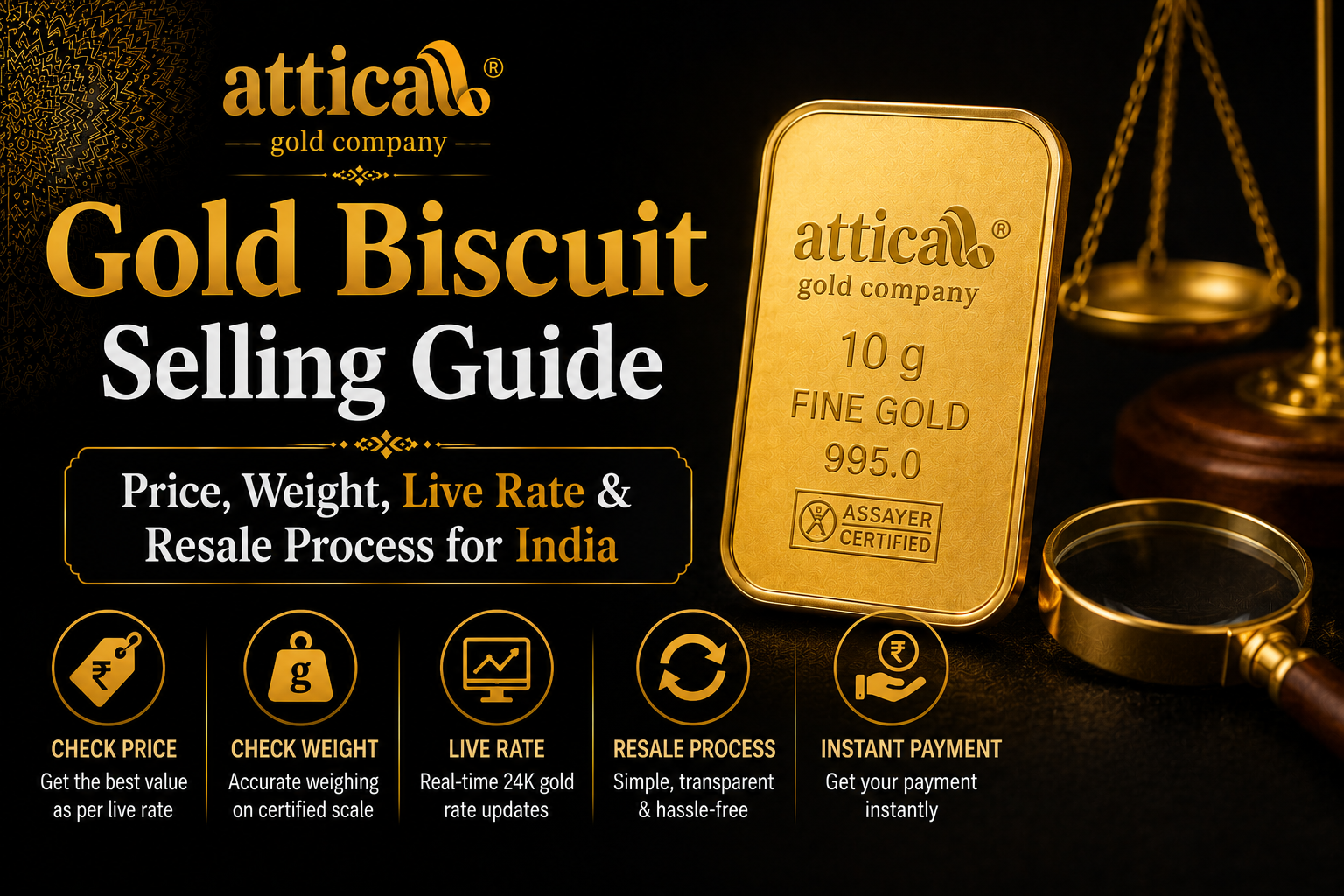
Every gold biscuit weight is stamped on the bar itself – typically on the obverse beside the refiner’s logo. Standard Indian denominations are 1g, 2g, 5g, 8g (one sovereign), 10g, 20g, 50g, 100g and 1kg. The weight is in grams, not tola or pavan; older biscuits from the pre-2010 era may show 10 tola (~117g), but anything sold post-2015 is metric. At the buyer counter,r the biscuit is weighed on a calibrated electronic scale stamped by the Department of Legal Metrology. The reading should match the stamped weight to within 0.01g – any meaningful discrepancy is investigated before pricing.
10-gramam gold biscuit is the most commonly held investment denomination in Indian households because it offers a clean balance between transaction size, liquidity, and per-gram value at today’s ₹14,918/g 24K rate. Larger biscuits (50g, 100g) are favoured for serious investment but cross the ₹2-lakh cash limit, so settle through banking channels. Smaller biscuits (1g, 5g) are popular gifts but often carry a higher per-gram retail markup at purchase, which is partially recovered at resale.
The Step-by-Step Process for Selling a Gold Biscuit
- Carry the biscuit, original purchase invoice (if available), Aadhaar and PAN to the buyer’s branch.
- Watch the XRF spectrometer test the biscuit in your presence – takes 30 seconds. Confirm 999 or 995 fineness on the screen.
- Watch the calibrated scale weigh the biscuit. Verify reading matches stamped weight.
- Receive a written quote: weight × tested purity × today’s live IBJA rate, minus refining margin (1–2%).
- Complete KYC: Aadhaar scan, PAN scan if sale is above ₹2 lakh, signature on intake voucher.
- Choose payment mode: cash up to ₹1,99,999, IMPS or RTGS for higher amounts.
- Confirm the bank SMS arrives (for IMPS/RTGS) or count cash, then leave with the signed invoice for your records.
Common Gold Biscuit Resale Mistakes
- Accepting a “biscuit rate” lower than the day’s live IBJA – the gold biscuit rate today should be within 1.5% of live spot, not 5%.
- Selling without watching the XRF test – every reputable buyer turns the spectrometer screen toward you during the read.
- Trusting verbal quotes – every figure must appear on a written invoice with weight, purity and applied rate as separate lines.
- Skipping the Department of Legal Metrology stamp check on the weighing scale – calibration ensures the gram reading is accurate.
- Accepting cash above ₹1,99,999 – illegal under Section 269ST and exposes both seller and buyer to penalty.
- Selling at the first quote without comparing – for a high-value biscuit, getting a second written quote can recover 1–2% extra.
- Forgetting that a worn or scratched biscuit may need an additional re-assay – the underlying gold is intact, but visible damage can prompt a fresh purity test.
Why Choose Attica Gold for Biscuit Selling
Selling a gold biscuit should be the simplest gold transaction in your entire portfolio – no purity dispute, no stone subtraction, no making-charge irrecoverability. The only meaningful variable is the refining margin the buyer charges, and a transparent buyer keeps it within 1–2% of the live IBJA rate. Anything wider is a margin grab dressed up as “biscuit market price”.
Attica Gold runs the same protocol at every one of its 200+ branches across Karnataka, Tamil Nadu, Andhra Pradesh, Telangana and Pondicherry – calibrated XRF in your presence, today’s live IBJA rate displayed openly on the wall, weighing on Department-stamped scales, written line-by-line invoice, KYC at the counter, and instant settlement through cash, UPI, IMPS or RTGS depending on amount. ISO 9001:2015 certification means the same standard at every branch, every day. If you have been holding a stack of biscuits and waiting for the right moment to convert them to cash, your wait is over. Walk in, watch the test, leave with the money in your account or pocket within 25 minutes.
Frequently Asked Questions
What is today’s gold biscuit price in India?
Today’s gold biscuit price is the live 24K IBJA rate × biscuit weight, minus a refining margin of 1–2%. At the current ₹14,918/g 24K benchmark (6 May 2026), a 10-gram biscuit fetches roughly ₹1,46,196 cash after refining margin; a 50-gram biscuit fetches roughly ₹7,30,982. Use the live rate widget on this page for the exact current realisation by weight.
How is the gold biscuit price calculated when selling?
The formula is: weight in grams × tested purity (999 = 99.9% or 995 = 99.5%) × today’s live 24K IBJA rate, minus a 1–2% refining margin. There are no making charges to deduct (biscuits are not fabricated jewellery), no stones to subtract, and no wastage allowance. Compared to jewellery, biscuits yield about 10% more per gram of gold actually owned.
What gold biscuit weight is best for investment?
For most Indian households, a 10-gram gold biscuit is the optimal investment denomination – clean transaction size, liquid resale, fits within the ₹2 lakh cash limit at today’s rates. Investors preferring larger holdings often choose 50g or 100g biscuits, which require banking-channel settlement. Smaller 1g and 5g biscuits are popular gifts but carry slightly higher per-gram retail markup at purchase.
Can I sell a gold biscuit without the original invoice?
Yes. A purchase invoice is helpful for audit-trail purposes, but it is not legally required to sell a biscuit in India. Reputable buyers verify the gold biscuit through XRF testing, which confirms 999 or 995 fineness regardless of paperwork. Aadhaar (mandatory) and PAN (mandatory above ₹2 lakh) are the only essential documents. The XRF reading matches the stamped purity in 99% of authentic biscuits.
How is today’s gold biscuit rate different from the gold jewellery rate?
The underlying live IBJA rate is the same – both are anchored to the same 24K spot price. The difference is in deductions. Biscuits sell at live rate minus only a 1–2% refining margin. Jewellery sells at live rate × tested purity (typically 91% for 22K), minus stones and solder. The net result: biscuits realise 97–99% of live 24K rate; jewellery realises 85–90%.
Are MMTC-PAMP and other branded biscuits priced higher at resale?
No – once the XRF confirms 999 fineness, the per-gram payout is the same regardless of brand. MMTC-PAMP, RBI, Augmont, Kundan, Rajesh Exports and retailer-branded biscuits all sell at the same live rate × purity formula. The brand affects buyer-side trust and authentication speed, but does not change the resale price. A reputable buyer accepts every BIS-licensed or LBMA-certified stamp.
How long does it take to sell a 10-gram gold biscuit?
A 10-gram gold biscuit sale typically takes 15–25 minutes from walk-in to cash-in-hand: 30 seconds for XRF verification, 30 seconds for weighing, 5 minutes for quote and invoice, 5 minutes for KYC, and 5–15 minutes for payment, depending on mode (cash is instant, IMPS settles in under 60 seconds). Biscuits are the fastest gold format to sell because there are no stones, no purity disputes and no making charge negotiations.
Is GST on gold biscuits different from jewellery?
Yes – gold biscuits attract only the 3% gold GST with no making-charge GST (since biscuits have no fabrication labour). Jewellery attracts both 3% on gold value and 5% on making charges. So for a ₹1 lakh purchase, biscuit GST is ₹3,000 while jewellery GST on a comparable invoice (with 15% making) is roughly ₹4,000. At resale, however, neither GST nor making charges are recoverable – your cash payout is based purely on live rate × tested purity.
{ “@context”: “https://schema.org”, “@type”: “FAQPage”, “mainEntity”: [ { “@type”: “Question”, “name”: “What is today’s gold biscuit price in India?”, “acceptedAnswer”: { “@type”: “Answer”, “text”: “Today’s gold biscuit price is the live 24K IBJA rate × biscuit weight, minus a refining margin of 1–2%. At the current ₹14,918/g 24K benchmark (6 May 2026), a 10-gram biscuit fetches roughly ₹1,46,196 cash after refining margin; a 50-gram biscuit fetches roughly ₹7,30,982. Use the live rate widget on this page for the exact current realisation by weight.” } }, { “@type”: “Question”, “name”: “How is gold biscuit price calculated when selling?”, “acceptedAnswer”: { “@type”: “Answer”, “text”: “The formula is: weight in grams × tested purity (999 = 99.9% or 995 = 99.5%) × today’s live 24K IBJA rate, minus a 1–2% refining margin. There are no making charges to deduct (biscuits are not fabricated jewellery), no stones to subtract, and no wastage allowance. Compared to jewellery, biscuits realise about 10% more per gram of gold actually owned.” } }, { “@type”: “Question”, “name”: “What gold biscuit weight is best for investment?”, “acceptedAnswer”: { “@type”: “Answer”, “text”: “For most Indian households, a 10 gram gold biscuit is the optimal investment denomination – clean transaction size, liquid resale, fits within the ₹2 lakh cash limit at today’s rates. Investors preferring larger holdings often choose 50g or 100g biscuits, which require banking-channel settlement. Smaller 1g and 5g biscuits are popular gifts but carry slightly higher per-gram retail markup at purchase.” } }, { “@type”: “Question”, “name”: “Can I sell a gold biscuit without the original invoice?”, “acceptedAnswer”: { “@type”: “Answer”, “text”: “Yes. A purchase invoice is helpful for audit-trail purposes, but it is not legally required to sell a biscuit in India. Reputable buyers verify the gold biscuit through XRF testing, which confirms 999 or 995 fineness regardless of paperwork. Aadhaar (mandatory) and PAN (mandatory above ₹2 lakh) are the only essential documents. The XRF reading matches the stamped purity in 99% of authentic biscuits.” } }, { “@type”: “Question”, “name”: “How is today’s gold biscuit rate different from the gold jewellery rate?”, “acceptedAnswer”: { “@type”: “Answer”, “text”: “The underlying live IBJA rate is the same – both are anchored to the same 24K spot price. The difference is in deductions. Biscuits sell at live rate minus only a 1–2% refining margin. Jewellery sells at live rate × tested purity (typically 91% for 22K), minus stones and solder. The net result: biscuits realise 97–99% of live 24K rate; jewellery realises 85–90%.” } }, { “@type”: “Question”, “name”: “Are MMTC-PAMP and other branded biscuits priced higher at resale?”, “acceptedAnswer”: { “@type”: “Answer”, “text”: “No – once the XRF confirms 999 fineness, the per-gram payout is the same regardless of brand. MMTC-PAMP, RBI, Augmont, Kundan, Rajesh Exports and retailer-branded biscuits all sell at the same live rate × purity formula. The brand affects buyer-side trust and authentication speed, but does not change the resale price. A reputable buyer accepts every BIS-licensed or LBMA-certified stamp.” } }, { “@type”: “Question”, “name”: “How long does it take to sell a 10-gram gold biscuit?”, “acceptedAnswer”: { “@type”: “Answer”, “text”: “A 10-gram gold biscuit sale typically takes 15–25 minutes from walk-in to cash-in-hand: 30 seconds for XRF verification, 30 seconds for weighing, 5 minutes for quote and invoice, 5 minutes for KYC, and 5–15 minutes for payment depending on mode (cash is instant, IMPS settles in under 60 seconds). Biscuits are the fastest gold format to sell because there are no stones, no purity disputes and no making charge negotiations.” } }, { “@type”: “Question”, “name”: “Is GST on gold biscuit different from jewellery?”, “acceptedAnswer”: { “@type”: “Answer”, “text”: “Yes – gold biscuits attract only the 3% gold GST with no making-charge GST (since biscuits have no fabrication labour). Jewellery attracts both 3% on gold value and 5% on making charges. So for a ₹1 lakh purchase, biscuit GST is ₹3,000 while jewellery GST on a comparable invoice (with 15% making) is roughly ₹4,000. At resale, however, neither GST nor making charges are recoverable – your cash payout is based purely on live rate × tested purity.” } } ] }Ready to convert your gold biscuits to cash at near-spot value?
Visit your nearest Attica Gold branch – calibrated XRF, live IBJA rate, refining margin within 2%, instant settlement.
Get Instant Valuation
Free evaluation · No obligation · Instant offer
🔒 Your details are safe and confidential