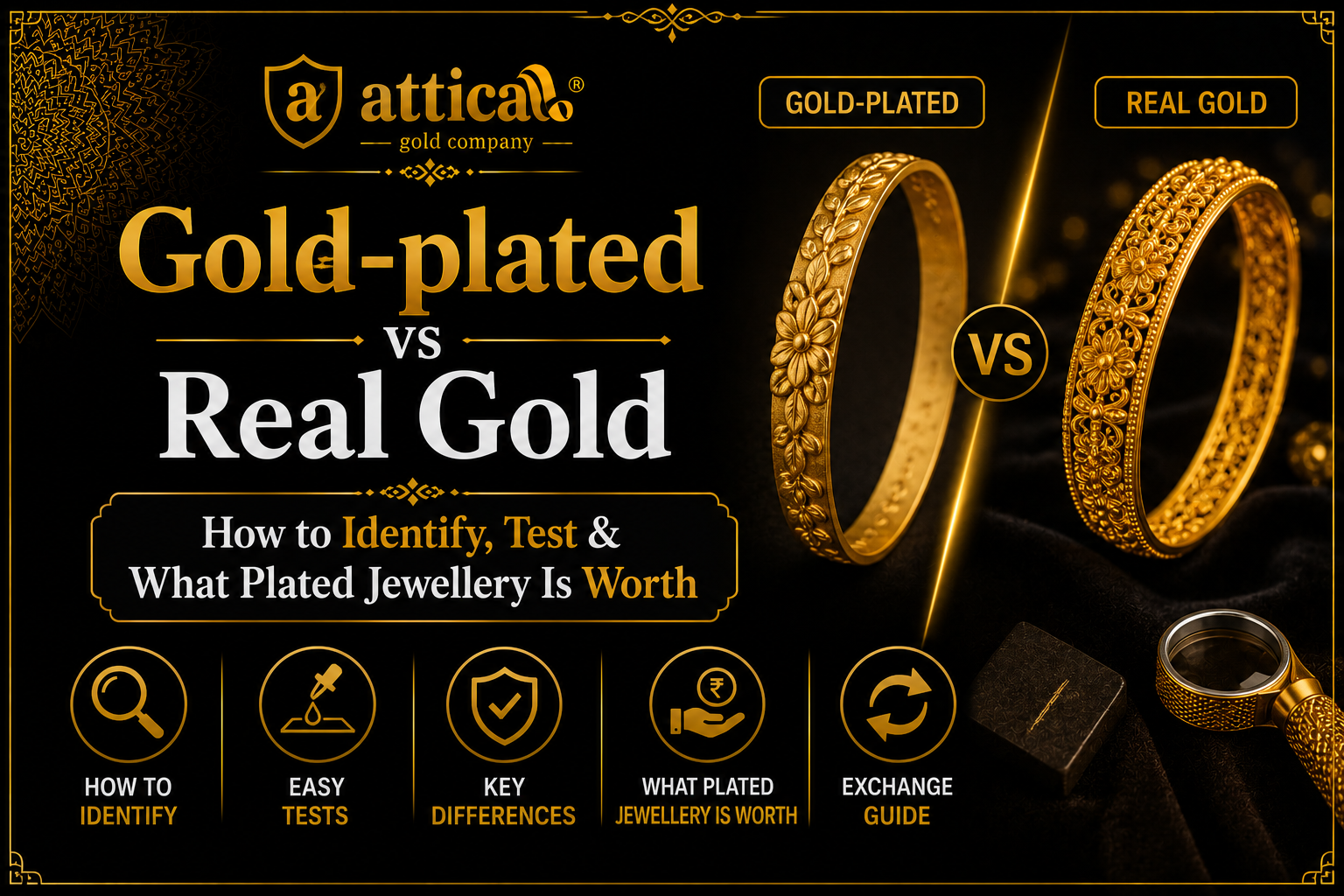
Why Knowing Gold-Plated vs Solid Gold Matters Before You Sell
Walk through any jewellery market in India, and roughly one in every twenty pieces on display is not solid gold at all – it is Gold-Plated jewellery sold at a fraction of the solid-gold price. Modern plating techniques are good enough that a quick visual inspection often cannot distinguish Gold-Plated from real 22K. The difference matters at resale: a solid 22K piece weighing 10 grams fetches ~₹1.25 lakh at today’s rates; the same-looking Gold-Plated piece is worth ₹500–₹2,000, since the gold layer is only a few microns thick. Sellers who do not check before walking into a buyer can be surprised when the XRF reading reveals the truth.
This guide is a practical walkthrough for anyone holding a piece they suspect may be Gold-Plated rather than solid. We cover the visual marks to look for, the at-home tests (magnet, density, acid touchstone), the definitive XRF check at a buyer’s branch, and what plated jewellery actually fetches at a reputable buyer. Read it once, and you will know exactly how to verify any piece in your collection before negotiating any resale price.
Gold-Plated vs Solid Gold at a Glance
| Solid 22K Gold | 91.6% pure gold throughout the piece |
| Solid 18K Gold | 75% pure gold throughout the piece |
| Gold-Plated | Thin gold layer (0.5–10 microns) over base metal core |
| Gold Filled (US standard, rare in India) | Thicker gold layer (5%+ by weight) over base metal |
| Vermeil (gold over silver) | Sterling silver core with gold plating |
| Hallmark on Solid Gold | BIS triangle + 916/750/585 + HUID |
| Hallmark on Plated | No BIS hallmark; may carry “GP”, “RGP”, “GE” stamp |
| Today’s 24K Reference Rate | ₹14,918 per gram (6 May 2026, IBJA) |
Visual Identification: 5 Marks That Reveal Gold-Plated Jewellery
Real Gold-Plated jewellery often carries small text stamps that gold buyers immediately recognise. Solid hallmarked Indian gold carries the BIS triangle, a purity number (916/750/585), a HUID code and a jeweller mark. Plated jewellery carries different stamps that distinguish it as a coating rather than solid metal:
- GP – Gold-Plated; thin layer of gold (typically 0.5–2.5 microns) over base metal.
- GEP – Gold Electroplated; same as GP but applied via electrolysis.
- RGP – Rolled Gold-Plated; mechanically bonded gold layer, thicker than electroplating.
- HGP – Heavy Gold-Plated; thicker plating (5+ microns).
- GF or 1/20 12K GF – Gold Filled; US standard, gold layer is at least 5% by weight.
A piece marked “925” is sterling silver, not gold; if it has a yellow appearance, it may be vermeil (silver with gold plating). A piece with no hallmark at all is most often pre-2021 unhallmarked Indian jewellery (legitimate solid gold), but in some cases is plated – XRF testing is the only definitive answer.
Today’s Live Rate: What Solid Gold Is Worth Right Now
Before testing your piece, anchor your expectation in today’s live Gold rate. If your piece is solid 22K hallmarked gold, the cash value is straightforward – weight × 91.6% × ₹14,918/g 24K rate. If it turns out to be Gold-Plated, the cash value is essentially the base metal value (typically copper, brass or silver) minus dismantling costs. Use the widget below to confirm today’s 24K, 22K and 18K rates before deciding what offer to accept.
At-Home Tests to Distinguish Gold-Plated From Real Gold
Before walking into any buyer, three at-home tests can give you a reasonable preliminary read. None is as accurate as XRF, but they catch the most common cases of Gold-Plated jewellery.
Magnet test – solid gold (any karat) is non-magnetic. Hold a strong neodymium magnet near the piece. If it pulls toward the magnet, the piece is plated over a ferrous core (iron or nickel). If there is no pull, the piece is either solid gold or plated over a non-ferrous core (copper, brass, silver) and needs further testing.
Density test (Archimedes’ principle) – solid gold has a density of 19.3 g/cc (24K) or ~17.5 g/cc (22K). Weigh the piece on a precise scale (in grams) and immerse it in water in a graduated measuring cup; record the water displacement (in cc). Divide weight by displacement. If the result is between 17 and 19.5, the piece is solid gold. If it is between 8 and 12, the piece has a base-metal core (likely copper or silver) and is plated.
Acid touchstone test – apply a small amount of nitric acid to a test scratch on the piece. Solid 22K gold will show no colour change. Lower-purity gold (18K, 14K) shows a slight green tint. Gold-Platedd jewellery shows a strong green or milky-white reaction within seconds, because the acid eats through the thin gold layer and reacts with the base metal underneath. This test damages the piece slightly, so reserve it for ambiguous cases.
💰 Get the Best Price for Your Gold Today
Instant valuation • Transparent pricing • 100% secure & trusted
XRF Testing: The Definitive Gold-Plated vs Solid Gold Check
X-ray fluorescence (XRF) spectroscopy is the gold standard verification at any reputable buyer’s branch. The machine fires low-energy X-rays at the surface of your piece and reads the characteristic emission lines of every element present. For solid 22K gold, the read shows ~91% Au, ~5% Cu, ~3% Ag (typical Indian alloy). For Gold-Plated jewellery, the read shows a few per cent Au at the surface but a different elemental signature deeper – XRF can detect the underlying base metal in many cases, especially with a “two-point” reading at different X-ray energies.
A reputable buyer will turn the XRF spectrometer screen toward you during the test. If the read shows surface Au of 30–60% with a heavy base-metal signature underneath, the piece is Gold-Plated. If the read shows uniform 91% Au throughout (or 75% for 18K, 58.5% for 14K), the piece is solid. The whole test takes 30 seconds per piece. Insist on watching it. Without watching, a careless reading can mistake a thick-plated piece for low-purity solid gold.
What is Gold-Plated Jewellery Actually Worth at Resale?
The honest answer is: very little. The gold layer on a typical electroplated piece is 0.5–2.5 microns thick – about one-thousandth of a millimetre. On a 10-gram chain, this works out to roughly 0.05–0.15 grams of actual gold. At today’s ₹14,918/g rate, that is ₹745–₹2,238 of recoverable gold value, minus the cost of stripping and refining. Most buyers find that the recovery cost outweighs the gold yield on small plated pieces and decline the sale entirely. Heavier plating (HGP, RGP, gold filled) yields more – sometimes 0.3–0.6 grams of gold on a 10g piece – but rarely worth more than ₹3,000–₹8,000 cash.
The value of Gold-Plated jewellery depends on three factors: plating thickness (microns), piece weight, and the cost a refiner will charge to extract the gold from the base metal. For most household-grade plated pieces (GP or GEP stamp), the realistic cash recovery is 5–15% of what an equivalent-weight solid 22K piece would fetch. If your “gold” chain feels too light, has no hallmark, has a “GP” or “GEP” stamp, and shows a magnet response, expect the buyer to either decline or quote a token amount.
Common Mistakes Sellers Make Around Gold-Plated Pieces
- Assuming a yellow piece is solid gold without testing – colour alone is not a reliable indicator; modern plating mimics 22K perfectly.
- Trusting a verbal “this is real gold” claim from a non-jeweller seller – provenance is irrelevant; XRF is the only proof.
- Skipping the magnet test for inherited pieces – a 30-second check rules out the cheapest plated forgeries.
- Believing a “GP” stamp means “Gold-Plated solid gold” – it explicitly means coated, not solid.
- Insisting a buyer test a clearly plated piece at full XRF protocol – most buyers will charge an inspection fee or politely decline.
- Assuming all unhallmarked pieces are plated – pre-2021 Indian jewellery is often solid gold without BIS marks; only XRF will tell.
Why Choose Attica Gold for Plated vs Solid Verification
Verifying whether a piece is Gold-Plated or solid is one of the most useful checks any seller can do before negotiating a sale. The right buyer treats every piece – solid or plated, hallmarked or unhallmarked – through the same XRF protocol with the screen turned toward you. The wrong buyer skips the test for “obvious” pieces, gives a verbal estimate without measurement, or quotes a flat percentage of 24K rate without measuring purity at all. The cost of these shortcuts lands on you when a plated piece is treated as low-purity solid gold (or, worse, when solid pre-2021 gold is treated as plated).
Attica Gold runs the same XRF protocol at every one of its 200+ branches across Karnataka, Tamil Nadu, Andhra Pradesh, Telangana and Pondicherry – calibrated XRF in your presence, today’s live IBJA rate displayed openly, written line-by-line invoice, KYC at the counter, and instant settlement through cash, UPI, IMPS or RTGS for any solid-gold value. ISO 9001:2015 certification means the same standard at every branch, every day. If you have been holding a piece you suspect may be plated and want a definitive answer, your wait is over. Walk in, watch the test, and either take the cash on a confirmed solid piece or leave with clarity on what your plated piece actually contains.
Frequently Asked Questions
How can I tell if my jewellery is Gold-Plated or real gold?
Three tests in increasing accuracy: (1) Look for stamps – GP, GEP, RGP or HGP indicate plating; BIS triangle + 916/750 indicates solid. (2) Use a magnet – solid gold is non-magnetic; plated pieces over iron cores will pull. (3) Density check – solid gold has 17–19.3 g/cc; plated pieces typically 8–12 g/cc. The definitive answer comes from XRF testing at a reputable buyer, which takes 30 seconds and reveals the exact composition.
What does Gold-Plated mean exactly?
Gold-Plated jewellery is a piece made of base metal (copper, brass, nickel or silver) with a thin layer of gold (typically 0.5–10 microns) bonded to the surface via electrolysis or mechanical rolling. The piece looks identical to solid gold but contains only 1–5% actual gold by weight. The base metal core determines almost all the piece’s weight; the gold layer is essentially decorative. Plated pieces are sold at a fraction of the solid-gold price.
Is Gold-Plated jewellery worth selling?
Often not. The gold layer on most plated pieces is 0.5–2.5 microns thick, yielding 0.05–0.15g of recoverable gold per 10g of piece weight. At today’s ₹14,918/g rate, that is ₹745–₹2,238 of gold value – frequently less than the buyer’s cost to strip and refine. Heavier plating (HGP, RGP, gold filled) yields more, sometimes ₹3,000–₹8,000 on a 10g piece. Most household-grade plated pieces have effectively no resale market.
Can the buyer always tell if a piece is Gold-Plated?
Yes – calibrated XRF spectrometers detect plating with high accuracy. The reading shows surface gold percentage + underlying base metal in a single 30-second test. A reputable buyer turns the screen toward you so you see the result yourself. Plating that reads 30–60% Au at the surface with a heavy base-metal signature underneath is unmistakable. Acid touchstone alone (without XRF) can occasionally mis-classify thick plating as solid 14K gold, but XRF resolves this.
What is the difference between Gold-Plated vs solid gold weight?
Gold-Plated and solid gold pieces of identical visual size differ in weight because the base metal core has a different density than gold. Solid 22K gold has density 17.5 g/cc; copper core has ~9 g/cc; brass ~8.5 g/cc; silver ~10.5 g/cc. So a plated piece typically weighs about half what a solid gold piece of the same dimensions weighs. If a chain feels too light for its size, plating is likely.
Does real gold vs Gold-Plated affect hallmark verification?
A real, solid gold piece sold in India after July 2021 must carry a BIS hallmark (triangle + 916/750/585 + HUID + jeweller mark). Gold-Platedd pieces are not eligible for BIS hallmarking and never carry these marks; they may carry GP, GEP, RGP or HGP stamps instead. So if a piece purchased after 2021 has no BIS hallmark, it is either plated or unhallmarked solid gold sold illegally. XRF is the only definitive check.
How to tell if gold is real at home without any test equipment?
Two no-equipment checks: (1) Visual stamp inspection – look for BIS triangle + 916 (solid) vs GP/GEP (plated). (2) Magnet test using any household neodymium magnet – solid gold is non-magnetic; plated pieces over iron pull toward the magnet. These two together catch the most obvious cases. For ambiguous pieces – no stamp, non-magnetic, looks “right” – only XRF at a buyer can confirm. The at-home tests are diagnostic, not definitive.
Is my gold real or plated if it has no hallmark?
Possibly real – pre-2021 Indian jewellery often lacks the BIS hallmark because hallmarking was voluntary then. A grandmother’s 1985 chain without a triangle stamp can still be solid 22K gold. Conversely, some unhallmarked pieces are plated counterfeits. The only reliable way to tell is XRF testing in a buyer’s presence. The hallmark mark is a regulatory artefact; the XRF reading is the physical truth.
{ “@context”: “https://schema.org”, “@type”: “FAQPage”, “mainEntity”: [ { “@type”: “Question”, “name”: “How can I tell if my jewellery is gold-plated or real gold?”, “acceptedAnswer”: { “@type”: “Answer”, “text”: “Three tests in increasing accuracy: (1) Look for stamps – GP, GEP, RGP or HGP indicate plating; BIS triangle + 916/750 indicates solid. (2) Use a magnet – solid gold is non-magnetic; plated pieces over iron cores will pull. (3) Density check – solid gold has 17–19.3 g/cc; plated pieces typically 8–12 g/cc. The definitive answer comes from XRF testing at a reputable buyer, which takes 30 seconds and reveals exact composition.” } }, { “@type”: “Question”, “name”: “What does gold-plated mean exactly?”, “acceptedAnswer”: { “@type”: “Answer”, “text”: “gold-plated jewellery is a piece made of base metal (copper, brass, nickel or silver) with a thin layer of gold (typically 0.5–10 microns) bonded to the surface via electrolysis or mechanical rolling. The piece looks identical to solid gold but contains only 1–5% actual gold by weight. The base metal core determines almost all the piece’s weight; the gold layer is essentially decorative. Plated pieces are sold at a fraction of the solid-gold price.” } }, { “@type”: “Question”, “name”: “Is gold-plated jewellery worth selling?”, “acceptedAnswer”: { “@type”: “Answer”, “text”: “Often not. The gold layer on most plated pieces is 0.5–2.5 microns thick, yielding 0.05–0.15g of recoverable gold per 10g of piece weight. At today’s ₹14,918/g rate, that is ₹745–₹2,238 of gold value – frequently less than the buyer’s cost to strip and refine. Heavier plating (HGP, RGP, gold filled) yields more, sometimes ₹3,000–₹8,000 on a 10g piece. Most household-grade plated pieces have effectively no resale market.” } }, { “@type”: “Question”, “name”: “Can the buyer always tell if a piece is gold-plated?”, “acceptedAnswer”: { “@type”: “Answer”, “text”: “Yes – calibrated XRF spectrometers detect plating with high accuracy. The reading shows surface gold percentage + underlying base metal in a single 30-second test. A reputable buyer turns the screen toward you so you see the result yourself. Plating that reads 30–60% Au at the surface with a heavy base-metal signature underneath is unmistakable. Acid touchstone alone (without XRF) can occasionally mis-classify thick plating as solid 14K gold, but XRF resolves this.” } }, { “@type”: “Question”, “name”: “What is the difference between gold-plated vs solid gold weight?”, “acceptedAnswer”: { “@type”: “Answer”, “text”: “gold-plated and solid gold pieces of identical visual size differ in weight because the base metal core has a different density than gold. Solid 22K gold has density 17.5 g/cc; copper core has ~9 g/cc; brass ~8.5 g/cc; silver ~10.5 g/cc. So a plated piece typically weighs about half what a solid gold piece of the same dimensions weighs. If a chain feels too light for its size, plating is likely.” } }, { “@type”: “Question”, “name”: “Does real gold vs gold-plated affect hallmark verification?”, “acceptedAnswer”: { “@type”: “Answer”, “text”: “A real, solid gold piece sold in India after July 2021 must carry a BIS hallmark (triangle + 916/750/585 + HUID + jeweller mark). Gold-plated pieces are not eligible for BIS hallmarking and never carry these marks; they may carry GP, GEP, RGP or HGP stamps instead. So if a piece purchased after 2021 has no BIS hallmark, it is either plated or unhallmarked solid gold sold illegally. XRF is the only definitive check.” } }, { “@type”: “Question”, “name”: “How to tell if gold is real at home without any test equipment?”, “acceptedAnswer”: { “@type”: “Answer”, “text”: “Two no-equipment checks: (1) Visual stamp inspection – look for BIS triangle + 916 (solid) vs GP/GEP (plated). (2) Magnet test using any household neodymium magnet – solid gold is non-magnetic; plated pieces over iron pull toward the magnet. These two together catch the most obvious cases. For ambiguous pieces – no stamp, non-magnetic, looks \”right\” – only XRF at a buyer can confirm. The at-home tests are diagnostic, not definitive.” } }, { “@type”: “Question”, “name”: “Is my gold real or plated if it has no hallmark?”, “acceptedAnswer”: { “@type”: “Answer”, “text”: “Possibly real – pre-2021 Indian jewellery often lacks the BIS hallmark because hallmarking was voluntary then. A grandmother’s 1985 chain without a triangle stamp can still be solid 22K gold. Conversely, some unhallmarked pieces are plated counterfeits. The only reliable way to tell is XRF testing in a buyer’s presence. The hallmark mark is a regulatory artefact; the XRF reading is the physical truth.” } } ] }Wondering if your piece is gold-plated or solid?
Visit your nearest Attica Gold branch – calibrated XRF in your presence reveals exact composition in 30 seconds.
Get Instant Valuation
Free evaluation · No obligation · Instant offer
🔒 Your details are safe and confidential