Bridge Finance – The Sell-Later Strategy
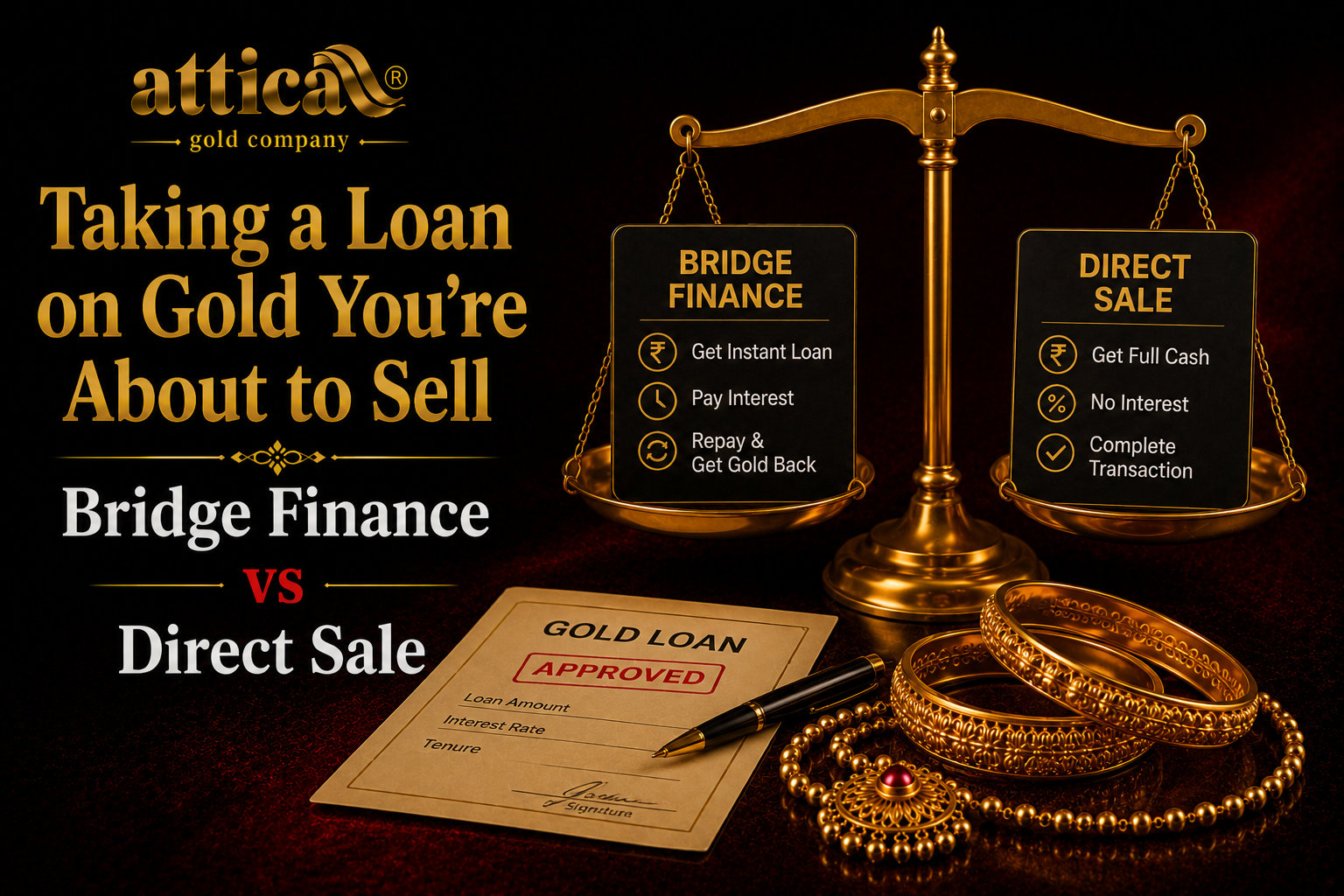
Sometimes you need cash today but believe gold prices will be higher in 3–12 months. Selling gold now means realising current value but losing the expected appreciation; not selling means no cash. The middle path is a short-term gold loan: pledge the gold, borrow up to 75% of its value, use the cash for your immediate need, then sell the gold later (after expected price rise), repay the loan, and keep the difference. This is bridge finance using gold as collateral – and it can work, but only when the math is right.
This guide compares the two strategies – gold loan vs sell gold – across cost, risk, complexity, and net outcome. We use a gold loan calculator approach to model the breakeven point, walk through scenarios where bridge finance pays off, and identify when direct sale at sell gold rate today is the better answer. The strategy is real but situation-specific; gold loan eligibility is easy, but the loan’s cost compounds during the bridge period. Whether you ultimately go for cash for gold today or bridge the wait with a loan, the math should drive the decision, not impulse.
How a Bridge Strategy Actually Works
- Day 0: You pledge gold (say 100g 22K worth ~₹6.5 lakh) to a bank or NBFC. They give you up to 75% LTV = ₹4.87 lakh as gold loan.
- Day 0: You use the ₹4.87 lakh for your immediate cash need (medical bill, deposit, etc.).
- Day 0 to Month 6 (or whenever you sell): You service the gold loan EMI or pay interest-only. The pledged gold sits with the lender.
- Month 6: Gold price has (you hope) risen. You repay the principal + accrued interest, take back the gold, walk down the road, and sell it at the higher rate at Attica Gold or similar.
- End: Net cash = Sale value at higher rate − Loan principal repaid − Total interest paid. Compare with direct-sale alternative on Day 0 to see if bridge was worthwhile.
The Math: Sell Gold Today vs Loan-and-Sell-Later
Worked example. You have 100g 22K gold worth ₹6.5 lakh today (sell gold rate today). You need ₹4.5 lakh cash for an immediate need. Two paths:
Path A – Sell today: Sell 70g (out of 100g) for ₹4.55 lakh net (after 1.5% buyer margin); keep 30g (worth ₹1.95 lakh) as remaining gold. You met your cash need; remaining gold sits with you, fully owned.
Path B – Take gold loan, sell later: Pledge all 100g, take ₹4.5 lakh loan at 12% (gold loan interest rate). Pay interest-only ₹4,500/month. Six months later, gold price has risen to (you hope) ₹7,300/g (a ~12% rise). You repay ₹4.5 lakh principal + accumulated interest of ₹27,000 = ₹4.77 lakh. Sell 100g at new rate = ₹7,30,000 net of buyer margin = ~₹7,19,000. Net to you = ₹7,19,000 − ₹4,77,000 = ₹2,42,000.
Path A net (today + future remaining): ₹4.55 lakh today + ₹1.95 lakh in remaining gold (could appreciate similarly to ~₹2.18 lakh in 6 months) = ₹6.73 lakh of total wealth at month 6.
Path B net at month 6: ₹4.5 lakh used for need + ₹2.42 lakh remaining = ₹6.92 lakh of total wealth.
Path B is better by ~₹19,000 IF gold rises 12% in 6 months. If gold is flat, Path B yields ₹4.5 lakh − ₹4.77 lakh repayment + ₹6.5 lakh sale = ~₹6.23 lakh – significantly worse than Path A. The bridge strategy lives or dies on the price assumption.
- Also Read: Live Gold Price Today
Gold Loan Calculator: Modeling Your Scenario
Plug your numbers into a gold loan calculator before deciding. Key inputs: pledged gold value, loan amount needed, gold loan interest rate offered, loan tenure, expected sale rate at end of tenure. Outputs to look at: total interest paid, breakeven price increase needed, net cash position vs direct-sale baseline.
Rule of thumb: bridge strategy makes sense when expected % price gain over the bridge period is at least 1.5x the % interest cost. So at 12% gold loan interest rate over 12 months, you’d want expected gold price to rise at least 18% in 12 months for the bridge to be a clear win. Below this margin, the risk-adjusted return is too thin to justify the loan complexity.
Gold Loan Eligibility & Process
Compared to other loans, gold loan eligibility is the easiest in the financial system:
- Documents: PAN card, Aadhaar, address proof (utility bill or rent agreement), 2 passport-size photos, gold to pledge.
- No income proof required for loan amounts up to ₹5 lakh; some lenders extend this to ₹10 lakh.
- No credit score check (gold acts as collateral; CIBIL irrelevant).
- Loan amount = LTV (max 75% under RBI cap) × pledged gold’s net value (after stone/solder deduction).
- Loan tenure: typically 3 months to 36 months; most popular is 12 months.
- Interest payment: choose monthly EMI (principal + interest) or interest-only-with-bullet-principal at end.
- Disbursement: usually within 30–60 minutes from KYC verification + gold valuation + loan agreement signing.
When Bridge Strategy Wins
- Strong conviction on near-term gold price rise (e.g., 10%+ in 3–6 months) based on macro/event triggers (geopolitical, Fed pivots, etc.).
- Cash need is genuinely temporary (3–6 months) – not a ongoing liquidity gap.
- Bank gold loan rate (8.5–11%) available – NBFC rates of 18%+ make the math harder.
- You have stable income to service interest payments without forcing early loan repayment.
- You’re comfortable with the operational risk of the gold sitting with the lender (theft, default, lender stress).
When Direct Sale Wins
- No strong conviction on near-term gold price direction – neutral or weakening view.
- Cash need is large or permanent – bridge would just defer the inevitable sale at higher cost.
- You can only access NBFC rates of 18%+ – interest cost overwhelms expected gold gain.
- Income / job uncertainty – risk of missing EMIs and triggering loan default & gold auction.
- Loan would only be needed for amount that’s < 50% of gold value – better to sell partial holdings, keep rest.
- You’d worry constantly about the pledged gold – psychological cost of the bridge isn’t worth ₹15,000 of expected gain.
💰 Get the Best Price for Your Gold Today
Instant valuation • Transparent pricing • 100% secure & trusted
Hybrid Approach: Sell Some, Borrow Against Some
A practical compromise. If you have 100g of gold and need ₹4.5 lakh cash, consider: sell 50g for ₹3.25 lakh (no interest cost), and take a small ₹1.25 lakh gold loan against remaining 50g (much smaller interest exposure). You keep some appreciation upside, you cover most of the cash need, and you reduce default risk to a smaller pledged amount. The hybrid often beats pure-A or pure-B on a risk-adjusted basis.
Important: Default Risk Considerations
If you take a gold loan and can’t repay on time, the lender can auction your pledged gold (after notice). Auction proceeds typically realise 80–90% of market value, and the lender deducts loan principal + interest + auction costs before returning anything to you. Net effect: you may lose 15–30% of your gold’s value in a default scenario. The gold loan vs sell gold decision must factor this risk: you’re trading guaranteed today’s value for expected-but-uncertain future value plus default exposure.
Why Choose Attica Gold for Direct Sale (or for After-Bridge Sale) – Your Wait Is Over
Bridge finance via gold loan is a real strategy with a real upside in specific market conditions. But it’s not free: gold loan interest rate accumulates whether prices rise or not, default risk attaches your gold to a lender, and the math only works when expected gold gain meaningfully exceeds the loan cost. For most retail sellers in most situations, direct sale at sell gold rate today is the cleaner answer – no interest, no LTV haircut, no default risk, no ongoing administrative burden. Use a gold loan calculator to model your specific scenario before committing to either path.
Whether you choose bridge-and-sell-later or sell-today, Attica Gold makes the eventual sale frictionless: ISO 9001:2015 certified, ~200+ branches across South India, free in-branch XRF testing, IBJA-linked rates published daily, transparent line-by-line invoices, full GST compliance, NEFT/RTGS payment within 24 hours. If you took a bank gold loan and are now paying it off to sell – bring the released gold to Attica for the highest possible IBJA-linked rate. If you’re skipping the loan entirely and selling directly – same process, faster cash. Your wait is over.
Frequently Asked Questions
What’s the typical gold loan interest rate at banks vs NBFCs in 2026?
Public sector banks (SBI, BoB, Canara): 8.5–10.5%. Private banks (HDFC, ICICI, Axis): 9.5–12%. Major NBFCs (Muthoot, Manappuram): 12–18% with quick disbursement. Smaller NBFCs and pawnshops: 18–24% or higher. Always shop 3 lenders before pledging; the difference between an 11% bank loan and a 22% pawnshop loan is enormous over a 12-month tenure.
How does a gold loan calculator help with the bridge strategy decision?
A gold loan calculator takes your pledged gold value, requested loan amount, interest rate, and tenure, and outputs monthly EMI, total interest paid, and loan-end repayment. Combine this with your expected gold sale rate at end-of-tenure to compute net outcome under bridge strategy and compare against sell-today baseline. The calculator turns abstract trade-offs into specific rupee numbers.
Is gold loan vs sell gold a clear-cut decision?
No – it depends on your specific situation: cash need (urgency, amount, duration), gold loan rate available, expected gold price direction, and default risk tolerance. Sell-today is simpler and lower-risk; bridge-via-loan offers upside if prices rise meaningfully. Most retail sellers benefit from sell-today; bridge strategy works for sophisticated holders with conviction on near-term price moves.
Can I take a gold loan and sell other gold today (hybrid approach)?
Absolutely – and it’s often the best compromise. Sell part of your holding for the immediate cash need (no interest cost), pledge another part for additional cash via gold loan (smaller exposure), and keep the rest for future appreciation. The hybrid splits the trade-offs and reduces single-strategy risk. Most CAs recommend hybrid for amounts above ₹5 lakh.
What’s the typical gold loan EMI for ₹1 lakh at 12% for 12 months?
Using standard EMI formula: ~₹8,885 per month, total interest ~₹6,620 over 12 months. If you opt for interest-only with bullet repayment of principal, monthly outflow is ₹1,000 (interest) and final payment is ₹1,06,620 – easier on monthly cash flow but same total cost.
Does gold loan eligibility require a CIBIL score or income proof?
For amounts under ₹5 lakh, typically no – gold loan eligibility is based on the gold pledged (collateral), not your creditworthiness. PAN + Aadhaar are the standard documents. For amounts above ₹5 lakh, some lenders may ask for income proof or run a soft credit check, but it’s rarely a deal-breaker since the gold itself secures the loan.
What happens to my gold if I default on the gold loan during the bridge period?
After 90+ days of default and proper notice, the lender can auction your pledged gold. Auction proceeds typically realise 80–90% of market value (less than direct sale would). Lender deducts loan principal, accrued interest, and auction costs; remainder (if any) is returned to you. Net effect: you lose 15–30% of gold’s value vs a normal sale. This is the main reason to keep bridge tenures short and EMIs comfortable.
Can I prepay the gold loan to take my gold back early for sale?
Yes – most gold loans allow prepayment at any time. Some lenders charge a 1–2% prepayment penalty in the first 3–6 months; many waive this entirely. Prepayment is the natural exit when gold prices rise faster than expected – repay loan, take gold, sell at higher rate, capture the upside. Always confirm prepayment terms before signing the loan agreement.
Sources & References
This page references and is informed by the following authoritative sources. Last verified: May 2026.
[1] RBI Master Direction on Gold Loan LTV (75% Cap) – Reserve Bank of India. https://www.rbi.org.in/
[2] Daily Gold Reference Rate – India Bullion and Jewellers Association (IBJA). https://ibja.co/
[3] Gold Loan Interest Rate Comparison – Banks & NBFCs – BankBazaar / PaisaBazaar (aggregator data). https://www.bankbazaar.com/gold-loan.html
[4] Gold Loan Auction & Default Procedure – Reserve Bank of India – SARFAESI Act. https://www.rbi.org.in/
[5] Gold Spot & Futures Pricing (Bridge Period Tracking) – Multi Commodity Exchange (MCX) India. https://www.mcxindia.com/
Ready to sell gold at best rate?
Sell directly to skip loan complexity, OR sell after the bridge period – either way, Attica Gold offers the best post-loan rate.