
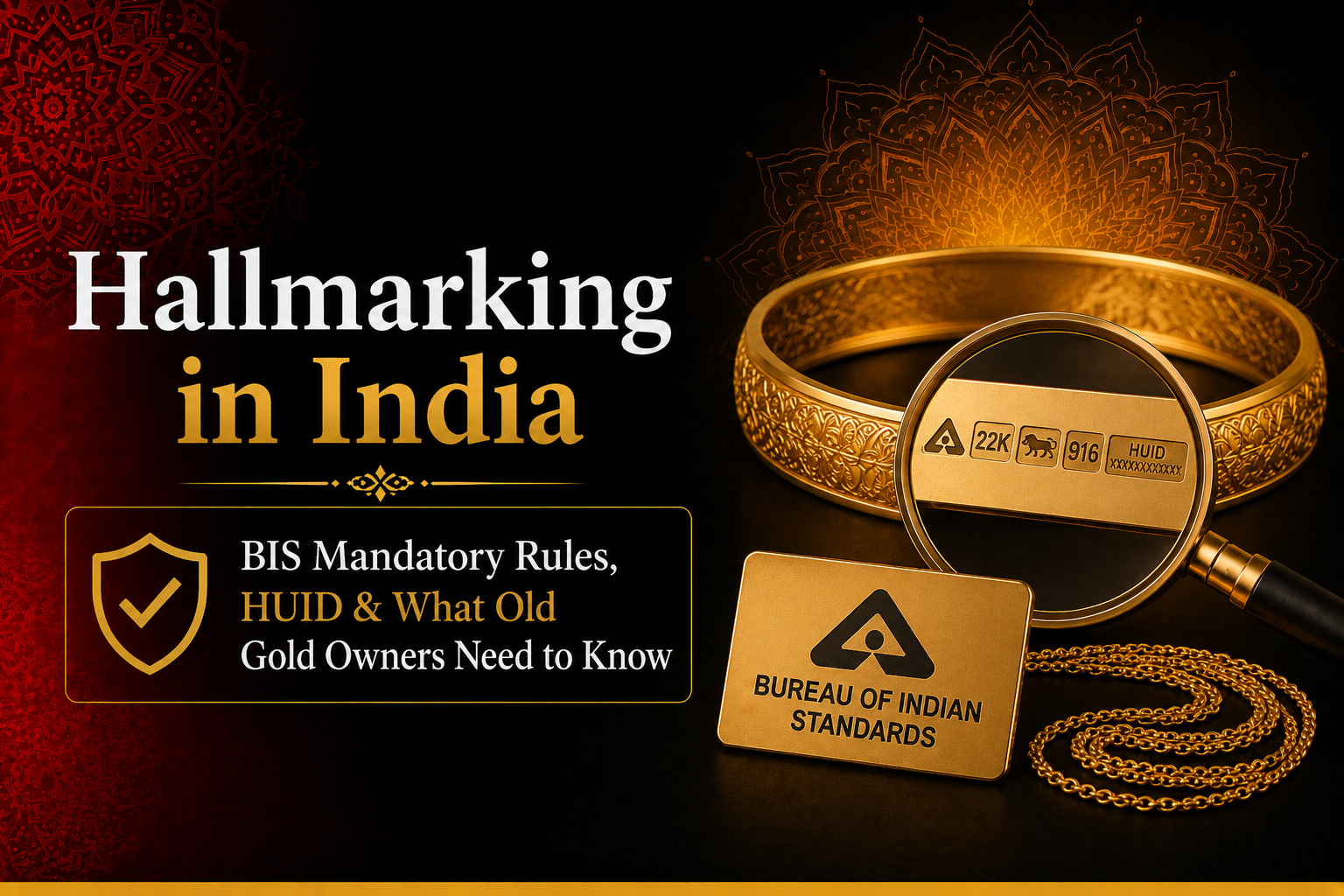
Why BIS Hallmark Rules Changed Indian Gold Forever
On 16 June 2021, the Bureau of Indian Standards (BIS) made gold hallmark certification compulsory for almost every piece of jewellery sold in India. Before that date, hallmarking was voluntary -you could buy a chain at one shop with a tiny BIS logo and another at the next street with no marks at all, and both were perfectly legal. Today, any jeweller selling un-hallmarked gold above 14 carat in a notified district is breaking the law. For sellers, this matters because the BIS hallmark is no longer a nice-to-have; it is the single most important signal of how much your old gold is worth at resale.
This guide is a plain-English explanation of the BIS hallmark system as it stands in 2026 -what the four marks on your jewellery mean, what HUID is, why pre-2021 gold without a hallmark is still saleable, and how the rules change the cash you receive when you walk into a buyer. If you have inherited jewellery, bought gold during the unmarked era, or are simply confused by the BIS triangle and the six-digit code stamped beside it, read this once, and you will understand exactly what every mark on your gold means.
What is a BIS Hallmark? The 4 Marks Every Indian Buyer Should Know
A BIS hallmark is a tiny set of stamped marks applied by a BIS-licensed Assaying and Hallmarking Centre (AHC) after the gold has been independently tested for purity. Since 2021, every hallmark on Indian jewellery must carry exactly four elements -and any piece missing one of them should make you pause.
- BIS Standard Mark -the recognisable BIS triangle logo confirming the piece has been tested at a licensed centre.
- Purity / Fineness Grade -the karat or fineness number, such as 22K916 (91.6% pure), 18K750, or 14K585. This tells you the actual gold content.
- HUID Number -a unique six-character alphanumeric code (e.g. AZ4XX9) assigned to that specific piece of jewellery and traceable to the manufacturer and AHC.
- Jeweller / Retailer Identification -earlier this was the jeweller’s mark; under the new HUID system, this information sits in the BIS Care app database, linked to the HUID itself.
If a salesperson tells you the BIS triangle alone is enough -or that “the HUID number doesn’t matter for old gold” -they are wrong. Hallmarking in India after 2021 means all four elements together; one without the others is a red flag for resale.
BIS Hallmark Rules at a Glance
| Mandatory From | 16 June 2021 (Phase 1 -256 districts) |
| Phase 2 Rollout | 4 April 2022 (32 more districts) |
| Phase 3 Rollout | 6 September 2023 (HUID strictly enforced) |
| Applies To | Gold jewellery & artefacts above 14 carat |
| Permitted Purities | 14K (585), 18K (750), 20K (833), 22K (916), 23K (958), 24K (995/999) |
| Verification Tool | BIS Care app -HUID lookup |
| Penalty for Sellers | 5x value of object plus up to ₹1 lakh fine (Sec 29, BIS Act) |
| Today’s 24K Reference Rate | ₹14,962 per gram (5 May 2026, IBJA) |
Today’s Live Gold Rate by BIS Purity Grade
The BIS hallmark on your jewellery dictates the per-gram rate a buyer applies. The same 10g chain fetches very different cash depending on whether it is 22K (916), 18K (750) or 14K (585). The rate you see on the live ticker below is for 24K reference; reputed buyers then multiply that rate by your tested fineness to arrive at the per-gram value of your specific piece.
- Also Read: Live Gold Price Today
Use the widget to check today’s 22K, 18K and 14K rates before walking into any buyer. If a quoted rate sits more than ₹100 below the live IBJA benchmark for your purity, ask why before signing anything.
The HUID Number: India’s Six-Character Gold Passport
HUID stands for Hallmark Unique Identification. Since 1 July 2021, every newly hallmarked piece of gold jewellery in India must carry a unique HUID engraved by the AHC during the testing process. The code is six characters long, alphanumeric, and permanently traceable through the BIS Care mobile app -free to download for both Android and iOS. Type the HUID into the app and it returns the registered jeweller, the AHC, the date of hallmarking and the declared purity. If the app says “HUID not found”, the mark is fake or the jewellery was never tested.
For sellers this is gold dust. A piece with a verifiable HUID needs no further argument over purity -the buyer scans, confirms, applies the IBJA rate and pays. A piece without a HUID still sells, but the buyer must perform XRF testing in your presence, and the rate is based on tested purity rather than declared purity. Both routes are legitimate; the HUID-marked one is just faster.
💰 Get the Best Price for Your Gold Today
Instant valuation • Transparent pricing • 100% secure & trusted
BIS Hallmark Purity Grades & What Each One Means at Resale
| Hallmark Grade | Purity | Common Use & Resale Notes |
| 22K916 | 91.6% pure | Standard Indian wedding jewellery; highest jeweller demand for resale |
| 18K750 | 75.0% pure | Diamond settings & modern designs; resale via refining route |
| 14K585 | 58.5% pure | Lightweight everyday pieces; resale at refining-margin discount |
| 24K995/999 | 99.5% / 99.9% | Investment coins, bars, biscuits; closest to spot rate at resale |
The bis hallmark grade does not change the maths of how much pure gold sits in your piece -that is fixed by physics. But the grade does change how easily a buyer can on-sell the piece. 22K and 24K are the easiest to resell because demand for 22K bridal jewellery and 24K coins is constant. 18K and 14K go through a refining cycle, which adds a small per-gram margin but does not destroy the value.
What If My Old Gold Has No BIS Hallmark?
A common worry -“my mother’s necklace from 1985 has no triangle, am I in trouble?” -has a clear answer. The 2021 BIS rules apply to jewellers selling new gold, not to households owning old gold. You can keep, gift, inherit, melt or sell unhallmarked legacy jewellery without breaking any law. What changes is the resale process: instead of a HUID lookup, the buyer runs an XRF (X-ray fluorescence) test in your presence to measure the exact gold content. The rate is then applied to the tested purity.
Most pre-2021 Indian household jewellery tests at 88–91% purity, which is a touch below the 916 mark. This is not because the jeweller cheated you in 1985; it is because the BIS standard was new and many smaller workshops worked at slightly lower fineness. A reputable buyer pays you for the gold actually present, not the gold you wish were present. If a buyer refuses to purchase unhallmarked gold or quotes you a flat 80% of the live rate “because there is no hallmark”, walk out.
BIS Hallmark Rules -What Changed in 2023 and 2024
After the initial 2021 rollout, BIS tightened the hallmark gold meaning further. From 1 April 2023, only HUID-marked jewellery could be sold by registered jewellers -the older four-mark system without HUID was retired. From September 2023, BIS Care app verification became the legal proof of authenticity. In the 2024 budget cycle, the government also adjusted import duty and the long-term capital gains tax framework, which indirectly pushed more sellers toward hallmark-verified resale to keep audit trails clean.
For everyday sellers, the practical takeaway is simple: any new jewellery you buy after 2023 must have a HUID, and any old jewellery you sell can either present its hallmark for fast settlement or undergo XRF testing for a measured settlement. The BIS hallmark mandatory rules protect you on both routes.
Common Hallmark Mistakes That Cost Sellers Money
- Trusting a single triangle stamp without checking the HUID -old four-mark pieces from 2017–2020 are valid, but many fakes copy only the triangle.
- Accepting an “approximate purity” quote instead of insisting on XRF testing for unhallmarked pieces.
- Letting a jeweller deduct “hallmark verification fee” from your sale price -verification on the BIS Care app is free.
- Selling hallmarked gold at a flat 22K rate when the piece is actually 18K -always confirm the purity grade printed on your jewellery before negotiating.
- Assuming inherited jewellery is “worthless without a hallmark” -old gold is fully legal to sell and routinely fetches 88–91% of 24K value once XRF-tested.
Why Choose Attica Gold for Hallmark-Verified Selling
Hallmarking in India is meant to protect the buyer of new jewellery -but at resale, the same system protects you, the seller, only if your buyer respects it. Many small shops still avoid HUID lookups, skip XRF for old gold, or quote flat percentages instead of tested purity. The cost of these shortcuts lands on you in the form of underpayment.
Attica Gold runs every transaction through the same protocol -HUID verification on the BIS Care app for hallmarked pieces, in-presence XRF testing for unhallmarked legacy gold, today’s live IBJA rate displayed openly, and a written line-by-line quote before you decide. Across 200+ branches in Karnataka, Tamil Nadu, Andhra Pradesh, Telangana and Pondicherry, the process is identical because ISO 9001:2015 certification means the same standard at every branch, every day. If you have been holding old gold and worrying about hallmarks, your wait is over. Walk in, watch the test, take the cash.
Frequently Asked Questions
Is the BIS hallmark mandatory for all gold jewellery in India?
Yes -since 16 June 2021, the BIS hallmark is mandatory for new gold jewellery above 14 carat sold by registered jewellers in 256 notified districts (extended to 288 districts by 2022). The bis hallmark rule does not apply retroactively to old gold you already own, but every newly purchased piece must carry the BIS triangle, purity grade and HUID number.
What is HUID, and how do I check it?
HUID is the Hallmark Unique Identification -a six-character alphanumeric code engraved on every BIS-hallmarked piece of jewellery sold in India after 1 July 2021. Download the free BIS Care app, tap “Verify HUID” and enter the code to see the registered jeweller, AHC, date of hallmarking and declared purity. If the app cannot find the HUID, the mark is fake.
Can I sell old gold without a BIS hallmark?
Yes, absolutely. The 2021 rules apply to jewellers selling new gold, not to households selling old gold. Reputable buyers test unhallmarked legacy jewellery using XRF (X-ray fluorescence) machines that measure exact gold content non-destructively. You receive payment based on the tested purity at today’s live IBJA rate.
What does the number 916 mean on my jewellery?
The number 916 is a BIS purity grade, meaning 91.6% pure gold, equivalent to 22 carat. It is the most common Indian wedding jewellery grade. Other BIS purity numbers include 750 (18K, 75% pure), 585 (14K, 58.5% pure), 995 (24K, 99.5% pure) and 999 (24K, 99.9% pure).
Are the BIS hallmark gold rules different across Indian states?
No -bis hallmark gold rules are uniform across India under the central BIS Act 2016. The only state-level variation is the rollout phase (some districts were notified in 2021, others in 2022 or 2023), but as of 2026, nearly every urban district in India is covered. The verification process via the BIS Care app works identically nationwide.
Does BIS hallmark verification cost anything when I sell?
No. HUID lookup on the BIS Care app is completely free and takes under 30 seconds. If a buyer tries to deduct a “hallmark verification fee” from your sale price, that is not legitimate -walk to a different buyer. XRF testing for unhallmarked old gold is also offered free by reputable buyers like Attica Gold.
What is the penalty for jewellers selling unhallmarked gold?
Under Section 29 of the BIS Act 2016, a jeweller selling non-hallmarked gold in a notified district faces a penalty of up to five times the value of the object, or up to ₹1,00,000, whichever is higher. Repeat offenders may face imprisonment up to one year. As a seller, this protects you -buyers operating without licences typically avoid the formal market.
How do I confirm my Hallmark Gold is genuine before selling?
Three checks: first, look for all four BIS marks (triangle logo, purity grade, HUID, jeweller code) on the inner surface of the piece. Second, scan the HUID through the BIS Care app and confirm the database entry matches your jewellery. Third, ask the buyer for a free XRF test in your presence as a final cross-check. If all three align, you have a verifiable bis hallmark genuine piece ready for resale at full live rate.
{ “@context”: “https://schema.org”, “@type”: “FAQPage”, “mainEntity”: [ { “@type”: “Question”, “name”: “Is BIS hallmark mandatory for all gold jewellery in India?”, “acceptedAnswer”: { “@type”: “Answer”, “text”: “Yes -since 16 June 2021, BIS hallmark is mandatory for new gold jewellery above 14 carat sold by registered jewellers in 256 notified districts (extended to 288 districts by 2022). The bis hallmark rule does not apply retroactively to old gold you already own, but every newly purchased piece must carry the BIS triangle, purity grade and HUID number.” } }, { “@type”: “Question”, “name”: “What is HUID and how do I check it?”, “acceptedAnswer”: { “@type”: “Answer”, “text”: “HUID is the Hallmark Unique Identification -a six-character alphanumeric code engraved on every BIS-hallmarked piece of jewellery sold in India after 1 July 2021. Download the free BIS Care app, tap \”Verify HUID\” and enter the code to see the registered jeweller, AHC, date of hallmarking and declared purity. If the app cannot find the HUID, the mark is fake.” } }, { “@type”: “Question”, “name”: “Can I sell old gold without a BIS hallmark?”, “acceptedAnswer”: { “@type”: “Answer”, “text”: “Yes, absolutely. The 2021 rules apply to jewellers selling new gold, not to households selling old gold. Reputable buyers test unhallmarked legacy jewellery using XRF (X-ray fluorescence) machines that measure exact gold content non-destructively. You receive payment based on tested purity at today’s live IBJA rate.” } }, { “@type”: “Question”, “name”: “What does the number 916 mean on my jewellery?”, “acceptedAnswer”: { “@type”: “Answer”, “text”: “The number 916 is a BIS purity grade, meaning 91.6% pure gold -equivalent to 22 carat. It is the most common Indian wedding jewellery grade. Other BIS purity numbers include 750 (18K, 75% pure), 585 (14K, 58.5% pure), 995 (24K, 99.5% pure) and 999 (24K, 99.9% pure).” } }, { “@type”: “Question”, “name”: “Are BIS hallmark gold rules different across Indian states?”, “acceptedAnswer”: { “@type”: “Answer”, “text”: “No -bis hallmark gold rules are uniform across India under the central BIS Act 2016. The only state-level variation is the rollout phase (some districts were notified in 2021, others in 2022 or 2023), but as of 2026 nearly every urban district in India is covered. The verification process via BIS Care app works identically nationwide.” } }, { “@type”: “Question”, “name”: “Does BIS hallmark verification cost anything when I sell?”, “acceptedAnswer”: { “@type”: “Answer”, “text”: “No. HUID lookup on the BIS Care app is completely free and takes under 30 seconds. If a buyer tries to deduct a \”hallmark verification fee\” from your sale price, that is not legitimate -walk to a different buyer. XRF testing for unhallmarked old gold is also offered free by reputable buyers like Attica Gold.” } }, { “@type”: “Question”, “name”: “What is the penalty for jewellers selling unhallmarked gold?”, “acceptedAnswer”: { “@type”: “Answer”, “text”: “Under Section 29 of the BIS Act 2016, a jeweller selling non-hallmarked gold in a notified district faces a penalty of up to five times the value of the object, or up to ₹1,00,000, whichever is higher. Repeat offenders may face imprisonment up to one year. As a seller, this protects you -buyers operating without licences typically avoid the formal market.” } }, { “@type”: “Question”, “name”: “How do I confirm my hallmark gold is genuine before selling?”, “acceptedAnswer”: { “@type”: “Answer”, “text”: “Three checks: first, look for all four BIS marks (triangle logo, purity grade, HUID, jeweller code) on the inner surface of the piece. Second, scan the HUID through the BIS Care app and confirm the database entry matches your jewellery. Third, ask the buyer for a free XRF test in your presence as a final cross-check. If all three align, you have a verifiable bis hallmark genuine piece ready for resale at full live rate.” } } ] }Ready to sell hallmarked or old gold at today’s live BIS-verified rate?
Visit your nearest Attica Gold branch for free HUID lookup, in-presence XRF testing and instant cash payment.
Get Instant Valuation
Free evaluation · No obligation · Instant offer
🔒 Your details are safe and confidential