Why Section 269ST Matters Before You Sell Gold
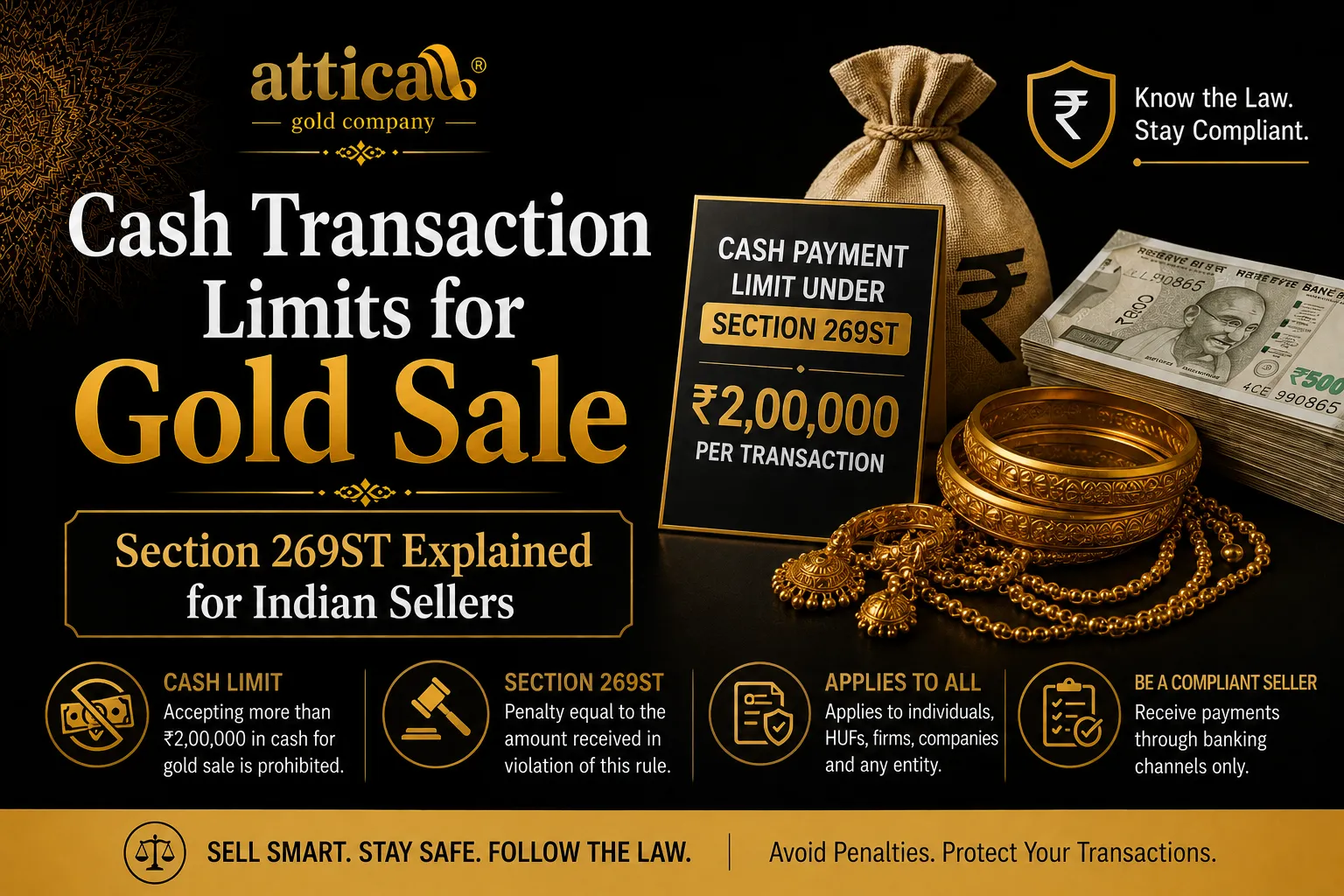
If you are planning to sell gold worth more than ₹2,00,000 in cash, Section 269ST of the Income Tax Act will affect how the transaction is structured – and ignoring it can cost you a 100% penalty on the entire amount. Introduced through the Finance Act 2017, this provision was designed to push high-value transactions away from cash and into bank channels. For gold sellers, the rule has become especially relevant because a single 22K chain weighing 15 grams already crosses the ₹2 lakh threshold at today’s rates.
This guide explains Section 269ST in plain English – what the ₹2 lakh limit covers, why splitting your transaction across two days does not help, when PAN becomes mandatory, what penalty applies if you break the rule, and how reputable gold buyers handle high-value transactions legally. Read it once before walking into any branch with significant gold, and you will know exactly which payment mode to ask for and which questions to refuse to answer.
Section 269ST in Plain English
Section 269ST prohibits any person from receiving ₹2,00,000 or more in cash – in-aggregate – from one person in one day, in respect of one event or occasion, or in respect of one transaction. The penalty falls on the receiver, not on you the payer or the gold seller. But because no reputable buyer will risk that penalty, the practical effect is that any gold sale exceeding ₹2 lakh must use a non-cash payment mode. The 269ST cash transaction limit is enforced through cross-checks between buyer GST returns and your PAN-linked income tax records.
- Also Read: Live Gold Price Today
The ₹2 Lakh Cash Limit – At a Glance
| Provision | Section 269ST , Income Tax Act 1961 |
| Effective From | 1 April 2017 |
| Cash Limit | ₹2,00,000 per person, per day, per transaction |
| Aggregation Rule | Multiple cash receipts from the same person on the same day are added together |
| Penalty (Sec 271DA) | Equal to the amount received in cash (100% penalty on the receiver) |
| PAN Requirement | Mandatory for gold sales above ₹2,00,000 |
| Allowed Payment Modes Above ₹2 Lakh | NEFT, RTGS, IMPS, UPI, account-payee cheque, bank draft |
| Today’s 24K Rate Reference | ₹14,962 per gram (5 May 2026, IBJA) |
How Much Gold Triggers the ₹2 Lakh Limit?
At today’s 24K rate of around ₹14,962 per gram, the cash limit for gold purchase or sale of ₹2,00,000 is crossed by approximately 13.4 grams of pure gold, or about 14.6 grams of 22K jewellery, or 17.5 grams of 18K jewellery. In practical terms, that is one solid chain, two thick bangles, or a small set of bridal earrings. Most household gold sales of inherited jewellery from a single piece easily exceed ₹ 2 lakh. Run today’s numbers through the live rate widget below before deciding which payment mode to ask the buyer for.
The Three-Way Aggregation Rule (Why Splitting Doesn’t Work)
Many sellers assume they can just split a ₹3 lakh sale into three ₹1 lakh cash receipts across three days and stay below the limit. Section 269ST closes that loophole through three independent aggregation tests, and breaking any one of them triggers the penalty:
- Per-day rule – total cash from one person in one day cannot exceed ₹2 lakh, even if booked under different invoices.
- Per-event rule – total cash relating to a single event (e.g. a single wedding-gold sale) cannot exceed ₹2 lakh, even if spread across multiple days.
- Per-transaction rule – total cash for a single transaction (e.g. one chain valued at ₹3 lakh) cannot be paid in cash even in two parts.
In short: if your gold is worth more than ₹2 lakh, the only legal way to receive payment is through a banking channel. The 2-lakh cash limit for gold is non-negotiable.
PAN Card Requirement Above ₹2 Lakh
Section 269ST works alongside Rule 114B of the Income Tax Rules, which requires PAN quotation for any single sale of bullion or jewellery above ₹2,00,000. The buyer is legally bound to record your PAN, and Form 60 is not allowed as a substitute for high-value gold transactions. If you do not yet have a PAN, you must obtain one before completing the sale. Aadhaar e-PAN is issued free in under 10 minutes through the Income Tax e-filing portal.
Aadhaar remains mandatory for all KYC under PMLA rules, irrespective of transaction size. Together, Aadhaar plus PAN form the standard documentation pack for any sale above the threshold. A buyer who tells you “no PAN needed, it stays off the books” is breaking the law on your behalf, and you bear the income tax notice if a tax officer cross-checks the buyer’s GST return.
💰 Get the Best Price for Your Gold Today
Instant valuation • Transparent pricing • 100% secure & trusted
Penalty Under Section 271DA – What Happens If You Break the Rule
Section 271DA, the enforcement arm of 269ST, levies a 269ST penalty equal to the amount received in cash. So if a buyer accepts ₹3 lakh from you in cash for gold, the buyer pays ₹3 lakh as a penalty in addition to the standard tax. The penalty falls on the receiver, but two consequences hit the seller anyway: first, no organised buyer will risk it, so you will simply not find a legitimate cash buyer above the limit; second, if the Income Tax Department traces the cash deposit back to you, you may face questions on the source of cash and unrelated scrutiny on your other returns.
Form 60 cannot be used to bypass this – Form 60 is for non-PAN holders in low-value transactions, not for circumventing 269ST. The only safe way to handle high-value gold sales is to accept payment via NEFT, RTGS, IMPS or UPI, all of which settle within minutes at any reputable branch.
Allowed Payment Modes for Gold Sales Above ₹2 Lakh
| Payment Mode | Settlement Time | Notes |
| NEFT | 30 minutes – 2 hours | Best for round amounts; works 24×7 since 2019 |
| RTGS | Real-time (under 30 minutes) | Mandatory above ₹2 lakh in some banks; minimum ₹2 lakh |
| IMPS | Instant (under 60 seconds) | Up to ₹5 lakh per transaction; fastest mode |
| UPI | Instant | Per-transaction limit ₹1 lakh (₹2 lakh for select banks) |
| Account Payee Cheque | 1–2 working days | Slowest; useful only if a cheque is required for records |
| Bank Draft | Same day | Used when the seller wants a guaranteed instrument |
Most Attica Gold sellers above the cash transaction limit in India choose IMPS or RTGS – funds reach the seller’s account before they leave the branch. The buyer issues a written receipt with the transaction reference, and the seller has a full audit trail on their bank statement. There is no waiting, no risk of carrying large cash, and no exposure to 269ST cash transaction limit penalties.
Common Mistakes That Trigger 269ST Penalty Risk
- Asking the buyer to “pay in cash, no records” above ₹2 lakh – this is illegal, and any buyer who agrees is breaking the law on your behalf.
- Splitting one chain’s sale across two days, hoping to stay under the limit – Section 269ST aggregation rules apply across days for the same transaction.
- Accepting cash for the first ₹2 lakh and a cheque for the remainder – the entire transaction must be non-cash if the total exceeds the limit.
- Refusing to share PAN above ₹2 lakh – the buyer is legally required to record your PAN; without it the sale cannot complete.
- Trusting an unwritten quote – always insist on a printed invoice showing weight, purity, applied rate, deductions, total and payment mode.
Why Choose Attica Gold for Compliant High-Value Sales
Selling gold above the 2 lakh cash limit gold threshold should not feel like a tax minefield. The rules are clear, the workarounds are not legal, and the only safe path is a buyer who follows the protocol from start to finish – PAN-Aadhaar KYC at intake, transparent XRF purity testing, today’s live IBJA rate displayed openly, written invoice with payment mode pre-selected, and instant settlement through IMPS or RTGS so funds reach your account before you leave the branch.
Attica Gold has built its 200+ branches across Karnataka, Tamil Nadu, Andhra Pradesh, Telangana and Pondicherry around exactly this protocol. ISO 9001:2015 certification means the same standard at every branch, every day. There is no off-the-books cash, no workaround pressure, no penalty risk – only a clean transaction with a paper trail you can use at tax time. If you have been holding back a high-value gold sale because the cash limit confused you, your wait is over. Walk in, complete KYC, choose your bank channel, and take the cash where it belongs.
Frequently Asked Questions
What is Section 269ST in simple words?
Section 269ST is an income tax provision that prohibits anyone in India from receiving ₹2,00,000 or more in cash from one person in one day, for one event, or for one transaction. Effective since 1 April 2017, the rule applies to gold buyers, jewellers and any commercial receiver. Above the ₹2 lakh threshold, payment must move through bank channels – NEFT, RTGS, IMPS, UPI or cheque.
Can I sell gold worth ₹5 lakh and receive cash?
No. Under Section 269, any cash receipt of ₹2,00,000 or more is prohibited. A ₹5 lakh gold sale must be settled through bank transfer, IMPS, RTGS or account-payee cheque. The buyer would face a 269ST penalty equal to the cash amount under Section 271DA, so no reputable buyer will offer cash above the limit. The good news: IMPS and RTGS settle within minutes, so you are not waiting any longer than a cash count.
Is PAN mandatory for selling gold above ₹2 lakh?
Yes. Under Rule 114B of the Income Tax Rules, PAN must be quoted for any single sale of bullion or jewellery exceeding ₹2,00,000. Form 60 is not accepted as a substitute for high-value gold transactions. Aadhaar is also mandatory under PMLA KYC rules at any sale value, so the standard pack for above-threshold sales is Aadhaar plus PAN.
Can I split my gold sale into smaller cash payments to avoid 269ST?
No. Section 269ST has three aggregation tests – per day, per event, and per transaction. Splitting a single ₹3 lakh sale into three ₹1 lakh cash payments across three days still falls under “per transaction” aggregation and triggers the penalty. The 269ST cash transaction limit cannot be bypassed through staggering. The compliant route is a single bank transfer.
What is the penalty under Section 271DA for breaking 269ST?
Section 271DA imposes a penalty equal to the amount received in cash. If a buyer accepts ₹3 lakh in cash, the buyer pays ₹3 lakh as a penalty (in addition to applicable tax). The penalty falls on the receiver, but the seller may face downstream income tax scrutiny on the source of cash if traced. The safe route is a non-cash payment for any sale above ₹2 lakh.
Does the cash limit for gold purchase of ₹2 lakh include making charges or only the gold value?
It applies to the total invoice value – gold value plus any making charges, GST and other line items. If the total cash receipt from one person reaches ₹2,00,000, Section 269ST applies. Buyers cannot split the gold value and make charges across separate invoices to dodge the limit; the per-transaction aggregation rule treats the whole sale as one event.
Are there any exemptions to the cash transaction limit in India under 269ST?
Specific exemptions exist for receipts by government bodies, post offices, banks, and certain notified institutions – none of which apply to a private gold sale. For ordinary sellers and buyers, the ₹2 lakh limit is absolute. The only practical “exemption” is paying through bank channels, which is fully legal and faster than carrying cash.
What is the safest way to receive payment for a high-value gold sale?
IMPS for amounts up to ₹5 lakh (instant) or RTGS for amounts above ₹2 lakh (real-time, under 30 minutes). Both create a permanent bank record, leave no Section 269ST penalty exposure, and settle before you leave the branch. Always insist on a written invoice showing the transaction reference number and the agreed amount.
{ “@context”: “https://schema.org”, “@type”: “FAQPage”, “mainEntity”: [ { “@type”: “Question”, “name”: “What is Section 269ST in simple words?”, “acceptedAnswer”: { “@type”: “Answer”, “text”: “Section 269ST is an income tax provision that prohibits anyone in India from receiving ₹2,00,000 or more in cash from one person in one day, for one event, or for one transaction. Effective since 1 April 2017, the rule applies to gold buyers, jewellers and any commercial receiver. Above the ₹2 lakh threshold, payment must move through bank channels – NEFT, RTGS, IMPS, UPI or cheque.” } }, { “@type”: “Question”, “name”: “Can I sell gold worth ₹5 lakh and receive cash?”, “acceptedAnswer”: { “@type”: “Answer”, “text”: “No. Under Section 269ST, any cash receipt of ₹2,00,000 or more is prohibited. A ₹5 lakh gold sale must be settled through bank transfer, IMPS, RTGS or account-payee cheque. The buyer would face a 269ST penalty equal to the cash amount under Section 271DA, so no reputable buyer will offer cash above the limit. The good news: IMPS and RTGS settle within minutes, so you are not waiting any longer than a cash count.” } }, { “@type”: “Question”, “name”: “Is PAN mandatory for selling gold above ₹2 lakh?”, “acceptedAnswer”: { “@type”: “Answer”, “text”: “Yes. Under Rule 114B of the Income Tax Rules, PAN must be quoted for any single sale of bullion or jewellery exceeding ₹2,00,000. Form 60 is not accepted as a substitute for high-value gold transactions. Aadhaar is also mandatory under PMLA KYC rules at any sale value, so the standard pack for above-threshold sales is Aadhaar plus PAN.” } }, { “@type”: “Question”, “name”: “Can I split my gold sale into smaller cash payments to avoid 269ST ?”, “acceptedAnswer”: { “@type”: “Answer”, “text”: “No. Section 269ST has three aggregation tests – per day, per event, and per transaction. Splitting a single ₹3 lakh sale into three ₹1 lakh cash payments across three days still falls under \” per transaction\” aggregation and triggers the penalty. The 269ST cash transaction limit cannot be bypassed through staggering. The compliant route is a single bank transfer.” } }, { “@type”: “Question”, “name”: “What is the penalty under Section 271DA for breaking 269ST ?”, “acceptedAnswer”: { “@type”: “Answer”, “text”: “Section 271DA imposes a penalty equal to the amount received in cash. If a buyer accepts ₹3 lakh in cash, the buyer pays ₹3 lakh as a penalty (in addition to applicable tax). The penalty falls on the receiver, but the seller may face downstream income tax scrutiny on the source of cash if traced. The safe route is non-cash payment for any sale above ₹2 lakh.” } }, { “@type”: “Question”, “name”: “Does the cash limit for gold purchase of ₹2 lakh include making charges or only gold value?”, “acceptedAnswer”: { “@type”: “Answer”, “text”: “It applies to the total invoice value – gold value plus any making charges, GST and other line items. If the total cash receipt from one person reaches ₹2,00,000, Section 269ST applies. Buyers cannot split the gold value and make charges across separate invoices to dodge the limit; the per-transaction aggregation rule treats the whole sale as one event.” } }, { “@type”: “Question”, “name”: “Are there any exemptions to the cash transaction limit in India under 269ST ?”, “acceptedAnswer”: { “@type”: “Answer”, “text”: “Specific exemptions exist for receipts by government bodies, post offices, banks, and certain notified institutions – none of which apply to a private gold sale. For ordinary sellers and buyers, the ₹2 lakh limit is absolute. The only practical \” exemption\” is paying through bank channels, which is fully legal and faster than carrying cash.” } }, { “@type”: “Question”, “name”: “What is the safest way to receive payment for a high-value gold sale?”, “acceptedAnswer”: { “@type”: “Answer”, “text”: “IMPS for amounts up to ₹5 lakh (instant) or RTGS for amounts above ₹2 lakh (real-time, under 30 minutes). Both create a permanent bank record, leave no Section 269ST penalty exposure, and settle before you leave the branch. Always insist on a written invoice showing the transaction reference number and the agreed amount.” } } ] }Planning a high-value gold sale?
Visit your nearest Attica Gold branch for compliant Section 269ST handling – PAN-Aadhaar KYC, XRF testing, IBJA-based pricing and same-day IMPS/RTGS settlement to your account.
Get Instant Valuation
Free evaluation · No obligation · Instant offer
🔒 Your details are safe and confidential