
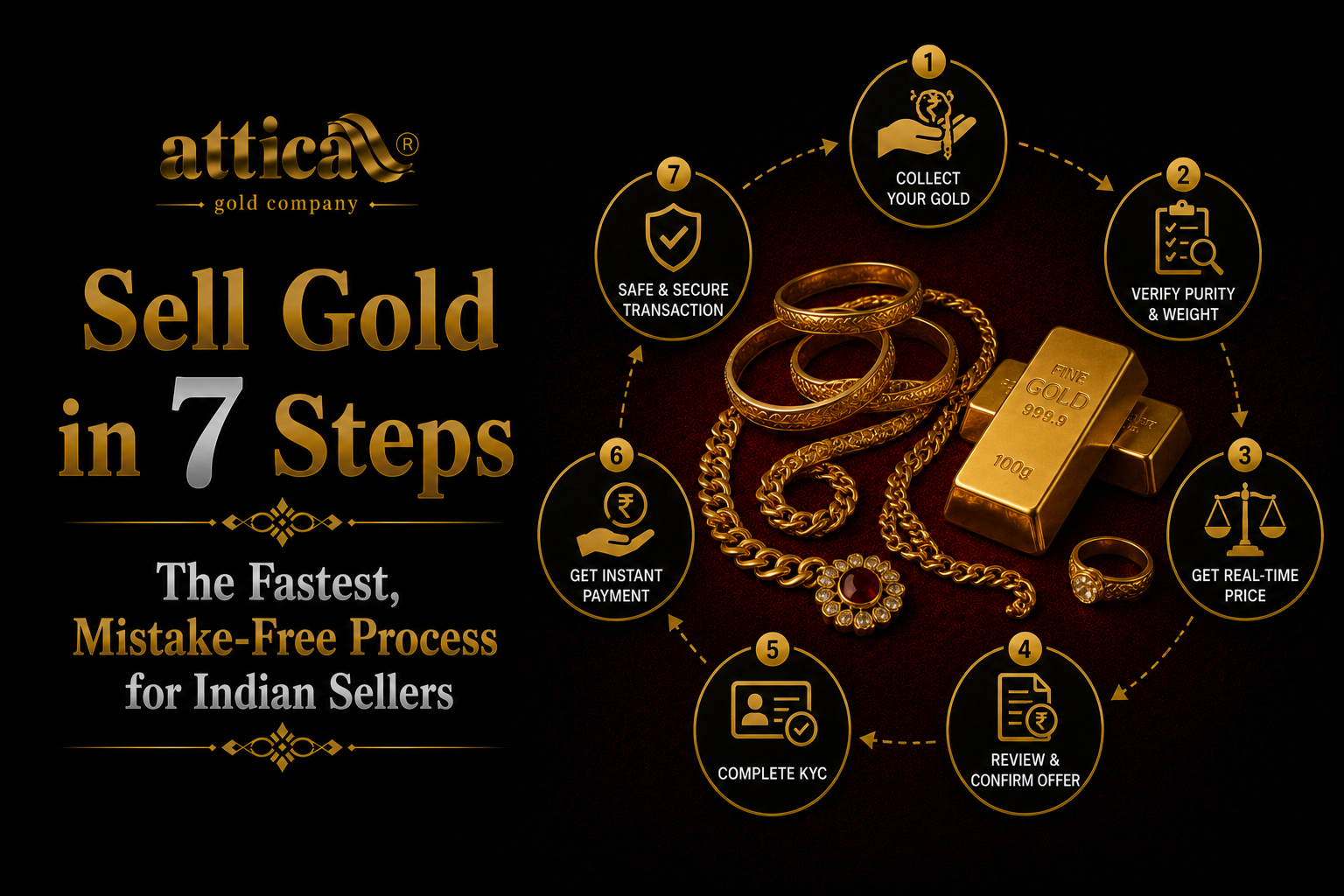
Why a Step-by-Step Process Matters
Most first-time gold sellers walk into a buyer’s shop with a vague idea — “they will weigh my gold and give me the price”. What actually happens next decides whether you walk out with full live-rate cash or 12–15% less than your gold is worth. The difference between the two outcomes is not luck or negotiation; it is process. The sellers who get full value follow a repeatable seven-step sequence — check rate, walk into a buyer with XRF, watch testing, accept the weighing, scrutinise deductions, get the written quote, choose the right payment mode, and complete KYC. Skip a step and the buyer’s margin grows; follow them all and you protect every gram of value in your hand.
This guide is the first time gold seller guide we wish every household had before their first sale. Each step is short, practical and explains exactly what to ask and what to refuse. By the end you will know how to sell gold in any city in India without losing money to confusion or pressure. Print it, keep it on your phone, follow it the next time you walk in.
The 7 Steps at a Glance
| Step 1 | Check today’s live IBJA rate before leaving home |
| Step 2 | Choose a buyer with calibrated XRF + ISO certification |
| Step 3 | Watch the XRF purity test happen in your presence |
| Step 4 | Confirm weighing on calibrated scale, deduct stones/solder |
| Step 5 | Demand a written line-by-line quote with all deductions |
| Step 6 | Choose the right payment mode for your transaction value |
| Step 7 | Complete KYC (Aadhaar + PAN above ₹2 lakh) + collect invoice |
| Today’s 24K Reference Rate | ₹14,962 per gram (5 May 2026, IBJA) |
Step 1: Check Today’s Live IBJA Rate
The single most important number in your gold selling process is today’s live rate. The India Bullion and Jewellers Association (IBJA) publishes morning and evening reference rates that nearly every reputable buyer in India uses as the benchmark. Before leaving home, check the live rate widget below or visit ibjarates.com to confirm the 24K and Gold rates for the day. Write it down. If a buyer’s rate displayed at the branch is more than ₹100 per gram below this figure, you have leverage to walk out.
Step 2: Choose a Buyer With Calibrated XRF + ISO Certification
Not every gold buyer measures purity the same way. The how to sell gold for the best price route requires XRF (X-ray fluorescence) testing — a non-destructive scan that reads exact gold content in 15–30 seconds. Acid touchstone testing (the older method, where a piece is rubbed against a stone and acid is applied) is approximate and routinely under-reads purity by 2–3%. ISO 9001:2015 certification on the buyer indicates they follow standardised quality protocols across all branches.
Three quick checks before walking into any buyer:
- Does the branch display its XRF calibration certificate? (Yes = trustworthy.)
- Is today’s IBJA rate displayed openly on a board or screen? (Yes = transparent.)
- Does the buyer issue a written invoice with all line items? (Yes = compliant.)
Three “no” answers means walk to the next branch. Two “yes” answers and one “maybe” is acceptable. All three “yes” is a quality buyer.
Step 3: Watch the XRF Purity Test
When the buyer takes your jewellery to test, ask to watch — every reputable buyer turns the XRF spectrometer screen toward the seller during the read. The test takes 15–30 seconds per piece. The screen shows the elemental composition, with gold percentage as the dominant figure. Note the percentage shown for each piece — it should match the printed reading on the receipt within 0.2%. If the buyer takes your jewellery to a back room and returns with a flat verbal quote, the test was either skipped or done on equipment they did not want you to see. Walk out.
XRF reads only the surface layer (a few microns deep). For very thin gold-plated pieces, this could be misleading, but for solid Indian jewellery — chains, bangles, rings — XRF is accurate to ±0.1%. Acid touchstone, by contrast, depends on operator skill and acid freshness; it is acceptable as a backup test, never as the primary one.
Step 4: Verify Weighing & Deductions
After purity testing, the buyer weighs each piece on a calibrated electronic scale (look for a stamp from the Department of Legal Metrology). Watch the reading; ask to see the calibration certificate if curious. The buyer then subtracts non-gold weight — stones, solder joints, beads — from the gross weight to arrive at the net gold weight that gets the per-gram rate applied.
Legitimate deductions include:
- Diamonds, polki, emeralds, rubies, pearls — weighed and subtracted (you can negotiate to keep the stones if you wish).
- Solder joints — typically 1–3% of total weight on chains, less on bangles.
- Beads, threads, lac filling — subtracted from total weight.
Illegitimate deductions to refuse:
- Wastage — you are not having jewellery made; no wastage applies to the gold sale.
- Making charges — paid by you originally; not recoverable but not deductible either.
- Hallmark verification fee — BIS Care app verification is free.
- Refining margin (above 1.5% on coins) — IBJA rate already accounts for refining.
💰 Get the Best Price for Your Gold Today
Instant valuation • Transparent pricing • 100% secure & trusted
Step 5: Demand a Written Line-By-Line Quote
A genuine quote is never verbal. Insist on a written quote that shows: gross weight, stones/solder weight subtracted, net gold weight, tested purity %, today’s rate per gram applied, gross gold value, deductions (itemised), and final net amount payable. Most reputable buyers print this on a single A5 sheet within minutes of the test. Verbal quotes shift; written quotes stick.
If the quote does not match what you expect, this is the moment to ask why. The buyer should be able to point to each line item and explain it. If the explanation is unsatisfactory or the buyer becomes evasive, you owe nobody anything — collect your gold and leave. There is no obligation to sell once you walk in. Sell gold step by step means walking out is always an option.
Step 6: Choose the Right Payment Mode
For sales up to ₹1,99,999, cash is the simplest mode — counted in your presence at the branch, no banking dependency. For sales of ₹2 lakh and above, cash is illegal under Section 269ST, and you must choose a banking channel:
| Mode | Settlement Time | Best For |
| Cash | Instant | Up to ₹1,99,999 only |
| UPI | Instant | Up to ₹1 lakh (₹2 lakh select banks) |
| IMPS | < 60 seconds | ₹2 lakh – ₹5 lakh, 24×7 |
| RTGS | < 30 minutes | Above ₹5 lakh, banking hours only |
| NEFT | 30 min – 2 hours | Backup if IMPS is unavailable |
| Cheque | 1–2 working days | Last resort |
IMPS is the workhorse for above-cash-limit sales — instant, large-value capable, and works on weekends. Confirm the bank SMS arrives before signing the receipt.
Step 7: Complete KYC & Collect Invoice
KYC is mandatory under PMLA (Prevention of Money Laundering Act) regardless of transaction size. Aadhaar is required for every gold sale; PAN is required only for sales above ₹2,00,000 under Rule 114B. The buyer scans both, takes your signature, and issues a final invoice. The invoice is your audit trail — for income tax records (especially if your sale exceeds the LTCG threshold), for insurance, and for proof of ownership transfer. Keep it permanently with your other financial records.
Verify before leaving:
- Buyer’s name, address and GST number on the invoice header.
- Date of transaction.
- Item description, weight, purity, rate applied.
- Gross, deductions, net amount payable.
- Payment mode and transaction reference (for IMPS/RTGS) or “Cash” (below ₹2 lakh).
- Your name, Aadhaar last 4 digits, PAN if applicable.
Common Mistakes & Gold Selling Tips
- Selling without checking today’s rate — quoted rates can be ₹100–₹500/gram below live IBJA.
- Accepting “approximate purity” — always insist on XRF, watch the screen.
- Letting the buyer take jewellery to a back room — testing must happen in your presence.
- Trusting verbal quotes — every figure must be on the written invoice.
- Accepting cash above ₹2 lakh — illegal under 269ST and creates audit problems.
- Skipping the bank SMS confirmation for IMPS — wait until the SMS arrives, then leave.
- Selling to one buyer without comparing — at minimum, get two quotes for high-value sales.
Why Choose Attica Gold for the Cleanest 7-Step Sale
The seven steps work at any genuinely transparent buyer — but the consistency of the experience is what separates a quality buyer from an average one. At a quality buyer, every step happens reliably, in the same order, with the same protocol, every time you walk in. There are no surprise detours, no “back-room” testing, no deductions that appear out of nowhere on the invoice.
Attica Gold runs the same protocol at every one of its 200+ branches across Karnataka, Tamil Nadu, Andhra Pradesh, Telangana and Pondicherry — IBJA rate displayed openly, calibrated XRF in your presence, weighing on stamped scales, written line-by-line invoices, KYC completion at the counter, and instant settlement through cash, UPI, IMPS or RTGS depending on the amount. ISO 9001:2015 certification means the same standard at every branch, every day. If you have been putting off a gold sale because the process felt opaque, your wait is over. Walk in, follow the seven steps, leave with the right amount.
Frequently Asked Questions
How to sell gold in India for the best price?
Follow seven steps: (1) check today’s live IBJA rate before leaving home, (2) choose a buyer with calibrated XRF and ISO certification, (3) watch the XRF purity test in your presence, (4) verify weighing and refuse illegitimate deductions like wastage, (5) demand a written line-by-line quote, (6) choose the right payment mode for your sale value, (7) complete KYC and collect the invoice. Following all seven prevents the 12–15% margin most casual sellers lose.
What is the fastest gold-selling process in India?
A typical 5-piece sale at a buyer with XRF and bank integration takes 20–40 minutes — rate check (3 min), XRF testing (5 min), weighing (4 min), invoice (6 min), KYC (7 min), payment (5–15 min). The whole sequence fits inside an hour with the right documents. The fastest mode for above-cash-limit settlement is IMPS, which credits the recipient bank account in under 60 seconds 24×7.
Can I sell gold step by step without a purchase bill?
Yes. A bill is not legally required to sell gold in India. Reputable buyers use XRF testing to measure exact purity and apply today’s live IBJA rate to the tested fineness. The bill speeds up the audit trail and proves original ownership, but does not change the per-gram price you receive. Aadhaar (mandatory) and PAN (above ₹2 lakh) are the only essential documents.
What documents are needed to sell gold in 2026?
Aadhaar is mandatory for every transaction under PMLA KYC rules. PAN is mandatory for any single sale exceeding ₹2,00,000 under Rule 114B of the Income Tax Rules. Bank account details (account number + IFSC) are needed for IMPS/RTGS settlement above the cash limit. Original purchase bills are optional. Amobilee linked to Aadhaar is helpful for OTP-based KYC at branches that use biometric authentication.
How do I know the buyer’s rate is fair?
Three checks: (1) compare the displayed branch rate against today’s live IBJA rate (ibjarates.com or the rate widget on this page) — should be within ₹100/gram; (2) verify XRF purity is shown to you on screen, not just spoken verbally; (3) ensure the written invoice itemises all deductions, with no “wastage” or “verification fee” lines. If all three pass, the rate is fair.
How long does the gold-selling process take from start to finish?
For most household sales (5 pieces, total weight 50g): 20–40 minutes start to finish. For larger sales (200g+, multiple pieces): 45–60 minutes. For edge cases (NRI sellers, multi-heir inheritance, foreign-bought gold): same-day quote and KYC, but bank-side credit may take an additional working day. The XRF testing itself is the fastest step (15–30 seconds per piece); KYC and payment processing take the most time.
What gold-selling tips help avoid losing money?
Five key tips: (1) always check today’s live rate before leaving home, (2) choose a buyer with calibrated XRF — not acid touchstone, (3) watch the test happen, never accept back-room results, (4) demand a written line-by-line quote with all deductions itemised, (5) use IMPS or RTGS for above-₹2-lakh sales (cash is illegal). These five together recover the 12–15% margin typically lost by casual sellers.
Can I refuse to sell after the XRF test if the offer is low?
Yes — absolutely, and you should. A purity test creates no obligation to sell. If the final quote is below your expectations, collect your jewellery and leave. Reputable buyers expect this and do not pressure sellers to commit. Sellers who walk out from one branch and into another with a higher quote routinely save 5–10% on their final realisation. The sell gold step-by-step process gives you full control until you sign the invoice.
{ “@context”: “https://schema.org”, “@type”: “FAQPage”, “mainEntity”: [ { “@type”: “Question”, “name”: “How to sell gold in India for the best price?”, “acceptedAnswer”: { “@type”: “Answer”, “text”: “Follow seven steps: (1) check today’s live IBJA rate before leaving home, (2) choose a buyer with calibrated XRF and ISO certification, (3) watch the XRF purity test in your presence, (4) verify weighing and refuse illegitimate deductions like wastage, (5) demand a written line-by-line quote, (6) choose the right payment mode for your sale value, (7) complete KYC and collect the invoice. Following all seven prevents the 12–15% margin most casual sellers lose.” } }, { “@type”: “Question”, “name”: “What is the fastest gold-selling process in India?”, “acceptedAnswer”: { “@type”: “Answer”, “text”: “A typical 5-piece sale at a buyer with XRF and bank integration takes 20–40 minutes — rate check (3 min), XRF testing (5 min), weighing (4 min), invoice (6 min), KYC (7 min), payment (5–15 min). The whole sequence fits inside an hour with the right documents. The fastest mode for above-cash-limit settlement is IMPS, which credits the recipient bank account in under 60 seconds 24×7.” } }, { “@type”: “Question”, “name”: “Can I sell gold step by step without a purchase bill?”, “acceptedAnswer”: { “@type”: “Answer”, “text”: “Yes. A bill is not legally required to sell gold in India. Reputable buyers use XRF testing to measure exact purity and apply today’s live IBJA rate to the tested fineness. The bill speeds up the audit trail and proves original ownership, but does not change the per-gram price you receive. Aadhaar (mandatory) and PAN (above ₹2 lakh) are the only essential documents.” } }, { “@type”: “Question”, “name”: “What documents are needed to sell gold in 2026?”, “acceptedAnswer”: { “@type”: “Answer”, “text”: “Aadhaar is mandatory for every transaction under PMLA KYC rules. PAN is mandatory for any single sale exceeding ₹2,00,000 under Rule 114B of the Income Tax Rules. Bank account details (account number + IFSC) are needed for IMPS/RTGS settlement above the cash limit. Original purchase bills are optional. Mobile linked to Aadhaar is helpful for OTP-based KYC at branches that use biometric authentication.” } }, { “@type”: “Question”, “name”: “How do I know the buyer’s rate is fair?”, “acceptedAnswer”: { “@type”: “Answer”, “text”: “Three checks: (1) compare the displayed branch rate against today’s live IBJA rate (ibjarates.com or the rate widget on this page) — should be within ₹100/gram; (2) verify XRF purity is shown to you on screen, not just spoken verbally; (3) ensure the written invoice itemises all deductions, with no \”wastage\” or \”verification fee\” lines. If all three pass, the rate is fair.” } }, { “@type”: “Question”, “name”: “How long does the gold selling process take from start to finish?”, “acceptedAnswer”: { “@type”: “Answer”, “text”: “For most household sales (5 pieces, total weight 50g): 20–40 minutes start to finish. For larger sales (200g+, multiple pieces): 45–60 minutes. For edge cases (NRI sellers, multi-heir inheritance, foreign-bought gold): same-day quote and KYC, but bank-side credit may take an additional working day. The XRF testing itself is the fastest step (15–30 seconds per piece); KYC and payment processing take the most time.” } }, { “@type”: “Question”, “name”: “What gold selling tips help avoid losing money?”, “acceptedAnswer”: { “@type”: “Answer”, “text”: “Five key tips: (1) always check today’s live rate before leaving home, (2) choose a buyer with calibrated XRF — not acid touchstone, (3) watch the test happen, never accept back-room results, (4) demand a written line-by-line quote with all deductions itemised, (5) use IMPS or RTGS for above-₹2-lakh sales (cash is illegal). These five together recover the 12–15% margin typically lost by casual sellers.” } }, { “@type”: “Question”, “name”: “Can I refuse to sell after the XRF test if the offer is low?”, “acceptedAnswer”: { “@type”: “Answer”, “text”: “Yes — absolutely, and you should. A purity test creates no obligation to sell. If the final quote is below your expectations, collect your jewellery and leave. Reputable buyers expect this and do not pressure sellers to commit. Sellers who walk out from one branch and into another with a higher quote routinely save 5–10% on their final realisation. The sell gold step-by-step process gives you full control until you sign the invoice.” } } ] }Ready to follow the 7-step sell process with a transparent buyer?
Visit your nearest Attica Gold branch — IBJA rate displayed openly, XRF testing in your presence, written invoice, instant payment.
Get Instant Valuation
Free evaluation · No obligation · Instant offer
🔒 Your details are safe and confidential