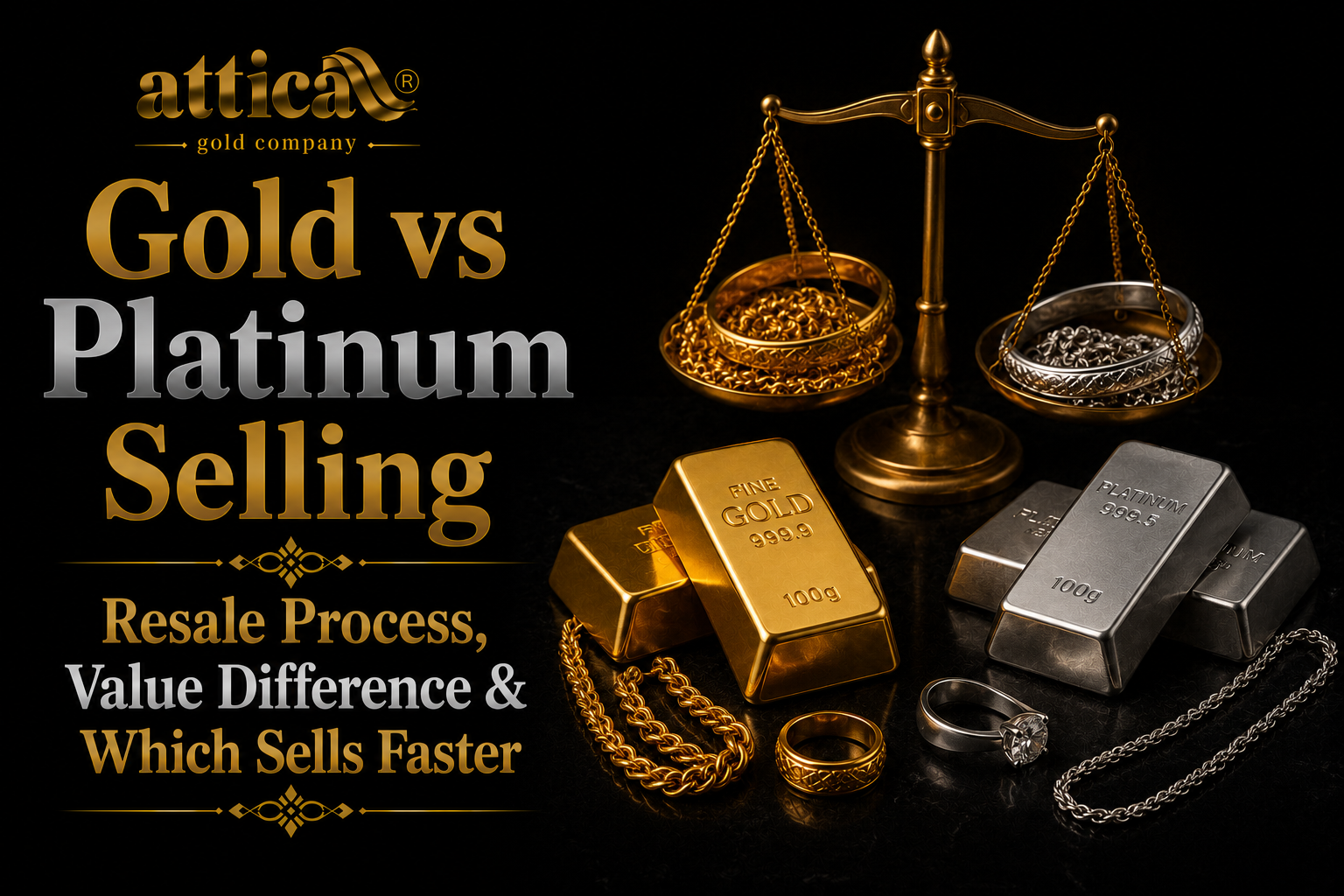
Two Precious Metals, Two Different Resale Markets
Anyone who owns both platinum and gold in their jewellery box quickly realises the two metals do not behave the same way at resale. A 10-gram gold chain can be turned into cash within an hour at any branch in any major Indian city. A 10-gram platinum ring may need a phone call ahead, a specialist buyer, and sometimes two or three days for settlement. Both are precious metals; both are PMLA-regulated; both pass through XRF testing and the standard KYC. The difference is liquidity – and at today’s prices, gold has roughly twice the per-gram value of platinum and ten times the resale market depth.
This guide is a practical comparison for anyone holding mixed metal jewellery and trying to decide which to sell first, or anyone wondering whether platinum is the “better investment” for resale. We walk through today’s per-gram price difference, how XRF testing works for both metals, the size of the Indian platinum resale market, the typical settlement time, and the realistic decisions facing a seller in 2026. Read it once, and you will know exactly what each metal in your collection is worth and how to convert it cleanly.
Today’s Live Rates Compared
| 24K Gold (999 purity) | ₹14,962 per gram |
| 22K Gold (916 purity) | ₹13,715 per gram |
| 18K Gold (750 purity) | ₹11,222 per gram |
| Platinum (PT950, 95% purity) | ~₹7,425 per gram |
| Platinum vs 22K Gold (gap) | Platinum ~46% lower per gram |
| Reference Date | 5 May 2026 (IBJA + Indian retail) |
| Rate Source | IBJA for gold; LBMA + retail markup for platinum |
| Daily Volatility | Gold ±0.5%, Platinum ±1–2% (thinner market) |
The Per-Gram Price Reality
In May 2026, the platinum vs gold price gap is at one of its widest points in the last decade. Gold has rallied past ₹14,000 per gram on the back of central-bank buying, geopolitical risk premium and steady Indian retail demand. Platinum, despite being rarer than gold by mass produced annually, has stayed under ₹8,000 per gram because its industrial demand (catalytic converters, electronics) has softened,d and its jewellery demand in India remains a niche market. The platinum price India most retail customers see is the LBMA London Platinum Fix translated into rupees, plus a small retail markup at jewellers like Tanishq and Joyalukkas.
Use the live Gold rate widget below to compare today’s actual figures for both metals before deciding which to sell. The relative gap moves daily.
How XRF Tests Both Metals
The good news for sellers is that the same XRF (X-ray fluorescence) machine used for gold testing also tests platinum. The spectrometer fires low-energy X-rays at the surface of the jewellery and reads the elemental composition by the characteristic emission lines of each element. Gold (Au) shows at one set of lines; platinum (Pt) at another; palladium, silver, copper and other alloying metals each at their own. The reading is non-destructive, takes 15–30 seconds per piece, and is accurate to ±0.1% for both metals.
Two practical differences in testing:
- Platinum is often alloyed with a small amount of cobalt or ruthenium for hardness. The XRF will show this; reputable buyers subtract the alloy weight before applying the per-gram rate.
- Indian platinum jewellery is mostly stamped PT950 (95% pure) under the De Beers / Platinum Guild standard. Cheaper imported pieces may be PT900 or PT850 – the XRF reveals the actual purity, and the per-gram rate is applied to the tested fineness.
Which Sells Faster: Gold or Platinum?
| Aspect | Gold | Platinum |
| Branches accepting in India | 5,000+ organised buyers | 500–800 specialist buyers |
| Same-day cash possible | Yes (any branch with XRF) | Sometimes – call ahead |
| Typical settlement time | 20–40 minutes | 1–3 hours, sometimes the next day |
| Per-gram price | Higher (~₹13,700 for 22K) | Lower (~₹7,425 for PT950) |
| Refining margin | 1–2% on coins, 0% on jewellery | 3–5% (smaller refining market) |
| Buyer competition | High – multiple quotes per city | Low – fewer comparison options |
| Liquidity in Tier-2/3 cities | Strong | Limited |
In every meaningful dimension, gold sells faster, more transparently, and at higher per-gram realisation in India. Platinum jewellery resale exists, but it is essentially a metropolitan market – Bangalore, Mumbai, Delhi, Hyderabad and Chennai have specialist buyers who handle PT950 routinely. Outside those cities, you may need to travel or ship the piece to a metro branch. For sellers prioritising speed and convenience, gold first is almost always the right call.
When Selling Platinum Makes Sense
Despite the liquidity disadvantage, several situations favour selling platinum:
- You own a platinum piece you no longer wear and have no emotional attachment – keeping it idle locks ₹50,000–₹2,00,000 of liquid value.
- You are diversifying out of jewellery into financial assets – the proceeds from selling a single platinum ring can fund several SGB or ETF units.
- Your holding includes both gold and platinum, and you want to liquidate the smaller-emotional-value pieces first – platinum is often the choice because it lacks the cultural weight of bridal gold.
- You inherited platinum jewellery from a relative whose taste differs from yours – selling and reinvesting in something you would actually wear (or hold) makes more sense than storage.
In all four cases, planning matters. Call the buyer one day before, confirm they handle platinum, ask whether the per-gram rate is locked or floating, and bring proper KYC documents.
💰 Get the Best Price for Your Gold Today
Instant valuation • Transparent pricing • 100% secure & trusted
The Platinum vs Gold Investment Question
A common framing – “Is platinum a better investment than gold?” – usually misses the point for Indian household sellers. Globally, platinum has underperformed gold over the last 15 years; the platinum vs gold investment ratio (platinum price ÷ gold price) has fallen from 2.0x in 2008 to under 0.5x in 2026. This is partly because platinum’s biggest demand source (auto catalysts) is shrinking with the move to electric vehicles, while gold’s demand from central banks and Indian/Chinese households is structurally stable.
For an Indian seller, the practical implication is that gold holds resale value more reliably year over year, while platinum is more volatile and more dependent on industrial cycles. This does not mean platinum is “bad” – for jewellery design and durability, platinum has unique advantages – but as a cash-out asset, gold is the cleaner option. A diversified household typically holds 80%+ in gold and the rest in platinum jewellery for specific pieces.
Common Mistakes When Selling Platinum
- Walking into a generic gold buyer expecting platinum service – many buyers do not have specialist scales for the higher density of platinum (21.45 g/cc vs gold’s 19.32 g/cc).
- Accepting a “we will price it at gold rate” offer – platinum has its own rate, lower than gold but still significant; gold-rate pricing under-pays you by 50%+.
- Not separating platinum from white gold – they look similar but have very different per-gram values; XRF will distinguish, but the seller should know the difference upfront.
- Skipping the call-ahead – platinum may not be in stock at every branch; calling avoids a wasted trip.
- Assuming the international platinum spot price applies directly – Indian retail platinum carries a 3–8% markup at sale, and a similar discount at resale.
A Practical Selling Plan for Mixed Holdings
For a household with both metals, a sensible sequence is to start with whichever piece you wear least and have the smallest emotional attachment to. Most Indian families find this to be platinum jewellery rather than 22K bridal gold. Selling a single PT950 ring frees ₹50,000–₹2,00,000 of liquid value without touching the cultural-heritage gold pieces that may have decades of memory attached. The metallurgical process, the KYC, and the invoicing – all are handled identically for both metals at a properly equipped buyer.
When a larger cash-out is needed, the maths still favours selling gold first because the per-gram realisation is roughly twice as high – fewer pieces to part with for the same rupee target. A 50g 22K gold sale and a 50g platinum sale are treated identically by the buyer, but yield ₹6.85 lakh and ₹3.5 lakh respectively. The sequence depends on the seller’s priorities: if the goal is minimum pieces sold, lead with gold; if the goal is keeping the bridal heritage intact, lead with platinum.
Why Choose Attica Gold for Mixed Metal Selling
A serious buyer should be able to handle gold and platinum on the same XRF protocol with consistent transparency – live rate displayed openly, in-presence testing, written line-by-line invoice, and KYC-compliant settlement. Many buyers handle one well and the other poorly. The right buyer treats both metals to the same standard so that, whether you walk in with 22K bridal gold or a PT950 ring, the experience is identical and the price is fair.
Attica Gold runs the same protocol at every one of its 200+ branches across Karnataka, Tamil Nadu, Andhra Pradesh, Telangana and Pondicherry – calibrated XRF for both metals, today’s live rate displayed openly (gold linked to IBJA, platinum to LBMA + Indian retail benchmark), written line-by-line invoice, KYC at the counter, and settlement through cash, UPI, IMPS or RTGS depending on amount. ISO 9001:2015 certification means the same standard at every branch, every day. If you have been holding mixed precious-metal jewellery and wondering which to sell first, your wait is over. Walk in, watch the test, take the cash on whichever metal makes sense for you.
Frequently Asked Questions
What is the price difference between gold and platinum in India today?
As of 5 May 2026, 22K gold trades at around ₹13,715 per gram while PT950 platinum trades at around ₹7,425 per gram – a roughly 46% gap in favour of gold. The platinum vs gold price ratio has widened over the last decade because gold demand has stayed strong (central banks, retail) while platinum’s biggest industrial demand source (auto catalysts) has softened with the move to electric vehicles.
Can I sell platinum jewellery in India easily?
Platinum jewellery resale exists but is concentrated in metropolitan areas – Bangalore, Mumbai, Delhi, Hyderabad and Chennai have specialist buyers who handle PT950 routinely. Outside metros, you may need to call branches ahead or travel to a city centre. The XRF testing process is identical to gold, and KYC requirements (Aadhaar, PAN above ₹2 lakh) are the same. Settlement typically takes 1–3 hours rather than the 20–40 minutes for gold.
How is platinum jewellery resale priced?
Platinum jewellery resale follows the same formula as gold: weight × tested purity × current per-gram rate − deductions. The per-gram rate is benchmarked to the LBMA London Platinum Fix translated to rupees, with a small refining margin (3–5%, slightly higher than gold’s 1–2% because the platinum refining market in India is smaller). Reputable buyers test purity via XRF in the seller’s presence and provide a written line-by-line quote.
Why is platinum cheaper than gold despite being rarer?
Although platinum is rarer than gold by annual mining production, demand drives price more than supply. Gold demand is structurally supported by central-bank reserves, Indian and Chinese household buying, and investment ETFs. Platinum demand is dominated by industrial use (auto catalysts, electronics), which is shrinking with the EV transition. Together, this has pushed the platinum vs gold investment ratio from 2.0x in 2008 to under 0.5x in 2026.
How does an XRF test platinum compared to gold?
The same XRF spectrometer reads both metals – it identifies elements by their characteristic X-ray emission lines. Gold (Au) and platinum (Pt) have distinct lines that the machine reads in 15–30 seconds without damaging the piece. The XRF also reveals alloying metals like cobalt or ruthenium (for platinum) or copper and silver (for gold), and reputable buyers subtract alloy weight before applying the per-gram rate to the actual gold or platinum content.
Should I sell the platinum vs the gold investment first?
For most Indian households, gold sells faster, at a higher per-gram value, with more buyer competition and lower refining margins. Platinum tends to make sense to sell first only if (a) you do not wear the piece and have no attachment, (b) you are diversifying into financial assets, or (c) you are in a metro with multiple platinum buyers offering competitive quotes. Otherwise, gold first, platinum on a planned schedule.
Is the platinum price in India the same as the international rate?
Indian platinum retail and resale rates derive from the LBMA Platinum Fix translated at the day’s INR-USD rate, plus or minus a markup/discount of 3–8% depending on whether you are buying or selling. The platinum price that most retail buyers see at Tanishq, Joyalukkas, or BHIMA includes that markup. At resale, expect a discount in the same range bas theinternational spot.
Can I sell platinum jewellery in India without a bill?
Yes – like gold, a bill is not legally required to sell platinum jewellery in India. Reputable buyers test purity via XRF in your presence and apply the day’s rate to the tested fineness. Aadhaar (mandatory) and PAN (above ₹2 lakh) are the only essential documents. The bill is helpful as an audit trail, but not a precondition. Always insist on a written line-by-line invoice from the buyer.
{ “@context”: “https://schema.org”, “@type”: “FAQPage”, “mainEntity”: [ { “@type”: “Question”, “name”: “What is the price difference between gold vs platinum in India today?”, “acceptedAnswer”: { “@type”: “Answer”, “text”: “As of 5 May 2026, 22K gold trades at around ₹13,715 per gram while PT950 platinum trades at around ₹7,425 per gram – a roughly 46% gap in favour of gold. The platinum vs gold price ratio has widened over the last decade because gold demand has stayed strong (central banks, retail) while platinum’s biggest industrial demand source (auto catalysts) has softened with the move to electric vehicles.” } }, { “@type”: “Question”, “name”: “Can I sell platinum jewellery in India easily?”, “acceptedAnswer”: { “@type”: “Answer”, “text”: “Platinum jewellery resale exists but is concentrated in metropolitan areas – Bangalore, Mumbai, Delhi, Hyderabad and Chennai have specialist buyers who handle PT950 routinely. Outside metros, you may need to call branches ahead or travel to a city centre. The XRF testing process is identical to gold, and KYC requirements (Aadhaar, PAN above ₹2 lakh) are the same. Settlement typically takes 1–3 hours rather than the 20–40 minutes for gold.” } }, { “@type”: “Question”, “name”: “How is platinum jewellery resale priced?”, “acceptedAnswer”: { “@type”: “Answer”, “text”: “Platinum jewellery resale follows the same formula as gold: weight × tested purity × current per-gram rate − deductions. The per-gram rate is benchmarked to the LBMA London Platinum Fix translated to rupees, with a small refining margin (3–5%, slightly higher than gold’s 1–2% because the platinum refining market in India is smaller). Reputable buyers test purity via XRF in the seller’s presence and provide a written line-by-line quote.” } }, { “@type”: “Question”, “name”: “Why is platinum cheaper than gold despite being rarer?”, “acceptedAnswer”: { “@type”: “Answer”, “text”: “Although platinum is rarer than gold by annual mining production, demand drives price more than supply. Gold demand is structurally supported by central-bank reserves, Indian and Chinese household buying, and investment ETFs. Platinum demand is dominated by industrial use (auto catalysts, electronics), which is shrinking with the EV transition. Together, this has pushed the platinum vs gold investment ratio from 2.0x in 2008 to under 0.5x in 2026.” } }, { “@type”: “Question”, “name”: “How does XRF test platinum compared to gold?”, “acceptedAnswer”: { “@type”: “Answer”, “text”: “The same XRF spectrometer reads both metals – it identifies elements by their characteristic X-ray emission lines. Gold (Au) and platinum (Pt) have distinct lines that the machine reads in 15–30 seconds without damaging the piece. The XRF also reveals alloying metals like cobalt or ruthenium (for platinum) or copper and silver (for gold), and reputable buyers subtract alloy weight before applying the per-gram rate to the actual gold or platinum content.” } }, { “@type”: “Question”, “name”: “Should I sell platinum vs gold investment first?”, “acceptedAnswer”: { “@type”: “Answer”, “text”: “For most Indian households, gold sells faster, at a higher per-gram value, with more buyer competition and lower refining margins. Platinum tends to make sense to sell first only if (a) you do not wear the piece and have no attachment, (b) you are diversifying into financial assets, or (c) you are in a metro with multiple platinum buyers offering competitive quotes. Otherwise, gold first, platinum on a planned schedule.” } }, { “@type”: “Question”, “name”: “Is the platinum price in India the same as the international rate?”, “acceptedAnswer”: { “@type”: “Answer”, “text”: “Indian platinum retail and resale rates derive from the LBMA Platinum Fix translated at the day’s INR-USD rate, plus or minus a markup/discount of 3–8% depending on whether you are buying or selling. The platinum price that most retail buyers see at Tanishq, Joyalukkas or BHIMA includes that markup. At resale, expect a discount in the same range below international spot.” } }, { “@type”: “Question”, “name”: “Can I sell platinum jewellery in India without a bill?”, “acceptedAnswer”: { “@type”: “Answer”, “text”: “Yes – like gold, a bill is not legally required to sell platinum jewellery in India. Reputable buyers test purity via XRF in your presence and apply the day’s rate to the tested fineness. Aadhaar (mandatory) and PAN (above ₹2 lakh) are the only essential documents. The bill is helpful as an audit trail, but not a precondition. Always insist on a written line-by-line invoice from the buyer.” } } ] }Holding mixed gold and platinum jewellery,y you want to convert to cash?
Visit your nearest Attica Gold branch – XRF testing for both metals, live rate displayed openly, instant payment.
Get Instant Valuation
Free evaluation · No obligation · Instant offer
🔒 Your details are safe and confidential