⚡ Quick Answer
Gold tax in india treats gold sale as a capital gain. If gold was held >24 months: long-term capital gains tax on gold (LTCG on gold) at 12.5% without indexation (post-July 2024 rules). If held ≤24 months: short-term, taxed at your slab rate. ITR filing gold sale steps: (1) calculate cost basis (original purchase price or fair market value as on April 1, 2001 if older); (2) calculate net sale proceeds; (3) compute capital gain; (4) report under Schedule CG of ITR-2 or ITR-3; (5) pay tax via challan ITNS 280 if liability exceeds TDS already deducted. Important: this is general information, not tax advice – consult a CA for your specific situation.
📌 Key Facts At A Glance
- Tax on gold in india on sale: long-term capital gains tax on gold = 12.5% (post-July 23, 2024 rules); short-term = your income tax slab rate.
- Holding period for LTCG on gold: more than 24 months from date of acquisition (revised from 36 months in Budget 2024).
- Cost basis: original purchase price + acquisition costs; for gold acquired before April 1, 2001, you can use FMV as on that date.
- ITR filing gold sale: capital gains reported in Schedule CG of ITR-2 (salaried) or ITR-3 (business income).
- Indexation benefit on gold LTCG: NOT available for transfers on/after July 23, 2024 (post-Budget 2024 amendment).
- How to show gold sale in ITR: enter sale value, cost basis, holding period, and net gain in Schedule CG, Section B (LTCG) or A (STCG).
- Inherited gold: cost basis = original owner’s purchase price; holding period includes their period of holding.
Why Gold Tax in India Matters at ITR Time
Selling gold is a taxable event in India. Whether you sell 50 grams of family jewellery for ₹3.5 lakh or 500 grams of inherited bullion for ₹35 lakh, the gain on sale is a capital gain that you must report in your Income Tax Return (ITR). The gold tax in india framework – and specifically the rules for tax on selling gold in india – treats gold like any other capital asset: holding period determines whether it’s short-term or long-term; cost basis determines the gain; the gain is added to your taxable income (or taxed at a flat rate, depending on holding period and Budget 2024 changes).
This guide walks through ITR filing gold sale step-by-step: how the law works, how to compute the gain correctly, which ITR form to use, how to fill Schedule CG, and how to pay any residual tax liability. It is general information for educational purposes; please consult a Chartered Accountant for advice tailored to your specific situation, especially if the amounts are large or your situation is complex.
Holding Period: Short-Term vs LTCG on Gold
The first determination: how long did you hold the gold before selling?
| Holding period | Classification | Tax treatment |
| ≤ 24 months | Short-term capital gain (STCG) | Added to income; taxed at slab rate |
| > 24 months (post-July 23, 2024) | Long-term capital gain (LTCG) | 12.5% flat, NO indexation |
| > 24 months (sold before July 23, 2024) | LTCG (old rules) | 20% with indexation |
| Inherited gold | Use original owner’s holding period | Usually LTCG |
Important: Budget 2024 changed both the holding-period threshold (from 36 months to 24 months) and the tax rate structure (from 20% with indexation to 12.5% without indexation). For sales completed on or after July 23, 2024, the new rules apply. Sales before that date follow the old framework.
- Also Read: Live Gold Price Today
Cost Basis: What Counts as Acquisition Cost
To compute the capital gain, you need the gold’s cost basis (acquisition cost). Sources of cost basis:
- Original purchase invoice – the rate you paid when buying the gold (preferred and most defensible).
- If purchased before April 1, 2001 – you may use Fair Market Value (FMV) as on April 1, 2001 (gold rate that day was approximately ₹4,400 per 10 grams).
- Inherited / gifted gold – cost basis = the original owner’s acquisition cost; holding period includes the original owner’s period.
- No documentation available – you may need to estimate based on family records, bank locker entries, or use FMV as on April 1, 2001 if the gold is clearly that old. Document your reasoning carefully – the assessing officer may ask.
Always keep digital copies of original invoices in cloud storage. They are the single most important document for ITR filing gold sale, often more important than the sale receipt.
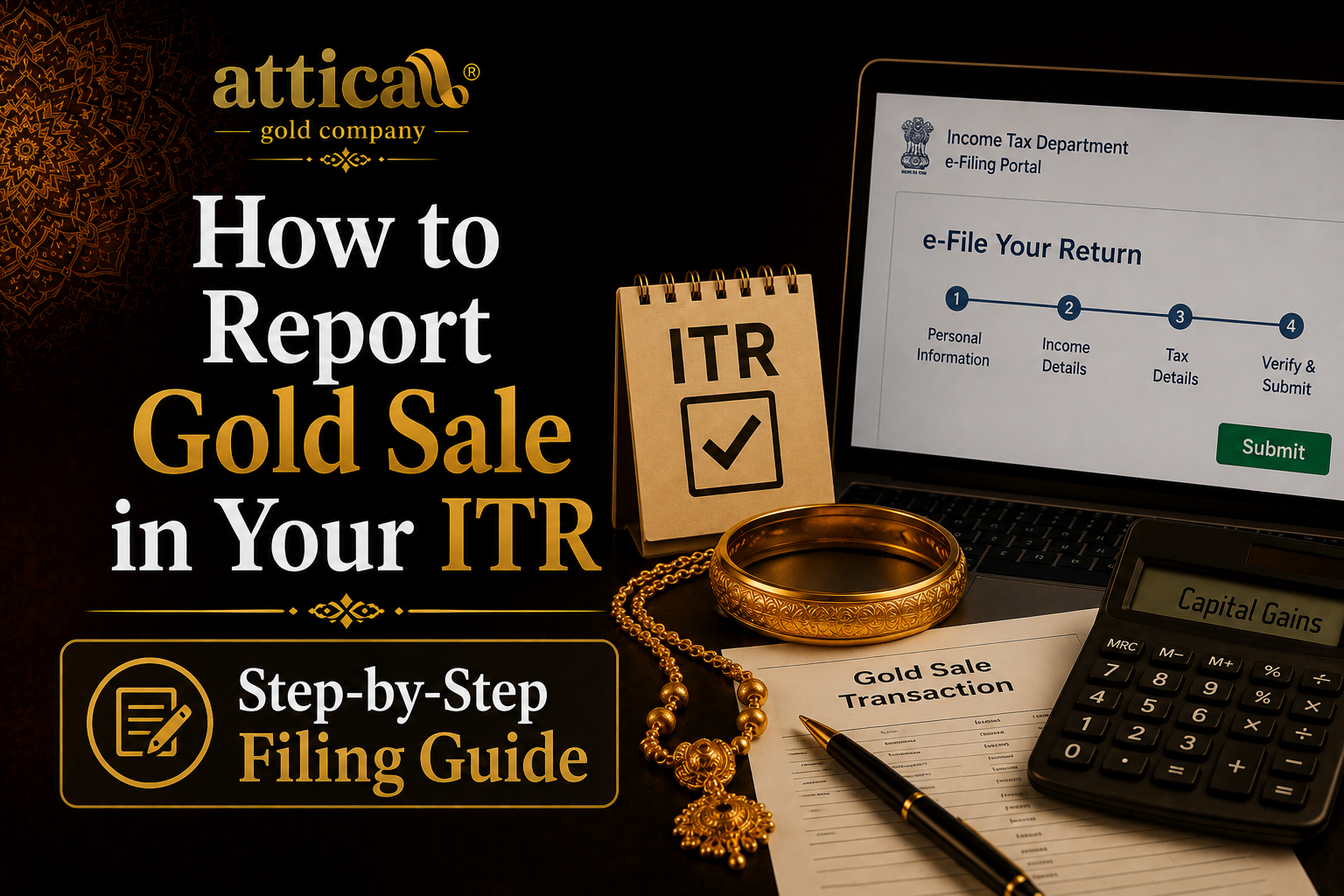
Step-by-Step ITR Filing Gold Sale Process
- Gather documents: original purchase invoice (or FMV-based estimate), sale receipt from buyer with weight/purity/rate/net amount, Form 26AS (to verify TDS, if any), buyer’s GSTIN-stamped invoice.
- Compute net sale value: sale price minus selling expenses (e.g., transportation, valuer’s fee if applicable). For most sellers, sale price = net amount on the buyer’s invoice.
- Compute cost basis: original purchase price + cost of acquisition expenses (making charges, GST paid at purchase). For pre-April 2001 gold, use FMV as on April 1, 2001 (₹4,400/10g approx).
- Compute capital gain: net sale value minus cost basis. If holding >24 months, gain is LTCG at 12.5%. Else STCG at slab.
- Choose ITR form: ITR-2 if you have salary + capital gains and no business income; ITR-3 if you have business income too.
- Login to incometax.gov.in; open the relevant ITR form. Navigate to Schedule CG (Capital Gains).
- How to show gold sale in ITR: under ‘B’ (LTCG, Section 112) or ‘A’ (STCG, Section 111A doesn’t apply to gold; use ‘others’ STCG section). Enter: full value of consideration (sale value), cost of acquisition, expenses on transfer, and capital gain.
- Compute total tax including the LTCG on gold component. Pay any balance via challan ITNS 280 (Self-Assessment Tax) if your total liability exceeds TDS already deducted.
- Verify the return – Aadhaar OTP, EVC, or signed ITR-V mailed to CPC Bengaluru. Save the acknowledgement (ITR-V) as final proof.
Worked Example: 50g of Family Gold Sold in 2026
You sell 50 grams of 22K family gold in May 2026 for ₹3,50,000 (after deductions). The gold was purchased in 1995. Since you don’t have the original 1995 invoice, you use FMV as on April 1, 2001: ₹4,400 per 10g × 5 (50g) = ₹22,000. Cost basis = ₹22,000.
Sale value = ₹3,50,000. LTCG = ₹3,50,000 − ₹22,000 = ₹3,28,000. Tax: 12.5% × ₹3,28,000 = ₹41,000 + applicable cess (4%) = ₹42,640. This is the capital gains tax on gold for this transaction.
Where to file: ITR-2 (assuming salary + capital gain), Schedule CG, Section B for LTCG, with cost basis of ₹22,000 and proceeds of ₹3,50,000. Pay ₹42,640 via Challan 280 if not already covered by TDS. Done.
Special Cases
1. Inherited Gold
Holding period includes the original owner’s period. Cost basis = original owner’s purchase price. If the original owner acquired pre-April 2001, you can use FMV as on April 1, 2001. The gold inheritance itself isn’t taxed; only the eventual sale is.
2. Gifted Gold (from Relative)
Gift from specified relatives (parent, spouse, sibling, etc.) is exempt from gift tax. Cost basis on subsequent sale = donor’s acquisition cost; holding period includes donor’s period. Gift from non-relatives above ₹50,000 in aggregate per year is taxed as ‘income from other sources’ at slab rate.
3. Sovereign Gold Bond Maturity
If you redeemed an SGB at maturity (after 8 years), the capital gain is fully tax-exempt. If sold before maturity on the secondary market, normal LTCG / STCG rules apply.
4. Gold ETF / Digital Gold
Gold ETFs and digital gold follow the same LTCG/STCG rules as physical gold post-Budget 2024. Earlier (before March 31, 2023), gold mutual funds and gold ETFs had a different treatment; verify the year of sale to confirm applicable rules.
💰 Get the Best Price for Your Gold Today
Instant valuation • Transparent pricing • 100% secure & trusted
Common ITR Filing Mistakes for Gold Sales
- Forgetting to report at all – Income Tax Department’s data sharing with banks (high-value transactions reported on Statement of Financial Transactions / SFT) means large gold sales often get flagged.
- Using post-July 2024 rules for a sale completed before July 23, 2024 – old indexation rules still apply for those.
- Ignoring small gains – even a ₹50,000 gain must be reported if you cross the basic exemption + the small-asset threshold.
- Reporting under wrong section – gold is ‘other capital asset’, NOT ‘listed equity’ (Section 111A); use the ‘others’ LTCG section.
- Not paying advance tax – if your total tax (including LTCG on gold) exceeds ₹10,000, advance tax in 4 instalments is required; otherwise interest under Section 234B/234C applies.
Why a CA Review Helps
Tax law is technical. The above guide covers standard cases, but every taxpayer has nuances: residency status, multiple income heads, set-off of capital losses, HUF vs individual treatment, foreign asset disclosure (Schedule FA), advance-tax liability, etc. A Chartered Accountant familiar with capital gains can: validate your cost-basis assumption, optimise indexation choice (where applicable), ensure correct ITR form selection, and handle scrutiny correspondence if it arises. CA fees for a single capital gains case typically range from ₹1,500 to ₹5,000 – modest insurance against a wrong filing.
Why Choose Attica Gold for Your Sale (and Get the Receipt You Need for ITR) – Your Wait Is Over
Tax on gold in india is straightforward once you know the rules: holding period determines short vs long term; cost basis determines the gain; capital gains tax on gold (LTCG on gold) applies at 12.5% without indexation post-July 2024, or at slab rate for short-term. ITR filing gold sale takes one Schedule CG entry per transaction. Keep your purchase invoice and sale receipt – both are critical.
Attica Gold makes the sale-side documentation airtight: every sell-gold transaction generates a printed GSTIN-stamped invoice with weight, purity, IBJA rate, deductions, and net amount – exactly what your CA needs for Schedule CG. ISO 9001:2015 certified, ~200+ branches across South India, IBJA-linked rates, NEFT/RTGS payment, full digital and physical receipts. Whether you’re selling to fund a goal or planning an inheritance distribution, our process supports clean, audit-ready documentation. Your wait is over.
Frequently Asked Questions
What’s the current capital gains tax on gold in India for FY 2025-26?
For sales completed on or after July 23, 2024: Long-term (held >24 months) is taxed at 12.5% flat without indexation, plus applicable cess. Short-term (held ≤24 months) is taxed at your income slab rate. For sales before that date, old rules of 20% with indexation apply for LTCG. Always verify with a CA – Budget changes can supersede general guidance.
Do I need to pay tax on gold in india if the sale value is small?
Yes – there’s no separate small-amount exemption for capital gains. The gain is added to your total income; if your total taxable income exceeds the basic exemption limit (₹3 lakh under new regime, ₹2.5 lakh under old), tax is payable. Even a ₹20,000 gain on small gold sale must be reported and is part of your Schedule CG.
How do I show gold sale in ITR if I don’t have the original purchase invoice?
If the gold was acquired before April 1, 2001, you can use the Fair Market Value as on April 1, 2001 (gold was ₹4,400 per 10g approximately) as your cost basis. If acquired after but with no invoice, estimate based on family records, contemporaneous bank locker entries, or insurance valuations. Document your reasoning. For high-value sales, consult a CA – the assessing officer may ask for justification.
Is LTCG on gold from inherited jewellery taxed differently?
No – same 12.5% flat rate applies (post-July 2024). Cost basis = original owner’s acquisition cost; holding period includes original owner’s period. The inheritance itself isn’t taxed; only the eventual sale generates a capital gain. Keep documents proving inheritance (will, succession certificate).
Do I need to file ITR if my only income is from selling gold?
If the capital gain alone (or combined with any other income) exceeds the basic exemption limit, yes – ITR filing is mandatory. Even below the limit, filing creates an audit trail for source-of-funds proof, especially for large gold sales. Most CAs recommend filing whenever a meaningful sale occurs.
Can I claim indexation on gold bought in 2010 and sold in 2026?
Generally no – for transfers on/after July 23, 2024, indexation has been removed for gold LTCG. The new regime is 12.5% flat without indexation. Older transfers (pre-July 2024) used 20% with indexation. The change typically results in lower tax for short-held assets and slightly higher tax for very long-held assets where indexation would have given a large benefit.
What if I forgot to report a gold sale in my ITR last year?
File a revised return under Section 139(5) if within the time window (typically 12 months from end of assessment year). If beyond that, an updated return under Section 139(8A) can be filed within 24 months from end of relevant AY, with additional tax. Consult a CA for the right route given your specific assessment year and timeline.
Is there gold tax in india on sale at the buyer’s end (TCS)?
Yes – Tax Collected at Source (TCS) at 1% applies to gold purchases by buyers exceeding ₹2 lakh in cash, but the rules are evolving. The TCS is collected at the time of sale and credited to your PAN. You can claim it as a refund/adjustment in your ITR. See our separate guide on TCS for details.
Sources & References
This page references and is informed by the following authoritative sources. Last verified: May 2026.
[1] Income Tax Act, 1961 – Sections 45, 48, 49, 54F (Capital Gains) – Income Tax Department, Government of India. https://www.incometax.gov.in/
[2] Finance Act 2024 – Capital Gains Tax Rate Amendments – Ministry of Finance, Government of India. https://www.indiabudget.gov.in/
[3] Schedule CG Filing Guide (ITR-2, ITR-3) – Income Tax Department, Government of India. https://www.incometax.gov.in/
[4] Cost Inflation Index & FMV as on April 1, 2001 – Central Board of Direct Taxes (CBDT). https://incometaxindia.gov.in/
[5] Daily Gold Reference Rate (FMV verification) – India Bullion and Jewellers Association (IBJA). https://ibja.co/
Make ITR filing easier
Attica Gold issues full GSTIN-stamped invoices with weight, purity, IBJA rate, deductions, net amount. Perfect for Schedule CG.