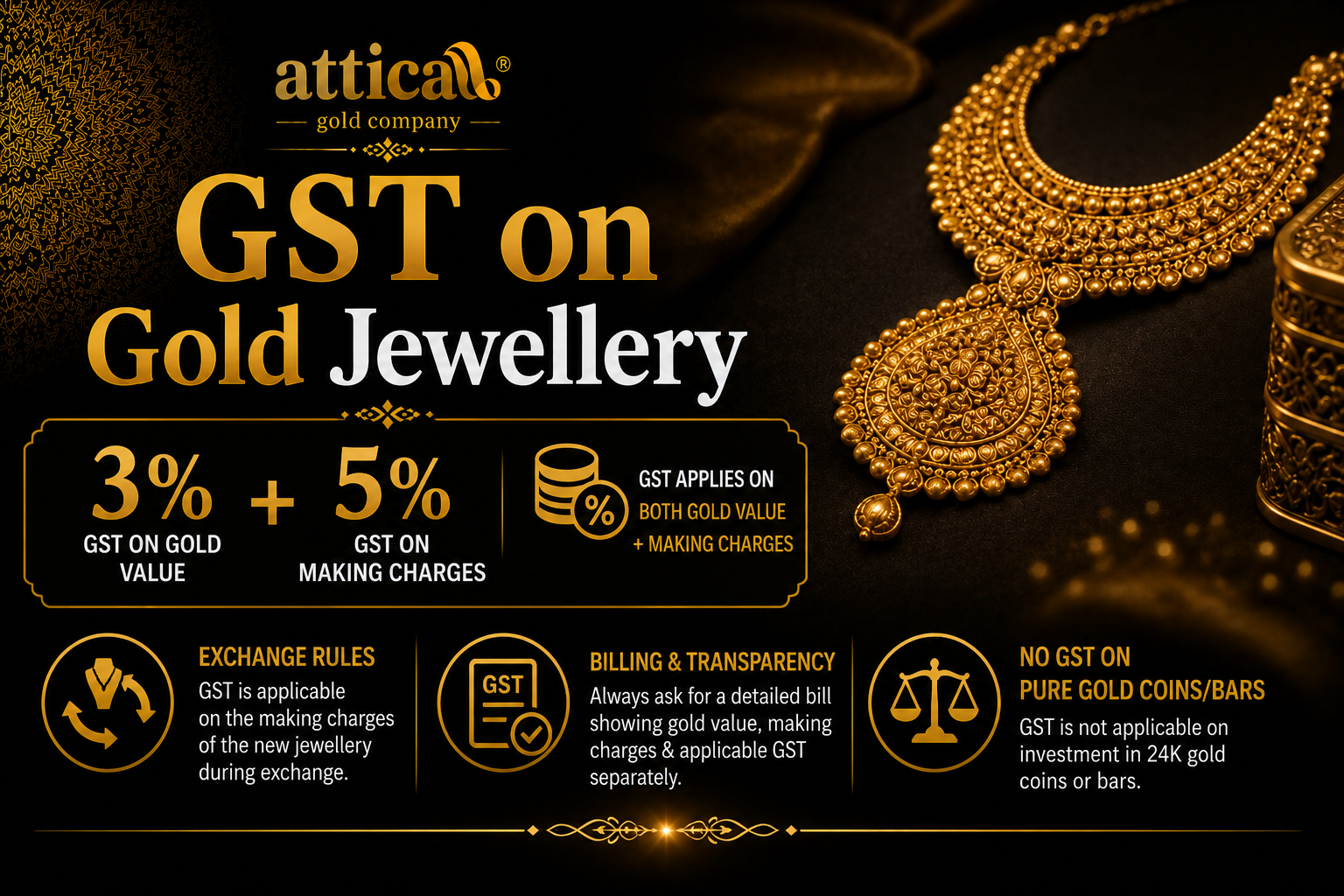
Why GST on Gold Jewellery Costs You More Than the 3% You Expect
Almost every Indian jewellery buyer remembers the headline number – “3% GST on gold”. What most do not realise is that the 3% applies only to the gold value of a piece. Making charges (the labour cost the jeweller adds for fabricating the chain, ring or set) attract a separate 5% GST. So a typical hallmarked jewellery purchase carries roughly 3.6–4.5% effective GST on the total invoice, depending on the making-charge percentage. On a ₹2 lakh chain, that is ₹7,200–₹9,000 of GST – significantly more than the simple “3% on ₹2 lakh = ₹6,000” mental shortcut most buyers use. Understanding GST on gold jewellery in its full two-rate form is the difference between accurately budgeting a purchase and being surprised at the counter.
This guide walks through the complete GST mechanics for jewellery transactions in India in 2026 – the 3%/5% split, hallmarked vs unhallmarked treatment, how exchange offers affect the GST calculation, refund rules, and what every line on a jewellery invoice should look like under correct GST practice. Read it once, and you will know exactly how to verify any jewellery bill before signing it.
GST on Gold Jewellery at a Glance
| GST on Gold Value | 3% (since 1 July 2017) |
| GST on Making Charges | 5% (since 18 July 2022) |
| Effective GST (typical 15% making %) | ~3.6% of the total invoice |
| Effective GST (high 25% making %) | ~4.5% of the total invoice |
| Hallmarked vs Unhallmarked | Same GST rate; hallmarking is a separate BIS regulation |
| Old Gold Exchange | GST applies to the net new-purchase value (gross minus old-gold credit) |
| GST on Sale (seller side) | Zero – old gold sale by an individual is outside the GST scope |
| Today’s 22K Reference Rate | ₹13,675 per gram (6 May 2026, IBJA) |
The 3% + 5% Stack: How GST Actually Builds Up
Before July 2022, jewellery-making charges attracted only 3% GST (treated the same as gold value). The 47th GST Council meeting changed this, making charges were reclassified as a separate service supply attracting 5% GST. The result is the current two-rate structure that confuses most retail buyers. The mechanics are best illustrated through a worked example.
Take a 22K hallmarked chain weighing 10 grams. Today’s rate is ₹13,675/g, so the gold value is ₹1,36,750. The jeweller charges 15% making (typical for a machine-made chain) = ₹20,513. The 3% GST applies to ₹1,36,750 = ₹4,103. The 5% GST applies to ₹20,513 = ₹1,026. Total invoice: ₹1,62,392. Total GST: ₹5,129. As a percentage of the total invoice, GST is 3.16%. As a percentage of the gold value alone, GST is 3.75%. Both readings are correct depending on which denominator you use.
Today’s Live Rate: The Number of GST Stacks On Top Of
Every GST on gold jewellery calculation begins with the day’s live IBJA rate × tested purity × weight. GST is then layered on top. Use the widget below to confirm today’s 22K rate (the most common Indian wedding jewellery purity), 24K rate (for coins and bars), and 18K rate (for diamond settings) before any showroom purchase or sale.
Worked Example: GST Across Three Different Making Percentages
| Line Item | 15% Making (chain) | 25% Making (bridal set) |
| 10g 22K gold value | ₹1,36,750 | ₹1,36,750 |
| Making charges | ₹20,513 (15%) | ₹34,188 (25%) |
| 3% GST on gold | ₹4,103 | ₹4,103 |
| 5% GST on making | ₹1,026 | ₹1,709 |
| Total Invoice | ₹1,62,392 | ₹1,76,750 |
| Total GST | ₹5,129 (3.16% of invoice) | ₹5,812 (3.29% of invoice) |
| Effective GST as % of gold value | 3.75% | 4.25% |
Notice the structural pattern: as the percentage rises, the effective GST as a percentage of the gold value rises too, because the 5% on making becomes a larger absolute number relative to the gold body. For ornate bridal sets with 25–30% making charges, the effective GST creeps toward 4.5%. For simple machine-made chains with 8–10% making, it drops below 3.5%. This is why high-design jewellery is structurally more GST-expensive than plain bullion.
Hallmarked vs Unhallmarked: Same GST, Different Compliance
A common confusion is whether GST varies between hallmarked (BIS) and unhallmarked jewellery. The answer is no – the GST rate on gold is uniform at 3% on gold value plus 5% on making, regardless of hallmark status. What differs is the legality of the sale itself. Since June 2021, the sale of unhallmarked gold jewellery above 14 carat by registered jewellers in 288 notified districts is illegal under the BIS Act, irrespective of GST treatment. So an unhallmarked piece sold to you in a covered district is a regulatory issue (not a tax one) – but if your jeweller does sell it, GST is identical to the hallmarked equivalent.
The seller’s side is the same – when you sell old gold for cash, neither hallmarked nor unhallmarked attracts seller GST. Both are treated as personal effects sales outside the GST scope. Hallmarked pieces speed up the buyer’s purity verification (HUID lookup on the BIS Care app) but do not affect the cash payout formula or any GST line on the receipt.
💰 Get the Best Price for Your Gold Today
Instant valuation • Transparent pricing • 100% secure & trusted
GST on Old-Gold Exchange Offers: Where the Real Savings Are Misunderstood
When you exchange old gold against a new piece, GST applies only on the differential – the new piece price minus the old-gold credit. So if you exchange ₹2 lakh of old gold against a ₹5 lakh new bridal set, GST is calculated on the ₹3 lakh net, not on the ₹5 lakh gross. At first glance, this seems to favour exchange – you save the 3.5–4.5% GST on the ₹2 lakh that was offset by old gold. On a ₹2 lakh exchange, that is ₹7,000–₹9,000 of GST saving.
But the GST saving is almost always swamped by the under-pricing of the old gold itself. Exchange counters typically credit old gold at 8–14% below cash sale value (declared purity, exchange rate, wastage deduction). On a ₹2 lakh old-gold credit, the under-pricing is ₹16,000–₹28,000 – much more than the ₹7,000–₹9,000 GST saving. The cleaner route for high-value upgrades is to sell old gold for cash at full live rate, then walk into the jeweller as a cash buyer for the new piece. You pay full GST on the new purchase but recover 8–14% on the old-gold realisation.
GST Refund When You Return Jewellery
If you return a jewellery piece within the jeweller’s return window (typically 7–30 days), the jeweller is legally required to refund both the gold value and the GST collected. The refund is processed against the original invoice, and the jeweller adjusts their GSTR-1 monthly filing. There is no separate process for the buyer to claim a refund directly from the GST department. Always retain the original invoice and the return acknowledgement; without these, the refund cannot be initiated.
For partial returns (e.g. one bangle from a four-bangle set), the GST refund is proportional. The jeweller cancels the original invoice and issues a fresh invoice for the retained items, with GST recalculated on the lower base. Beware: making charges, once paid, are sometimes treated as labour already rendered and refunded only partially. Read the return policy on the back of your invoice before assuming a full refund.
Common GST Mistakes Indian Jewellery Buyers Make
- Assuming 3% GST is the only line – making charges, add a separate 5% that often outweighs the 3% in absolute terms.
- Accepting an invoice without itemised GST lines – both 3% and 5% must appear separately under correct GST practice.
- Believing exchange offers save GST cleanly – the GST saving is real, but typically swamped by under-priced old gold.
- Confusing GST with TCS (Tax Collected at Source) – TCS at 1% applies on jewellery sales above ₹10 lakh, separate from GST.
- Trusting “GST included in price” without checking – invoice must itemise GST as separate lines, not bundle it into one figure.
- Forgetting GST is non-recoverable at resale – when you sell the jewellery later, the GST you paid is gone forever.
Why Choose Attica Gold for Cash Sale (No GST on Your Receipt)
When you sell old jewellery for cash to a registered gold buyer, no GST applies on your receipt – the sale is outside GST scope under Schedule III of the CGST Act. But the buyer’s GST registration and compliance protocol still affect you indirectly. A GST-registered buyer issues an inward-purchase voucher with your KYC details, files monthly returns linking the purchase to your PAN, and gives you a paper trail that holds up in any income-tax assessment. An unregistered buyer paying off-the-books cash exposes you to questions on the source of cash and may trigger downstream tax scrutiny.
Attica Gold is GST-registered across every one of its 200+ branches in Karnataka, Tamil Nadu, Andhra Pradesh, Telangana and Pondicherry. ISO 9001:2015 certification means the same standard at every branch, every day – calibrated XRF testing, today’s live IBJA rate displayed openly, written line-by-line invoice with PAN-Aadhaar KYC, and instant settlement through cash, UPI, IMPS or RTGS depending on the amount. If the GST on gold jewellery framework has been making you hesitate to upgrade, your wait is over. Sell your old jewellery for cash at full live rate, then use the cash freely – toward a new piece (with full GST clarity), toward another asset, or for any other need.
Frequently Asked Questions
What is the current GST rate on gold jewellery in India?
GST on gold jewellery is structured in two parts: 3% on the gold value (since 1 July 2017) and 5% on making charges (since 18 July 2022). The combined effective GST is roughly 3.6% on a typical 15%-making invoice, or 4.5% on a 25%-making bridal set. Both rates apply uniformly to hallmarked and unhallmarked jewellery and across all karat purities (22K, 18K, 14K).
Is GST higher on bridal jewellery than on chains?
Effective GST is slightly higher on bridal sets because making charges are higher (25–30% vs 8–15% on chains). The 3% gold-value GST is identical, but the 5% making-charge GST applies to a larger making base. On a ₹5 lakh bridal set with 25% making, effective GST is ~4.3% of the total invoice. On a ₹1.6 lakh chain with 15% making, effective GST is ~3.2%. Both calculations are mathematically correct.
Do I save GST when I exchange old gold for new jewellery?
Technically, yes – GST on gold jewellery applies only on the net new-purchase value (gross minus old-gold credit). So a ₹3 lakh net exchange differential attracts GST on ₹3 lakh, not ₹5 lakh. But the GST saving (₹10,500 in this example) is typically swamped by under-priced old gold (₹16,000–₹28,000 below cash sale value). For high-value transactions, sell old gold for cash first, then buy the new piece – better net realisation.
Does GST apply to gold-making charges separately?
Yes – since 18 July 2022, making charges attract a separate 5% GST classified as a service supply. Before this date, making charges were taxed at 3% (same as gold value). The change adds about 0.3–0.7 percentage points to the effective total GST depending on the making-charge percentage. The line should appear separately on every invoice as “GST on making charges @ 5%”.
Is GST refundable if I return gold jewellery?
Yes – when you return a piece within the jeweller’s return window (7–30 days), the jeweller refunds both the gold value and the GST collected, processed against the original invoice. The jeweller adjusts the refund in their GSTR-1 monthly filing. Always retain the original invoice and the return acknowledgement; without these documents, the refund cannot be initiated. Partial returns receive a proportional GST refund.
Is GST charged on hallmarked vs unhallmarked jewellery the same?
Yes – GST is uniform: 3% on gold value plus 5% on making, irrespective of hallmark status. The hallmark mark is a separate BIS regulation, not a tax classification. Note: since June 2021, sale of unhallmarked gold jewellery above 14 carat in 288 notified districts is illegal under the BIS Act. So while GST treatment is identical, the legality of selling unhallmarked pieces is not.
Do I pay GST when I sell old gold jewellery for cash?
No. The sale of old gold by an individual is outside the GST scope under Schedule III of the CGST Act, treated as a sale of a personal effect rather than a business transaction. The buyer pays you live rate × tested purity in cash, UPI or banking channel – with no GST line on your receipt. The buyer (a registered business) records the inward purchase in their GST returns.
Is the 5% GST on making charges recoverable when I sell the jewellery later?
No. Once paid at first purchase, both the making charges and the 5% GST on them are sunk costs – not recoverable at resale. Old-gold buyers value the piece purely by its gold content (weight × tested purity × live rate), with no credit for the original making charges or any GST paid. This is why investment-focused buyers often choose 24K coins or bars (no making charge, lower GST burden) over fabricated jewellery.
Ready to sell gold near me at today’s live rate?
Sell old jewellery for cash with no GST on your receipt at the full live IBJA rate. Visit your nearest Attica Gold branch – calibrated XRF, GST-compliant invoice, instant payment.