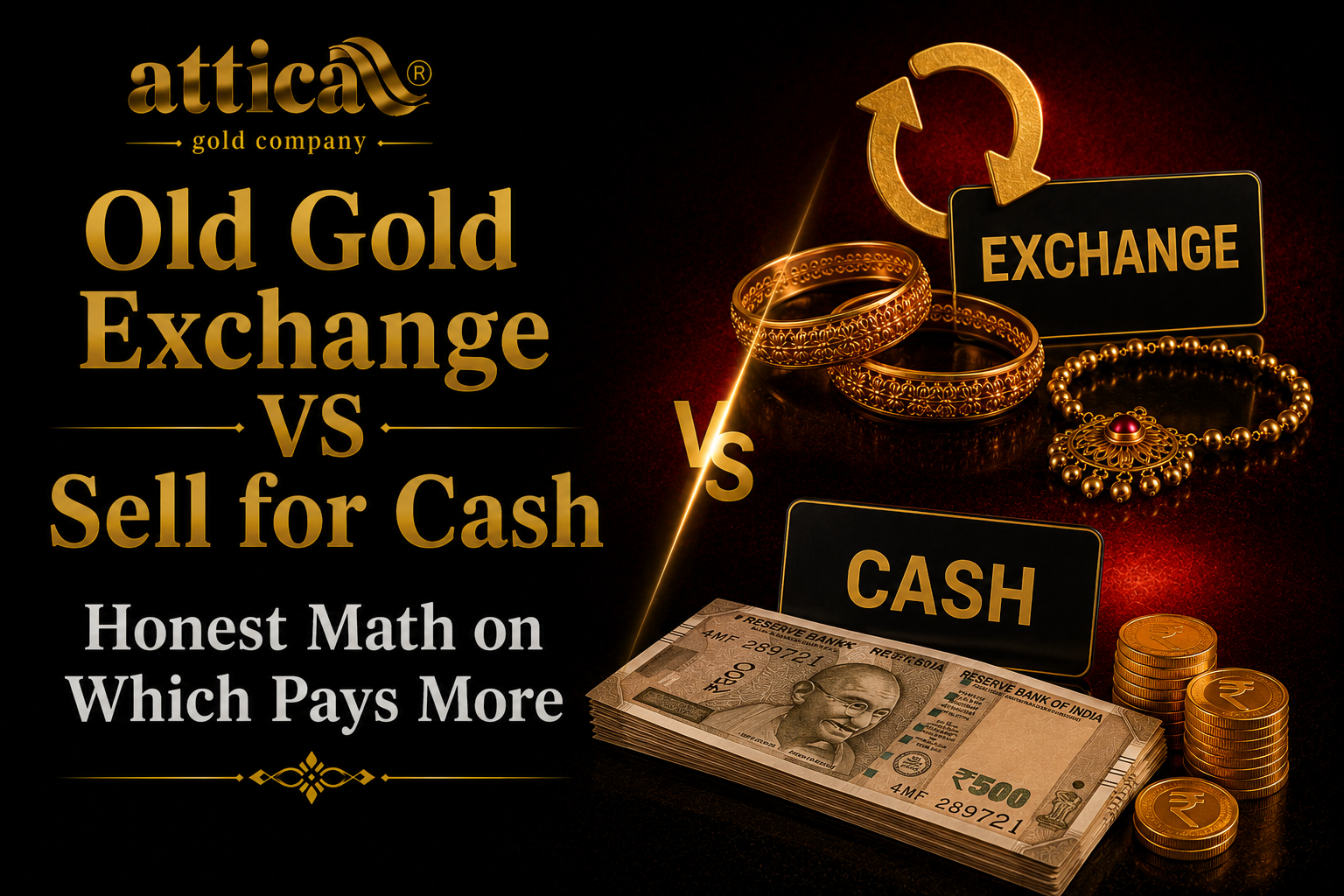
The Question Every Old Gold Owner Asks
When you bring an old chain or a set of inherited bangles to a jeweller, you almost always hear two pitches in quick succession – “we will give you a great old gold exchange offer if you upgrade to new jewellery”, or “we will buy your gold for cash today”. Both options sound similar, but the actual money you walk out with can differ by ₹40,000 or more on a 50-gram sale. The difference comes from how each route handles purity testing, making charges, exchange rates and deductions – most of which are quietly hidden in the offer page or the receipt fine print.
This guide is the honest comparison no jeweller will give you. We break down the maths of an old gold exchange offer step by step, set it next to a straight cash sale at a dedicated buyer, and show you exactly when exchange makes sense (rare cases) and when cash sale wins (most cases). Read it once, and the next time someone offers you “100% value, no deduction” on an exchange, you will know exactly which questions to ask.
Exchange vs Cash Sale – At a Glance
| Old Gold Exchange (at a jeweller) | Credit toward a new jewellery purchase |
| Cash Sale (at dedicated buyer) | Direct cash, UPI, IMPS or RTGS payment |
| Purity Testing | Exchange: usually visual / acid; Cash: XRF (in your presence) |
| Making Charges Recovered | Exchange: never; Cash: not applicable |
| New Item Making Charges | Exchange: payable on new piece; Cash: none |
| Wastage Charges | Exchange: typical 8–14% deduction; Cash: zero |
| Final Cash Realisation | Exchange: locked into store credit; Cash: yours to use anywhere |
| Today’s 24K Reference Rate | ₹14,962 per gram (5 May 2026, IBJA) |
How an Old Gold Exchange Offer Actually Works
A typical old gold exchange rate pitch sounds generous: “We will give you 100% of the gold value.” What the salesperson does not say is that “100%” applies only after deductions for non-gold content, declared purity, and an exchange-specific rate that is often ₹100–₹200 per gram lower than today’s live IBJA rate. Then the credit you receive is locked into the purchase of a new piece, and that new piece carries its own making charges (15–30% of value) and wastage allowance (5–10% of weight). By the time you walk out with new jewellery, you have effectively “sold” your old gold at 65–75% of its real cash value.
- Also Read: Live Gold Price Today
Worse, the original making charges you paid on your old chain – sometimes thousands of rupees – are gone forever. Making charges have no resale value to any buyer; the chain is valued purely by its gold content. An exchange does not recover those charges either; it just buries them under fresh making charges on the new piece.
Today’s Live Rate: The Number Both Routes Should Start From
Whether you exchange or sell for cash, the conversation should start with today’s live IBJA rate. If a jeweller’s exchange rate is more than ₹100/gram below the live rate, that gap is going into their margin, not yours. Use the widget below to confirm the current per-gram price for 22K, 18K and 24K before any negotiation. The same number should appear on the receipt of any reputable buyer.
Worked Example: 50g of 22K Old Jewellery
Imagine you have 50 grams of 22K old jewellery – a chain, two bangles and a pair of earrings inherited from your grandmother. Here is how the same gold plays out on the two routes at today’s ₹14,962/g 24K rate.
| Item | Cash Sale (Attica) | Exchange Offer (typical jeweller) |
| Gross gold value | 50 × 0.916 × ₹14,962 = ₹6,85,260 | 50 × 0.88 × ₹14,800 = ₹6,51,200 (declared purity used) |
| Making charges recovered | ₹0 (none deducted) | ₹0 (irrecoverable) |
| Wastage/impurity deduction | Only stones/solder, ~₹0–2,000 | 8–14% wastage = ~₹65,000 deducted |
| Net “credit” you receive | ~₹6,83,000 cash | ~₹5,86,000 store credit |
| Locked into a new purchase? | No | Yes – must buy new jewellery |
| Difference | – | ~₹97,000 less, locked in store credit |
The cash sale wins by roughly ₹97,000 on a 50g transaction – and that gap can fluctuate from 8% to 15% depending on the jeweller. If you genuinely want to upgrade your jewellery, the cleanest route is to sell your old gold for cash at full live rate, then walk into the jeweller of your choice and pay cash for the new piece (and negotiate the making charges hard, since you are now a cash buyer). You stay in control of both legs of the transaction.
Where Exchange Offers Hide Their Margin
- “Approximate purity” testing – many jewellers use acid touchstone or visual estimation rather than XRF, declaring 22K pieces as 88% when XRF would show 91%.
- Exchange-specific rate – a separate “exchange rate” displayed in fine print, ₹100–₹200/gram below the live IBJA rate.
- Wastage deduction – a flat 8–14% deduction “for melting” that has no basis in the actual non-gold content of your piece.
- Stone weight included as gold weight – the diamond, emerald or polki stones in your old piece can weigh 5–15% of the total, and that weight should be subtracted before applying the rate.
- Forced upgrade pressure – exchange credit can only be used in-store within a deadline (often 7–30 days), pushing you to buy a new piece you may not want.
A reputable cash buyer using XRF testing avoids all five of these traps. The gold exchange vs sell question becomes simple once you understand which route uses tested purity and which uses declared purity.
💰 Get the Best Price for Your Gold Today
Instant valuation • Transparent pricing • 100% secure & trusted
When Does an Exchange Offer Actually Make Sense?
There are narrow situations where exchanging old gold for new is the better route – usually when emotion or convenience trumps maths. If the new jewellery is a custom heirloom design unavailable elsewhere, an exchange may save logistics. If the jeweller offers a documented zero-wastage exchange against a printed XRF purity test (extremely rare), the price gap with cash narrows to 3–5%, which some sellers accept for the convenience. If you genuinely cannot wait for cash settlement (instant cash sales settle in under an hour anyway), an exchange may bridge a same-day need.
In every other case – inherited jewellery, broken or out-of-fashion pieces, or any sale where you want to retain the option of using the cash for non-gold needs – a cash sale is mathematically and practically superior. The jewellery exchange offer pitch is essentially a marketing tool to lock you into another retail purchase.
Common Mistakes Sellers Make at Exchange Counters
- Accepting “approximate purity” without insisting on XRF – even at exchange counters, you can ask for measured purity in your presence.
- Not weighing stones separately – diamond and gemstone weights should be subtracted before the gold rate is applied.
- Trusting verbal quotes – every offer should appear on a written receipt before you sign.
- Believing “no deduction” claims – every exchange has at least one of: wastage, exchange-rate gap, or stone-weight inclusion.
- Comparing only one buyer – always get an XRF-tested cash quote from a dedicated buyer before accepting any exchange offer.
A Three-Step Decision Framework
When facing the gold exchange vs sell choice, a simple three-step framework removes the emotion and pressure. First, get a written cash quote from a dedicated buyer with XRF testing – this anchors the real market value of your gold. Second, get a written exchange quote from the jeweller you are considering – make sure it itemises declared purity, exchange rate per gram, and any wastage or other deductions. Third, subtract the second from the first; the difference is the amount you will lose by choosing exchange.
On a typical 50g sale, that gap runs ₹80,000–₹1,00,000. On a 20g sal,e it runs ₹30,000–₹40,000. Even on a small 10g cha,n the loss is ₹15,000+. There are very few situations where the convenience of a one-stop exchange justifies that scale of loss. The framework forces a moment of clarity in what is otherwise a high-pressure retail interaction. Take the cash quote in writing; bring it to the jeweller; ask them to match it. If they cannot, the answer is straightforward.
Why Choose Attica Gold for Cash Sale Over Exchange
The honest comparison nearly always favours cash sale – but only if your buyer applies tested purity, today’s live IBJA rate, and zero wastage deductions. That is not a given in the Indian market. Many small buyers and jewellers still operate on declared-purity, exchange-rate and wastage protocols that quietly cost sellers 10–15% on every transaction.
Attica Gold runs the same protocol at every one of its 200+ branches across Karnataka, Tamil Nadu, Andhra Pradesh, Telangana and Pondicherry – XRF purity testing in your presence, today’s live IBJA rate displayed openly on the wall, deductions only for actual stones and solder, written line-by-line quote before you decide, and instant payment in cash, UPI, IMPS or RTGS. ISO 9001:2015 certification means the same standard at every branch, every day. If you have been weighing exchange against cash on inherited gold, your wait is over. Walk in, get the XRF reading, take the cash where it belongs.
Frequently Asked Questions
What is an old gold exchange offer, and how does it work?
An old gold exchange offer is a jeweller’s pitch to take your old jewellery as part-payment toward a new piece. The jeweller declares your old gold’s value (often using approximate purity and a discounted exchange rate), credits that value to your account, and you pay the difference in cash or card for the new piece. The credit is locked into the new purchase and cannot be withdrawn as cash.
Is an exchange always better than selling old gold for cash?
No – the gold exchange vs sell maths usually favours cash sale by 10–15%. Exchange offers typically use declared purity, an exchange-specific rate of ₹100–₹200/gram below live IBJA, and an 8–14% wastage deduction. Cash sale at a dedicated buyer with XRF testing applies tested purity at full live rate with deductions only for actual stones and solder.
Can I get back the making charges I paid on old gold?
No – making charges paid on the original jewellery are not recoverable through any route. They are a labour cost paid to the jeweller for fabrication and have no residual value. Both exchange and cash sale value the piece purely by gold content. The honest comparison is which route gives you the highest cash value of that gold content, and that is almost always a dedicated cash buyer.
What is the typical old gold exchange rate at jewellers?
Most large jewellery chains publish an old gold exchange rate that is ₹100–₹200 per gram below the day’s live IBJA rate. On top of that, declared purity is often 2–3 percentage points below actual XRF purity, and a wastage deduction of 8–14% is applied. The combined effect can lower your effective realisation by 12–18% compared to a cash sale at IBJA-linked live rate.
Can I exchange old gold from one jeweller for new gold at another?
Most jewellers only accept old gold purchased from their own brand for exchange, and even then, with a wastage deduction. Cross-jeweller exchange is rare and usually unfavourable. The cleanest route if you want to upgrade is to sell your old gold for cash at a dedicated buyer at full live rate, then walk into any jeweller as a cash buyer (where you can negotiate making charges harder).
Does Old Gold Exchange need a bill or a hallmark?
A bill is helpful but not mandatory in most jewellers. Aadhaar is required for KYC, and PAN is required for transactions above ₹2 lakh. A hallmark speeds up the purity assessment, but is not essential – XRF testing handles unhallmarked old gold equally well. The same is true for cash sales to dedicated buyers, where the bill is fully optional.
When should I choose an exchange over a cash sale?
Three narrow cases: (1) you specifically want a unique custom design from one jeweller that is not available elsewhere, (2) the jeweller offers documented XRF testing and zero wastage in writing (rare), and (3) you genuinely value the convenience over the 10–15% price gap. In all other cases – including most inherited gold sales – cash sale wins by maths.
How much can I save by selling old gold for cash instead of exchanging it?
On a typical 50-gram 22K sale at today’s rates, the gap is roughly ₹90,000–₹1,00,000 (12–15%). On smaller sales (10g), the gap is ₹15,000–₹20,000. The saving comes from three sources: tested purity vs declared purity, full live IBJA rate vs exchange rate, and zero wastage deduction vs 8–14% wastage. Always get a cash quote before accepting any exchange offer.
{ “@context”: “https://schema.org”, “@type”: “FAQPage”, “mainEntity”: [ { “@type”: “Question”, “name”: “What is an old gold exchange offer and how does it work?”, “acceptedAnswer”: { “@type”: “Answer”, “text”: “An old gold exchange offer is a jeweller’s pitch to take your old jewellery as part-payment toward a new piece. The jeweller declares your old gold’s value (often using approximate purity and a discounted exchange rate), credits that value to your account, and you pay the difference in cash or card for the new piece. The credit is locked into the new purchase and cannot be withdrawn as cash.” } }, { “@type”: “Question”, “name”: “Is exchange always better than selling old gold for cash?”, “acceptedAnswer”: { “@type”: “Answer”, “text”: “No – the gold exchange vs sell maths usually favours cash sale by 10–15%. Exchange offers typically use declared purity, an exchange-specific rate of ₹100–₹200/gram below live IBJA, and an 8–14% wastage deduction. Cash sale at a dedicated buyer with XRF testing applies tested purity at full live rate with deductions only for actual stones and solder.” } }, { “@type”: “Question”, “name”: “Can I get back the making charges I paid on old gold?”, “acceptedAnswer”: { “@type”: “Answer”, “text”: “No – making charges paid on the original jewellery are not recoverable through any route. They are a labour cost paid to the jeweller for fabrication and have no residual value. Both exchange and cash sale value the piece purely by gold content. The honest comparison is which route gives you the highest cash value of that gold content, and that is almost always a dedicated cash buyer.” } }, { “@type”: “Question”, “name”: “What is the typical old gold exchange rate at jewellers?”, “acceptedAnswer”: { “@type”: “Answer”, “text”: “Most large jewellery chains publish an old gold exchange rate that is ₹100–₹200 per gram below the day’s live IBJA rate. On top of that, declared purity is often 2–3 percentage points below actual XRF purity, and a wastage deduction of 8–14% is applied. The combined effect can lower your effective realisation by 12–18% compared to a cash sale at IBJA-linked live rate.” } }, { “@type”: “Question”, “name”: “Can I exchange old gold from one jeweller for new gold at another?”, “acceptedAnswer”: { “@type”: “Answer”, “text”: “Most jewellers only accept old gold purchased from their own brand for exchange – and even then with a wastage deduction. Cross-jeweller exchange is rare and usually unfavourable. The cleanest route if you want to upgrade is to sell your old gold for cash at a dedicated buyer at full live rate, then walk into any jeweller as a cash buyer (where you can negotiate making charges harder).” } }, { “@type”: “Question”, “name”: “Does old gold exchange need a bill or hallmark?”, “acceptedAnswer”: { “@type”: “Answer”, “text”: “A bill is helpful but not mandatory in most jewellers. Aadhaar is required for KYC, and PAN is required for transactions above ₹2 lakh. A hallmark speeds up the purity assessment, but is not essential – XRF testing handles unhallmarked old gold equally well. The same is true for cash sales to dedicated buyers, where the bill is fully optional.” } }, { “@type”: “Question”, “name”: “When should I choose exchange over cash sale?”, “acceptedAnswer”: { “@type”: “Answer”, “text”: “Three narrow cases: (1) you specifically want a unique custom design from one jeweller that is not available elsewhere, (2) the jeweller offers documented XRF testing and zero wastage in writing (rare), and (3) you genuinely value the convenience over the 10–15% price gap. In all other cases – including most inherited gold sales – cash sale wins by maths.” } }, { “@type”: “Question”, “name”: “How much can I save by selling old gold for cash instead of exchanging?”, “acceptedAnswer”: { “@type”: “Answer”, “text”: “On a typical 50-gram 22K sale at today’s rates, the gap is roughly ₹90,000–₹1,00,000 (12–15%). On smaller sales (10g), the gap is ₹15,000–₹20,000. The saving comes from three sources: tested purity vs declared purity, full live IBJA rate vs exchange rate, and zero wastage deduction vs 8–14% wastage. Always get a cash quote before accepting any exchange offer.” } } ] }Considering an old gold exchange offer?
Get a free cash quote first at your nearest Attica Gold branch – XRF tested purity, full live IBJA rate, zero wastage deduction. Compare the numbers before deciding.
Get Instant Valuation
Free evaluation · No obligation · Instant offer
🔒 Your details are safe and confidential