
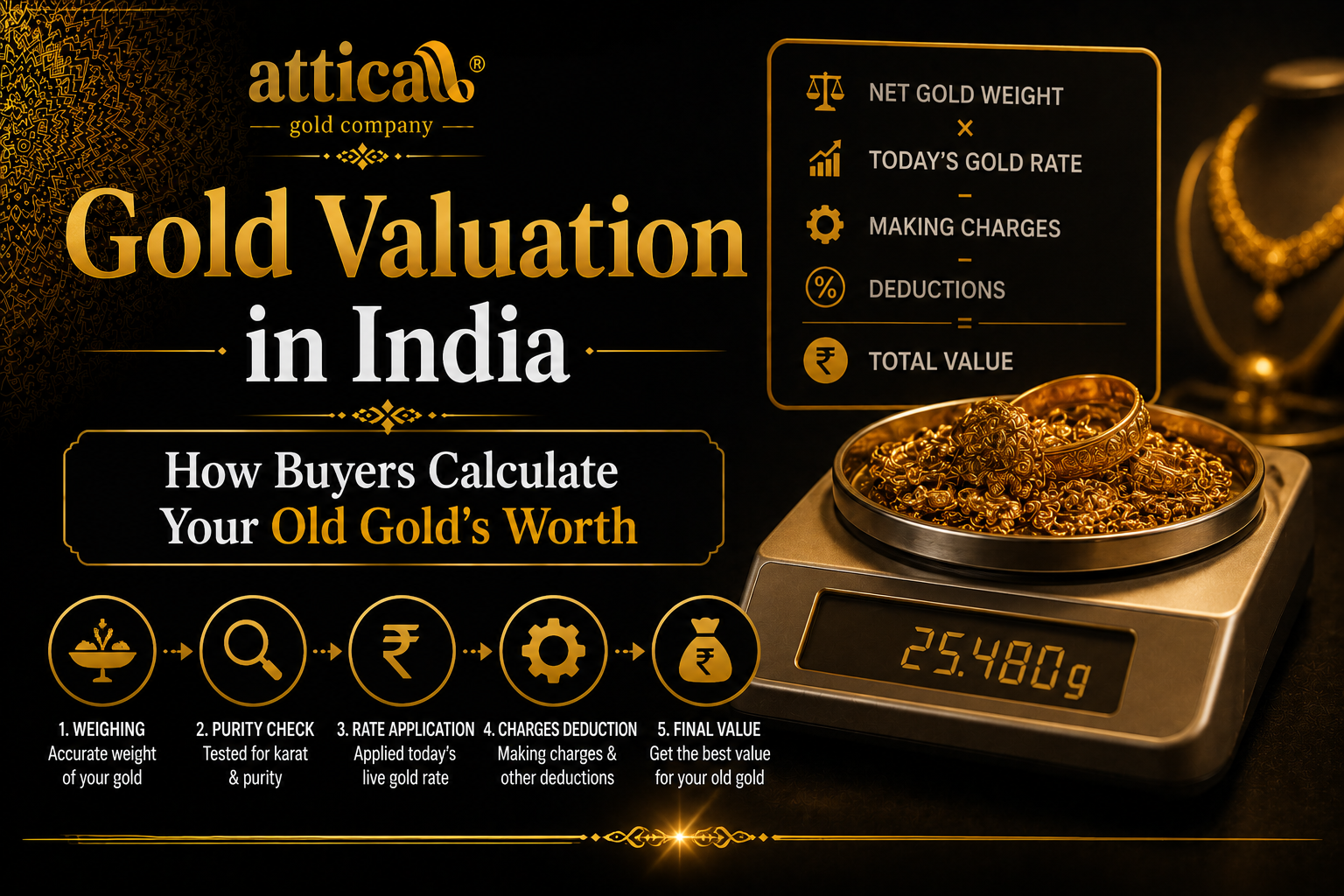
Why Gold Valuation Is Simpler Than Most Sellers Think
When you carry an old chain or a set of inherited bangles to a buyer, the gold valuation that determines your final cash payout is built on just three numbers – weight, purity, and today’s live IBJA rate. Multiply them, subtract any non-gold content (stones, solder), and you have your cash quote. The whole calculation can be done in under a minute on a calculator. Yet the gap between buyer offers on the same piece can be 10–15%, which means somewhere between formula and final quote, opacity is being introduced. Understanding the valuation process makes you immune to that opacity.
This guide is a complete walkthrough of how a reputable Indian gold buyer values your old gold in 2026 – the formula, the role of XRF testing, the legitimate deductions, the illegitimate ones to refuse, and a worked ₹-math example. Read it once, and you will be able to estimate your own piece’s value within 1% before walking into any buyer.
Gold Valuation at a Glance
| Core Formula | Final Price = Weight × Tested Purity × Today’s 24K Rate − Deductions |
| Purity Test Method | XRF (X-ray fluorescence) – non-destructive, 30 seconds per piece |
| Weighing Equipment | Calibrated electronic scale with Department of Legal Metrology stamp |
| Reference Rate | IBJA morning + evening rates (live) |
| Legitimate Deductions | Stones, solder, beads – only actual non-gold mass |
| Illegitimate Deductions | Wastage, making charges, “verification fee” |
| Today’s 24K Reference Rate | ₹14,918 per gram (6 May 2026, IBJA) |
| Today’s 22K Reference Rate | ₹13,675 per gram (6 May 2026, IBJA) |
The Three Numbers That Determine Your Final Cash
Every gold valuation in India hinges on three measurable values:
- Weight in grams. Measured on a calibrated electronic scale stamped by the Department of Legal Metrology. The reading should be displayed openly and recorded on your invoice. For pieces with stones, the gross weight (full piece) and net weight (after stone subtraction) are both recorded separately.
- Tested purity (% gold content). Measured by XRF spectrometer – a non-destructive scan that reads exact elemental composition in 30 seconds per piece. Reputable buyers turn the XRF screen toward you so you can see the reading. For 22K hallmarked gold, the reading should be ~91.6%; for 18K, ~75%; for 14K, ~58.5%. Pre-2021 unhallmarked pieces often test slightly below the original stamp value.
- Today’s live 24K rate. The IBJA-published reference is updated twice daily (morning + evening) and tracked through the MCX spot. Today’s rate is ₹14,918/g for 24K. The buyer applies this rate × tested purity to get your per-gram payout. For 22K pieces, this works out to ~₹13,675/g.
Multiply weight × purity × rate, subtract legitimate deductions for stones and solder, and you have your final cash quote. The formula has no other variables.
Today’s Live Rate: The Anchor of Every Valuation
The most volatile input in any gold valuation is the day’s live rate, which moves daily with international spot, the rupee, and import duty. Use the live rate widget below to confirm the exact 24K and 22K rate before walking into any buyer. If a buyer’s quoted rate is more than ₹100/gram below the IBJA benchmark for the relevant purity, ask why before signing anything.
Worked Example: Valuing a 30g 22K Hallmarked Chain
| Step | Calculation | Result |
| Weight on the calibrated scale | 30.20g gross | 30.20g |
| Solder weight subtracted | ~0.20g (typical chain) | 30.00g net gold |
| XRF purity reading | Au = 91.5% (slightly below 91.6 stamp) | 91.5% |
| Today’s live 24K rate | IBJA published rate | ₹14,918/g |
| Pure-gold mass | 30.00 × 0.915 | 27.45g |
| Gross gold value | 27.45 × 14,918 | ₹4,09,499 |
| Stone/other deductions | No stones in a plain chain | ₹0 |
| Final Cash Payout | After all deductions | ₹4,09,499 |
A transparent buyer would print exactly this breakdown on a written invoice – every line traceable, every deduction explained. The seller can verify the maths in under a minute. By contrast, a non-transparent buyer would quote a flat “₹3,80,000 final” without showing the breakdown – a 7% margin grab hidden behind verbal opacity.
💰 Get the Best Price for Your Gold Today
Instant valuation • Transparent pricing • 100% secure & trusted
How Gold Valuation Differs by Type
| Type of Gold | Valuation Adjustment | Typical Realisation % |
| 24K Bullion (coin/bar) | −1-2% refining margin | 97-99% of live spots |
| 22K Hallmarked Plain Chain | No deductions beyond solder | 91% of live 24K (= 100% of 22K rate) |
| 22K Hallmarked Bridal (with stones) | Stones were weighed and subtracted | Variable – depends on stone weight |
| 18K Diamond Setting | Stones subtracted; gold portion only | Gold portion at 75% of 24K rate |
| Pre-2021 KDM Gold | XRF tests ~90.5% (below 91.6 stamp) | Tested purity at live rate |
| Gold Plated | Recoverable gold layer only | 5-15% of equivalent solid value |
The realisation percentage tells you what fraction of “stamped value” the piece actually fetches. For solid bullion, it is near 100%. For solid jewellery, it is near 100% of the relevant karat rate (= 91% of 24K for 22K pieces). For stone-set pieces, the gold portion realises the full rate, but the stones reduce the gold weight. For plated pieces, realisation is dramatic – often 5-15% of equivalent solid value.
Legitimate Deductions vs Illegitimate Ones
A clean gold valuation in India accepts only deductions for the actual non-gold mass in the piece. Legitimate deductions include:
- Stones (diamonds, rubies, emeralds, polki, kundan) – weighed separately and subtracted from gross weight before applying gold rate.
- Solder joints – typically 1–3% of total weight on chains, less on bangles. Buyer estimates and subtracts.
- Beads, threads, lac filling – all subtracted from total weight.
- Refining margin – applies only to 24K bullion (1–2% of value); not applied to jewellery.
Illegitimate deductions to refuse:
- Wastage charges (8–14% flat) – common at jewellers, illegitimate at a cash buyer; you are not having jewellery made.
- Making charges deduction – the original making charges paid are non-recoverable but not deductible from the gold value.
- Hallmark verification fee – BIS Care app verification is free.
- XRF testing fee – reputable buyers offer XRF free; a fee is a margin grab.
- Cash-handling fee – illegal under banking rules.
If a buyer quotes any of these illegitimate deductions, ask for the breakdown in writing. Most will withdraw the deduction once the seller pushes back; the deductions exist mainly to catch sellers who do not push back.
How a Reputable Gold Valuation Looks on Paper
A clean written quote from any reputable Indian gold buyer in 2026 should show:
- Branch name, GST number, KYC details (your Aadhaar last 4 + PAN if applicable).
- Item-wise gross weight in grams (each piece separately).
- Stone/solder/non-gold weight subtracted (with brief description).
- Net gold weight after subtraction.
- XRF tested purity % per item.
- Today’s applied 24K IBJA rate.
- Per-item gross value (purity × weight × rate).
- Refining margin (only for 24K bullion).
- Final cash payable, in figures and words.
- Payment mode (cash up to ₹1,99,999, IMPS/RTGS for higher amounts).
If the quote you receive shows any of these lines as missing or merged into a single “final amount”, ask for itemisation. Without itemisation, you cannot verify the maths. With itemisation, you can verify the gold valuation in 60 seconds.
Why Choose Attica Gold for Transparent Valuation
A clean gold valuation depends entirely on the buyer’s willingness to apply the standard formula transparently. The right buyer measures purity in your presence, displays the live IBJA rate openly, and prints every line of the calculation on a written invoice. The wrong buyer measures behind a counter, quotes a flat “today’s offer”, and leaves you with no breakdown to verify. The cost of opacity lands on the seller – typically 8–15% below true valuation.
Attica Gold runs the same valuation protocol at every one of its 200+ branches across Karnataka, Tamil Nadu, Andhra Pradesh, Telangana and Pondicherry – calibrated XRF in your presence, today’s live IBJA rate displayed openly, written line-by-line invoice with every deduction itemised, KYC at the counter, and instant settlement through cash, UPI, IMPS or RTGS depending on the amount. ISO 9001:2015 certification means the same standard at every branch, every day. If you have been hesitating to sell because the valuation process felt opaque, your wait is over. Walk in, watch the test, see the maths printed on paper, and take the cash that the formula adds up to.
Frequently Asked Questions
How is gold valuation calculated in India?
The standard gold valuation formula is: Weight in grams × Tested purity × Today’s 24K live IBJA rate, minus deductions for actual non-gold mass (stones, solder). For a 30g 22K plain chain at today’s ₹14,918/g 24K rate, valuation works out to roughly 30 × 0.915 × 14,918 = ₹4,09,499 cash. The formula has no other variables; any buyer adding “wastage” or “verification fee” is applying illegitimate deductions.
What role does XRF testing play in gold valuation?
XRF (X-ray fluorescence) testing measures the exact gold content of your piece in 30 seconds without damaging it. The reading determines the purity multiplier in the valuation formula. For solid 22K hallmarked gold, XRF typically reads 91.4–91.6%; for pre-2021 KDM gold, ~90.5%; for plated pieces, surface gold of 30–60% with heavy base metal underneath. Reputable buyers turn the XRF screen toward you during the test.
How is gold resale value different from gold valuation?
Gold resale value is the cash payout you actually receive from a buyer; gold valuation is the underlying calculation that produces that payout. They are essentially the same number when the buyer applies the standard formula transparently. The difference appears when buyers introduce illegitimate deductions (wastage, exchange-rate gap, verification fee) that lower the resale cash below the true valuation. A clean buyer’s resale value equals the valuation maths exactly.
How is the gold resale price calculated for jewellery vs bullion?
For solid jewellery, gold resale price = Weight × Tested purity × Live 24K rate − stone/solder subtraction. No making-charge or wastage deduction applies. For bullion (coins, bars, biscuits), the formula simplifies because purity is already 99.9% (24K) or 99.5%, and there are no stones; the only deduction is a 1–2% refining margin. Bullion typically realises 97–99% of live spot; solid jewellery realises 91% of 24K rate (= 100% of relevant karat rate).
What does a gold purity check involve for a buyer?
A reputable gold purity check involves three steps: (1) Visual inspection for BIS hallmark – triangle, purity grade (916/750/585), HUID, jeweller mark; (2) HUID lookup on the BIS Care app for hallmarked pieces (free, 30 seconds); (3) XRF spectrometer testing in your presence to measure exact composition. For unhallmarked pre-2021 pieces, only step 3 applies. The purity reading determines your per-gram cash multiplier in the valuation formula.
How can I check gold purity at home before going to a buyer?
Three at-home checks: (1) Look for BIS hallmark stamps – triangle + 916 (22K), 750 (18K), 585 (14K). (2) Magnet test – solid gold (any karat) is non-magnetic; if it pulls toward a magnet, it is plated over iron. (3) Density test – solid gold has density 17.5 g/cc (22K) or 19.3 g/cc (24K); divide weight by water displacement to estimate. None of these is as accurate as XRF, but they catch obvious cases. The definitive answer comes from a buyer’s XRF reading.
How to check if my gold is real before selling?
Four checks in increasing accuracy: (1) BIS hallmark stamps and HUID lookup on the BIS Care app. (2) Magnet test – non-magnetic = either solid gold or plated over non-ferrous core. (3) Density test using weight ÷ water displacement. (4) XRF testing at a buyer (the definitive answer in 30 seconds). For pieces without hallmarks (legitimate pre-2021 Indian gold), XRF is the only reliable method. Reputable buyers offer XRF free of charge.
What is the difference between gold valuation and online gold valuation?
Standard gold valuation happens at a buyer’s branch with calibrated XRF and an in-person inspection. Online gold valuation services use customer-submitted photos and self-declared weight to give an indicative quote – useful for ballpark estimates but not for finalising a transaction. Final cash payout always requires physical XRF and weighing at a branch. Online valuations are typically 5–10% below the actual branch quote because they cannot verify purity definitively without testing.
Ready to see your old gold valued transparently –
Every line on paper, every deduction explained? Visit your nearest Attica Gold branch – calibrated XRF, live IBJA rate, written invoice.