
Why Verifying Gold Purity Before Selling Matters More Than Anything Else
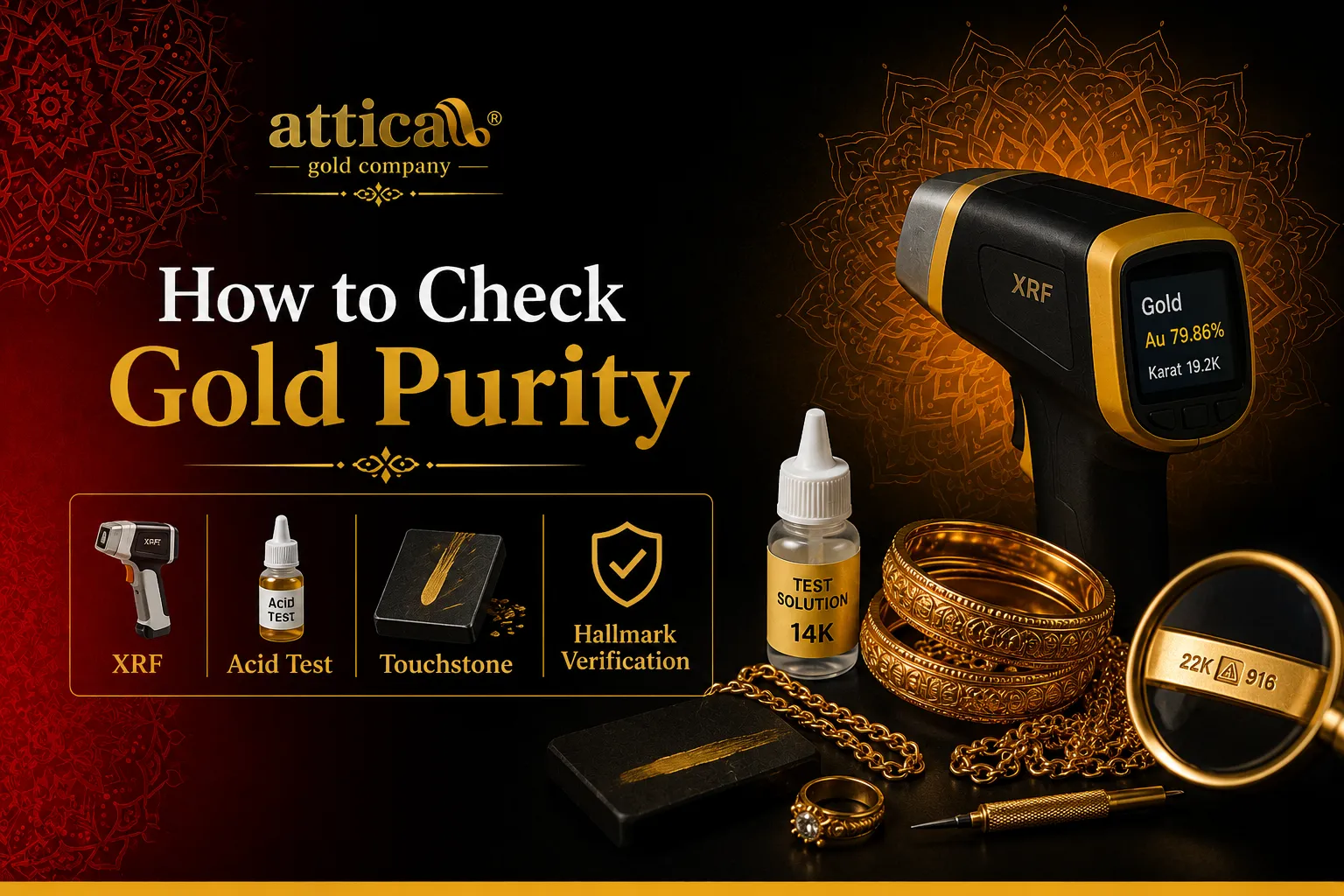
When you sell gold, only one number determines your final cash payout: the tested purity of your piece. Two pieces of identical weight can fetch dramatically different prices simply because one tests at 91.6% (22K) and another at 87% (despite both being stamped ’22K’ decades ago). The question ‘how to check gold purity’ is therefore the single most important question any gold seller can ask. Reputable buyers use four main methods to verify gold purity: XRF (X-ray fluorescence) testing, the acid test, the touchstone method, and BIS hallmark verification on the BIS Care app. Each has different accuracy, cost, and reliability – and knowing which one is being applied to your gold protects you from being underpaid.
This guide covers every method used to check gold purity in India: how each works, how accurate it is, what it costs, when to insist on which one, and what XRF testing in your presence guarantees that other methods do not. By the end, you will know how to verify the purity of any gold piece in your possession before walking into any buyer’s branch.
Gold Purity Testing Methods at a Glance
| Method | Accuracy | Time | Damage to Piece | Best For |
| XRF (X-ray Fluorescence) | ±0.1% | 30 seconds | None | All gold (industry standard) |
| BIS Care App (HUID) | 100% (database) | 10 seconds | None | Hallmarked gold (post-2021) |
| Acid Test | ±2-3% | 5 minutes | Tiny scratch | Quick rough check |
| Touchstone Method | ±5-10% | 5 minutes | Tiny streak | Traditional jeweller’s test |
| Specific Gravity | ±1-2% | 10 minutes | None | Stone-free, solid pieces only |
XRF Testing: The Industry Gold Standard
XRF (X-ray fluorescence) is the most accurate, fastest, and least invasive method for checking gold purity. The XRF machine fires low-energy X-rays at your gold piece; each metal in the alloy fluoresces at a unique wavelength, and the machine reads these signatures to calculate the exact percentage of gold, silver, copper, zinc, and other metals. The reading takes about 30 seconds, is accurate to within ±0.1%, and causes no damage to your jewellery – the piece comes out exactly as it went in. Modern XRF machines also detect plating: if your piece is gold-plated rather than solid gold, XRF will reveal a thin gold layer over a base metal core within seconds.
- Also Read: Live Gold Price Today
XRF is the standard at all reputable Indian gold buyers, refineries, and BIS-licensed assay centres. The machine costs ₹15–25 lakh, which is why it is found mainly at organised buyers (like Attica Gold’s 200+ branches) and not at every small-town jeweller. When selling any gold worth more than ₹50,000, insist on XRF testing in your presence – the accuracy and lack of damage make it the only method that should determine your final payment for high-value transactions.
BIS Care App: Verify Hallmark Gold in 10 Seconds
If your gold piece carries a six-digit Hallmark Unique ID (HUID), you can verify it in 10 seconds without leaving home. The BIS Care app (free on Android and iOS) lets you enter the HUID and instantly see when the piece was hallmarked, by which BIS-licensed assay centre, for which jeweller, and at what tested purity. This system is government-controlled, real-time, and impossible to forge – every HUID is unique to the specific piece and registered in BIS’s central database. The HUID system was made mandatory for new gold sales in July 2021.
Older hallmarked gold (pre-July 2021) may carry the BIS triangle and purity grade (916, 750, etc.) but no HUID. The BIS Care app cannot verify these older pieces – but they are still genuine if they carry the BIS triangle. For pre-2021 hallmarked pieces and unhallmarked pieces, XRF testing at any reputable buyer is the practical verification method. The BIS Care app and XRF testing together cover every possible scenario for verifying gold purity in India today.
The Acid Test: Old-School but Still Used
The acid test is the oldest method still in regular use, especially at small-scale jewellers and pawn shops. The jeweller scratches a tiny mark on a black stone (the ‘touchstone’) with your gold piece, then applies different concentrations of nitric acid to the scratch. Pure 24K gold does not react to nitric acid; 22K shows minimal reaction; 18K shows slight reaction; 14K and below show clear reactions. The pattern of reactions tells the tester roughly which karat the piece is. Accuracy is ±2-3%, which is acceptable for rough estimates but not precise enough for high-value transactions.
The acid test has three drawbacks. First, it leaves a tiny scratch on the piece (usually invisible, but technically damages the gold). Second, the precision depends entirely on the tester’s experience and the freshness of the acids used. Third, certain plated or coated pieces can fool the acid test if the gold layer is thick enough to react like solid gold. For small transactions (under ₹20,000), acid testing is reasonable. For anything larger, insist on XRF instead.
The Touchstone Method: Visual but Imprecise
The touchstone method is the simplest gold test and the least precise. The tester rubs your gold piece against a small black stone, leaving a streak. They then compare the colour, brightness, and spread of the streak against reference streaks made by gold of known purity. Experienced jewellers can identify gold purity within ±5-10% accuracy using touchstone alone. The method requires no chemicals, no equipment beyond the stone, and takes about 5 minutes. It is portable, cheap, and useful for quick rough estimates – but not for setting the final price.
The touchstone method is most commonly used at small jewellers, pawn shops, and informal gold buyers in tier-2 and tier-3 cities. If a buyer offers only touchstone testing on a high-value piece, treat it as a warning sign – the imprecision (5-10% margin of error) means you could be underpaid by ₹5,000–₹15,000 on a 10g piece simply because the test cannot distinguish 87% from 91.6%. Always ask for XRF backup verification on any high-value transaction.
💰 Get the Best Price for Your Gold Today
Instant valuation • Transparent pricing • 100% secure & trusted
Specific Gravity Testing: Niche but Useful
Specific gravity testing measures the density of your gold piece by weighing it in air and then in water. Pure 24K gold has a specific gravity of 19.3 (it is 19.3 times denser than water); 22K has around 17.7-17.9; 18K has around 15.6; 14K has around 13.0. The method is non-destructive, reasonably accurate (±1-2%), and works on solid pieces without stones or air gaps. However, it is impractical for jewellery with stones, hollow pieces, or intricate designs where small air pockets distort the density reading.
Specific gravity is mostly used at refineries and bullion testing labs as a cross-check against XRF. For everyday jewellery sellers, it is rarely the primary test. If a buyer offers specific gravity testing on a stone-set piece or an ornate design, the reading will be inaccurate – XRF is the better choice. Specific gravity is a useful supplementary verification, not a primary purity test for typical Indian jewellery.
How to Cross-Verify Gold Purity Before Selling
Before walking into any buyer’s branch, you can do three simple checks at home to estimate the purity of your gold:
- Look for the BIS hallmark – BIS triangle, purity number (585/750/916/999), HUID (if post-2021), jeweller’s mark. If all four are present and the HUID verifies on the BIS Care app, the piece is genuine at the marked purity.
- Check the colour and weight – pure 24K is more orange-yellow than 22K; 18K is paler; 14K is lighter still. A 10g 22K chain feels noticeably heavier than a 10g 14K chain due to higher density.
- Test with a magnet – pure gold is non-magnetic. If a strong magnet attracts your piece, it contains significant ferrous content and is not solid gold (or is heavily plated).
These home checks rule out obvious fakes but cannot give you the precise purity figure. For the actual selling price calculation, only XRF testing in the buyer’s presence – verified by your own observation of the screen reading – provides the precision required for fair valuation.
What to Watch For When a Buyer Tests Your Gold
Three issues are worth watching for during the purity testing process. First, the test must happen in your presence – not in a back room. Reputable buyers test at the front counter, on a transparent machine where you can see the screen reading. If a buyer takes your piece into a separate room for testing, that is a warning sign. Second, the XRF reading should be visible on the machine screen, with the gold percentage clearly displayed. Most modern XRF machines show all metal percentages (Au, Ag, Cu, Zn, etc.) – ask the operator to walk you through the reading.
Third, the tested purity should appear on your written receipt with no rounding tricks. If the XRF shows 91.5% and the receipt rounds it to 90% (a common underpaying trick), the buyer is shaving 1.5% off your payment – about ₹230 per gram on 22K. The receipt should state the exact tested purity to one decimal place. Insist on this transparency.
Why Choose Attica Gold for Honest Gold Purity Testing
How to check gold purity is the most important question any gold seller can ask – and the answer should be: XRF, in your presence, at the front counter, with the screen reading visible, and the exact percentage printed on your receipt. Anything less is an opening for the buyer to underpay. The right buyer treats purity testing as a transparent service, not a hidden margin opportunity. The XRF test is fast, accurate, non-damaging, and unambiguous; there is no reason a reputable buyer would conduct it any way other than in front of you.
Attica Gold runs free XRF purity testing at every branch across Karnataka, Tamil Nadu, Andhra Pradesh, Telangana and Pondicherry – always at the front counter, always in your presence, always with the machine reading visible to you, and always with the exact tested purity printed on your written receipt. Today’s IBJA rate is published openly, the math (weight × tested purity × today’s 24K rate) is transparent, and payment is instant in cash, UPI, NEFT, RTGS, or IMPS. ISO 9001:2015 certification means the same standard at every branch, every day. Your wait is over – walk into your nearest Attica Gold branch for free XRF purity testing and a written quote at today’s rate.
Frequently Asked Questions
How can I check the purity of my gold at home?
You can do three quick home checks: (1) look for the BIS hallmark (BIS triangle, purity number 585/750/916/999, HUID for post-2021 pieces); (2) verify the HUID on the BIS Care app if your piece has one; (3) test with a magnet – pure gold is non-magnetic. These checks rule out obvious fakes but cannot give precise purity figures. For actual selling, you need XRF testing at a reputable buyer’s branch – accurate to ±0.1% and non-damaging.
What is the most accurate way to check gold purity?
XRF (X-ray fluorescence) testing is the most accurate method, with ±0.1% precision, completed in 30 seconds, and causing no damage to the piece. It is the industry standard at all reputable Indian gold buyers, refineries, and BIS assay centres. XRF measures actual gold content in the metal – not just the surface – so it cannot be fooled by plating, solder content variations, or hidden alloy mixes.
Is the acid test reliable for checking gold purity?
The acid test is reasonably accurate (±2-3%) and useful for rough estimates, but not precise enough for high-value transactions. It also leaves a tiny scratch on the piece. Acid testing is acceptable for small transactions (under ₹20,000) at trusted local jewellers, but for any sale above this, XRF testing is far safer and more accurate. Always ask for XRF backup on high-value pieces.
Can I verify hallmark gold without going to a buyer?
Yes – if your piece carries a six-digit HUID (Hallmark Unique ID, mandatory for new gold sales since July 2021), you can verify it on the BIS Care app (free on Android and iOS). Enter the HUID and the app instantly shows the assay centre, jeweller, hallmark date, and tested purity. Pre-2021 hallmarked pieces don’t have HUIDs but can still be verified by XRF testing.
How much does XRF gold testing cost?
At reputable gold buyers like Attica Gold, XRF testing is free for sellers – it is part of the standard valuation process. The buyer absorbs the cost of operating the XRF machine (typical machines cost ₹15-25 lakh) because accurate testing is essential for their business. Some independent BIS assay centres charge ₹100–500 per piece for XRF certification, but this is usually only needed for documentation purposes, not for selling.
Can XRF testing damage my gold jewellery?
No. XRF testing is completely non-damaging. The machine fires low-energy X-rays at the surface of your piece for about 30 seconds, reads the fluorescence signature of each metal, and calculates the purity. Your piece comes out exactly as it went in – no scratch, no chemicals, no melting. This is one of the main reasons XRF replaced acid testing as the industry standard.
What if a buyer only offers acid or touchstone testing?
If a buyer offers only acid or touchstone testing on a high-value piece (above ₹50,000), treat it as a warning sign. The ±2-10% margin of error in these methods could underpay you by thousands of rupees compared to an XRF test. Insist on XRF – and if the buyer cannot provide it, walk away to a buyer who can. Reputable buyers like Attica Gold offer free XRF testing at every branch as standard.
How does the touchstone method differ from XRF?
Touchstone is a visual comparison test – the gold is rubbed against a black stone and the colour of the streak is compared against reference samples. Accuracy is ±5-10%, dependent on the tester’s experience. XRF is a physical analysis using X-rays, accurate to ±0.1%, machine-read with no human bias. Touchstone is portable and cheap; XRF is precise and unambiguous. For setting a fair price, XRF is far superior; touchstone is suitable only for rough rural-market estimates.
Want a free XRF gold purity test before deciding to sell?
Visit your nearest Attica Gold branch – purity testing in your presence, transparent screen reading, exact percentage on your written receipt, and a quote at today’s live rate.