
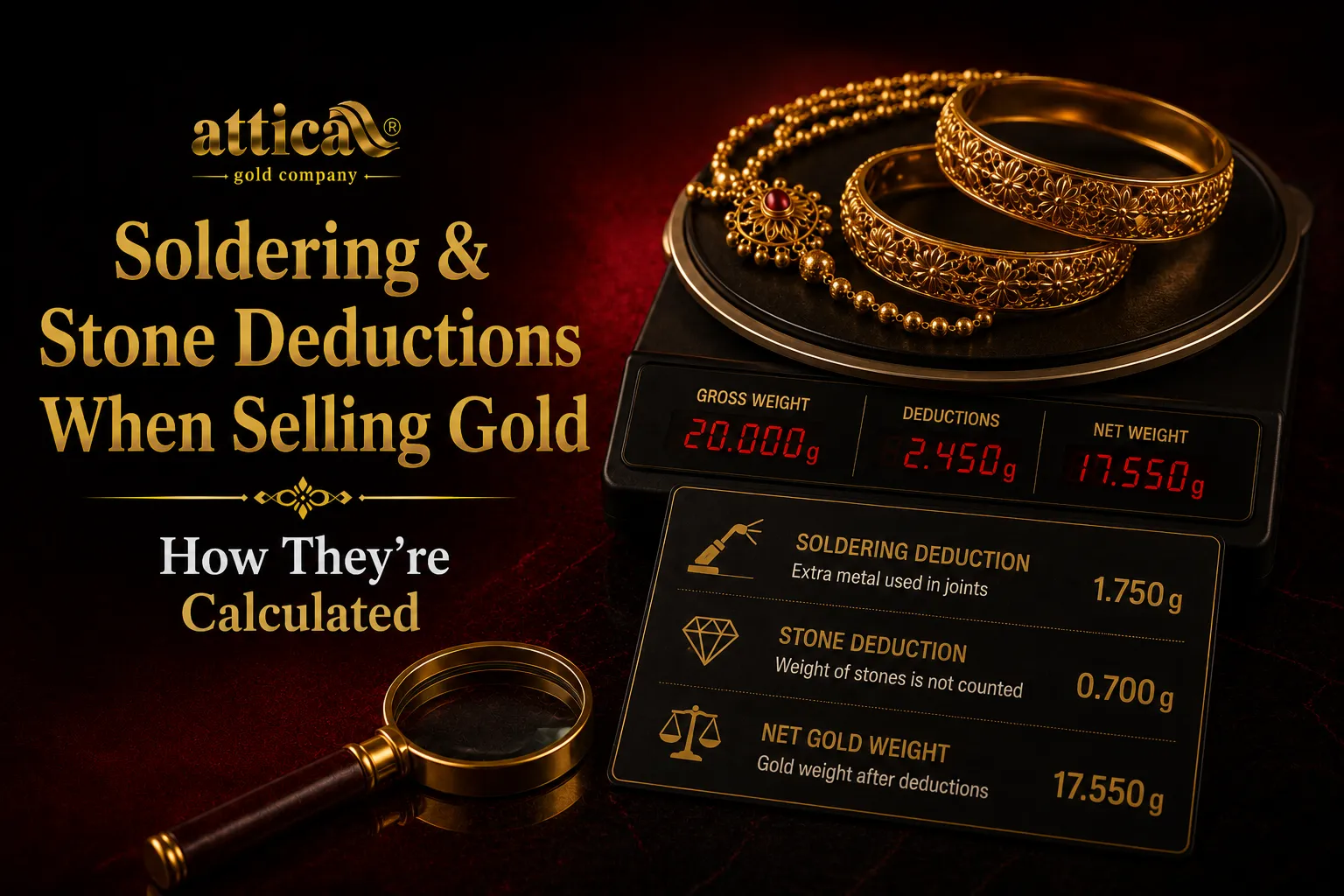
Why Solder & Stone Deductions Move the Sell Gold Rate Today
When you walk into any gold buyer, the sell gold rate today they quote is just the starting point. The amount you actually receive depends on three deductions: stones (gemstones, semi-precious, synthetic), solder (the alloy used to join links and joints), and any visible damage that prevents melting. Stone and solder deductions account for 90% of the difference between gross weight and final cash. Understanding how they’re calculated – and which deductions are fair vs which are pure margin grabs – is the difference between getting a fair price and being underpaid 5–10%.
This guide is the complete gold valuation process explanation: how stones are physically removed and weighed, how the buyer estimates solder weight, what fair industry-standard deductions look like, and the red flags that signal an unfair buyer. By the end, you’ll know exactly what to ask at the counter and what to push back on.
How Stone Deduction Is Calculated Fairly
Fair stone deduction has three steps: (1) buyer physically removes the stones from the piece (using small dental tools or by carefully cutting the prongs); (2) stones are weighed separately on the same calibrated scale that weighed the gold; (3) the gold weight is recalculated as (total piece weight − stone weight) and that net gold weight is what gets multiplied by today’s sell gold rate today × purity factor.
- Also Read: Live Gold Price Today
Worked example: a 22K ring weighing 8.5g with a single diamond. Buyer removes the diamond, weighs it: 0.5g. Net gold weight = 8.5 − 0.5 = 8.0g. At ₹6,000/g 24K rate, fair value = 8.0 × 0.916 × ₹6,000 = ₹43,968. The 0.5g stone is returned to you separately. There is no ‘percentage cut’ for stones – only the actual weight is deducted.
Sell Gold with Stones: When You Should and Shouldn’t Remove Beforehand
If you have time, remove the stones yourself before visiting (using a careful jeweller). Why: (1) you can sell stones separately – diamonds, rubies, certified sapphires can be substantially valuable; (2) you avoid any disputed estimates from the buyer’s removal process; (3) the remaining gold is cleaner to weigh and value.
If you don’t have time or skill to remove stones, sell gold with stones at a buyer who removes them in your presence and returns them. This is standard at Attica Gold and other reputable buyers. Avoid buyers who ‘estimate’ stone weight without removing – that’s a margin grab. Avoid buyers who refuse to return removed stones, claiming ‘they’re worthless’ – that’s not for them to decide; the stones are your property.
Solder Weight Deduction Gold: How Much Is Fair?
Solder is the alloy (typically lead, copper, or low-karat gold) used to join links of chains, attach clasps, or fix bangles. When the piece is melted for refining, the solder doesn’t refine into pure gold – so reputable buyers deduct an estimated solder weight before applying the sell gold rate today. The fair industry estimate is:
| Piece Type | Typical Solder % | Notes |
| Plain gold chain | 1–2% | Standard link-soldering |
| Heavy chain with clasps | 2–3% | Multiple solder joints |
| Bangle (single piece) | 0–1% | Often cast, minimal solder |
| Ring | 0–0.5% | Usually no solder |
| Earring with multiple parts | 1–3% | Soldered hooks/connectors |
| Necklace with pendant + chain | 2–4% | Multiple soldered joints |
| Heavily repaired piece | 3–5% | Visible solder; case-by-case |
If a buyer claims more than 5% solder weight deduction gold without showing visible solder evidence, push back. The deduction should be visible on the piece (silvery joints) and proportionate to construction.
The Gold Valuation Process: Step-by-Step
- Weighing: The buyer weighs the jewellery in your presence on a calibrated scale and records the gross weight.
- Purity testing: The gold is tested using an XRF machine to determine purity (22K, 18K, etc.), and the purity percentage is recorded.
- Stone removal (if applicable): Stones are physically removed using small tools, weighed separately, and returned to you.
- Solder assessment: The buyer estimates solder weight based on visible solder joints (typically around 1–3%).
- Net gold calculation: Net gold weight = Gross weight − Stone weight − Solder deduction
- Final valuation: Final value = Net gold weight × Tested purity × Today’s 24K sell gold rate
- Written quote: The buyer should provide a detailed written quote with every deduction itemised clearly.
- Your decision: You can either accept the offer and receive payment or take the quote elsewhere for comparison.
💰 Get the Best Price for Your Gold Today
Instant valuation • Transparent pricing • 100% secure & trusted
Red Flags: Unfair Stone & Solder Deductions
- Flat “5%” or “10%” deductions without actually removing or weighing stones.
- Refusal to remove stones: “The stones can’t be separated” is rarely valid for standard jewellery.
- Excessive solder claims: Solder deductions above ~3% without visible justification are suspicious.
- Buyer keeps the stones: Stones remain your property and must be returned.
- “Making + stone deduction” combined into one line: Making charges are irrelevant when selling gold — reject this practice.
- Stone weight estimated without a scale: Reputable buyers weigh stones separately; “estimation” often benefits the buyer unfairly.
How to Sell Gold for Cash with Maximum Value
Three practical steps to maximise your cash on stoned/soldered jewellery:
- Before visiting the buyer: Photograph each jewellery piece, note an approximate weight using a kitchen scale (for a rough sanity check), and check today’s sell gold rate on IBJA.
- At the counter: Watch every step carefully — gross weighing, XRF purity testing, stone removal, and solder deduction estimation. Request that each step and deduction be clearly itemised on the written quote.
- Compare offers for larger sales: If the transaction value exceeds ₹3 lakh, get a written quote from one buyer and compare it with a second buyer’s quote. Spending an extra 30–60 minutes comparing can often recover ₹5,000–₹15,000 in additional value.
How to sell gold for cash with maximum value isn’t complicated – it’s about choosing transparent buyers and refusing opaque deductions. Reputable buyers welcome scrutiny; opaque ones discourage it.
Why Choose Attica Gold for Transparent Stone & Solder Handling
Stone and solder deductions are where unfair buyers extract most of their margin from sellers. The mechanics are simple – physical removal, separate weighing, fair percentage estimates – but the temptation to apply opaque flat cuts is strong because most sellers don’t push back. The fix is straightforward: sell at a buyer whose process is itemised and visible, and walk away from any buyer who introduces a flat ‘percentage cut’ line item.
Attica Gold uses calibrated XRF testing on every piece, physical stone removal in your presence with stones returned to you, and itemised solder estimates clearly written on the quote. Today’s sell gold rate today (linked to IBJA) is displayed openly at every branch. ISO 9001:2015 certified processes ensure the same standard at all 200+ branches across Karnataka, Tamil Nadu, Andhra Pradesh, Telangana, and Pondicherry. If you’ve been hesitating to sell stoned or soldered jewellery because you weren’t sure what fair deductions look like, your wait is over. Visit your nearest Attica Gold branch today for a free, line-by-line valuation.
Frequently Asked Questions
How is the sell gold rate today affected by stones in jewellery?
The sell gold rate today is applied only to net gold weight (after stones are removed and weighed separately). Stone deduction = exact stone weight × rate. Stones do not change the per-gram gold rate; they just reduce the amount of gold being sold. Fair deduction is by physical removal and weighing, not by flat percentage.
What is a fair solder weight deduction gold percentage?
Solder weight deduction gold ranges from 0–5% depending on construction: chains 1–2%, heavy clasps 2–3%, bangles 0–1%, rings 0–0.5%. Heavily repaired pieces with visible solder can go to 5%. Anything above 5% without visible solder evidence is unfair.
How can I sell gold with stones for fair value?
Sell gold with stones at a buyer who: (1) physically removes stones in your presence, (2) weighs stones separately on the same calibrated scale, (3) returns stones to you afterwards, (4) deducts only stone weight from gross gold weight. Reject buyers who ‘estimate’ stones without removing or who refuse to return them.
What is the gold valuation process at a reputable buyer?
The gold valuation process: (1) gross weight on calibrated scale, (2) XRF purity test, (3) stone removal and separate weighing, (4) solder weight estimate based on visible joints, (5) net gold weight × purity × today’s sell gold rate today, (6) written line-by-line quote with all deductions. Each step happens in your presence.
Should I remove stones before selling gold?
If you have time and access to a skilled jeweller, yes – you can sell stones separately for additional value. If not, sell gold with stones at a reputable buyer who removes them in your presence. Either approach is valid. Avoid buyers who insist on ‘estimating’ stone weight without physical removal.
How to sell gold for cash with old gold selling price today optimisation?
How to sell gold for cash optimally: (1) check today’s IBJA rate before visiting, (2) calculate expected value (weight × purity × rate), (3) at the counter, demand line-by-line breakdown of stone weight, solder weight, and any other deductions, (4) compare quote against your IBJA-based expectation. The old gold selling price today should be within ₹100/g of IBJA after fair stone/solder deductions.
What if a buyer applies a flat ‘making charges deduction’ on selling gold?
Reject it. Making charges are a buying-side cost (you paid them when purchasing); they’re not relevant to selling. The gold valuation process is purely about gold weight × purity × rate. Any line item labelled ‘making charge’, ‘wastage’, or flat percentage cut without itemisation is a margin grab. Demand removal or walk away.
How is the gold sell price today different from the rate I see online?
Gold sell price today (what you receive per gram) = today’s IBJA 24K rate × your piece’s tested purity × (1 − stone/solder %). The rate you see online (₹6,000/g for 24K) is the gross benchmark; your gold sell price today after deductions for a 22K piece with 2% solder might be ₹6,000 × 0.916 × 0.98 = ₹5,388/g. Reputable buyers explain this calculation clearly.
Sources & References
This page references and is informed by the following authoritative sources. Last verified: May 2026.
[1] Daily Gold Reference Rate – India Bullion and Jewellers Association (IBJA). https://ibja.co/
[2] BIS Hallmarking Standards & HUID System – Bureau of Indian Standards. https://www.bis.gov.in/
[3] Legal Metrology Act, 2009 – Weighing Scale Certification – Department of Consumer Affairs. https://consumeraffairs.nic.in/
[4] Gold Spot Reference Rates – Multi Commodity Exchange of India (MCX). https://www.mcxindia.com/
[5] Gold Refining Industry Standards – World Gold Council. https://www.gold.org/
Have stoned or soldered jewellery to sell?
Visit your nearest Attica Gold branch – physical stone removal in your presence, transparent solder estimates, line-by-line quotes at today’s IBJA rate.