Why High-Interest Debt Calls for Selling Gold
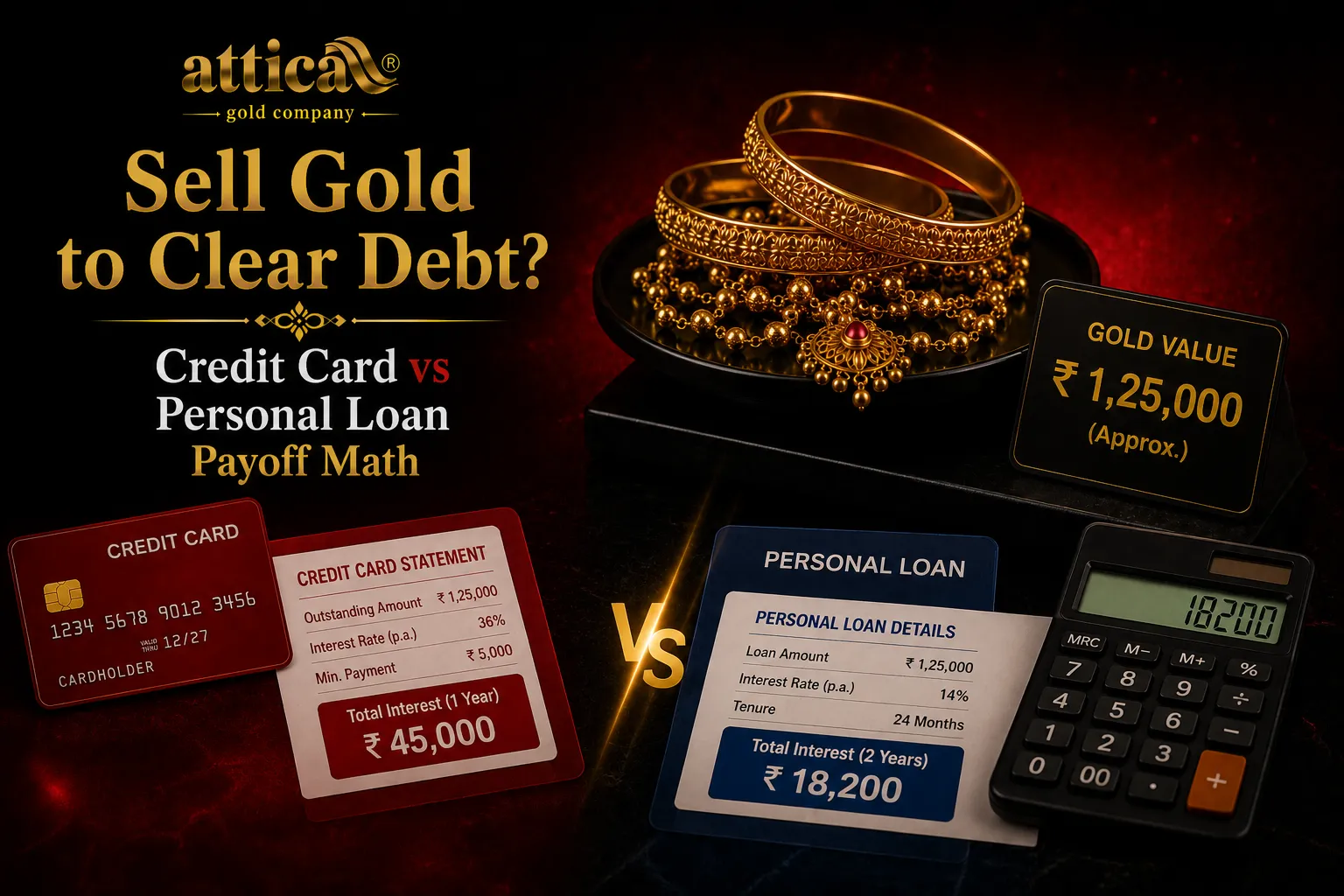
If you’re sitting on family gold while paying 36% APR on credit card outstanding or 15% APR on a personal loan, the math is brutal. ₹2L on a credit card at 36% costs ₹72,000/year just in interest – about the value of 12g of 22K gold. Most Indian households hold gold precisely as ‘wealth in case of emergency’ – and high-interest debt is exactly that emergency. Yet many sellers hesitate because they conflate gold’s emotional value with its financial role. This guide cuts through that with concrete payoff math: when sell gold to pay debt makes sense, when refinancing via gold loan interest rate is better, and when keeping the debt is the right call.
The framework is simple: compare your debt APR against gold sale cost (5–10% one-time) and gold loan interest rate (9–15% per annum). If debt APR is higher than both – typical for credit cards – selling or borrowing both win versus paying the debt down slowly. Choosing between sell and loan depends on whether you want clean closure or shorter-term refinance.
Real Cost Comparison: Sell vs Loan vs Pay-Down
Suppose you have ₹3L credit card debt at 36% APR and ₹4L worth of gold. Three paths:
| Path | 12-Month Cost | Outcome | Best For |
| Pay CC slowly (₹15K/month) | ~₹54,000 interest + ₹1.5L outstanding | Debt drags 24 months | Avoid if possible |
| Take gold loan @ 12% | ₹36,000 interest | Loan + CC closed; new monthly EMI | Want gold back later |
| Sell gold for cash | ~₹25,000 (spread) + ₹15,000 tax = ₹40,000 one-time | Debt fully cleared, no EMI | Want clean closure |
Selling gold for cash wins on total cost (₹40,000 vs ₹36,000–₹54,000), but the gold loan interest rate route is close enough that the choice often comes down to whether you want the gold back later. If you don’t need to recover the same physical gold (heirloom value), selling is cleaner.
- Also Read: Live Gold Price Today
When Sell Gold to Pay Debt Definitely Makes Sense
- Credit card debt at 36–48% APR – selling almost always wins; the spread + tax cost is recovered in 2–4 months of avoided interest.
- Multiple high-interest debts (CC + BNPL + personal loan) – consolidating via gold sale stops the compound damage.
- Debt consolidation india context: combining 3–4 high-APR debts into a single sale is psychologically and financially cleaner than juggling multiple EMIs.
- Personal loan vs gold loan comparison: if existing PL has >12 months remaining at 15%+ APR, selling gold and closing PL saves ₹15,000+ on a ₹3L outstanding.
- Stress / mental health: high-interest debt creates real stress; selling gold to clear it has psychological as well as financial benefits.
When Gold Loan Interest Rate Path Is Better Than Selling
Gold loan interest rate of 9–15% p.a. wins over selling when: (1) you genuinely need the same gold back later (heirloom or wedding piece), (2) you can comfortably service the EMI, (3) the loan tenure is short (<12 months). For these situations, taking a gold loan to pay off CC debt and then repaying the gold loan over 6–9 months is often the cleanest path – you keep the gold, kill the high-APR debt, and the gold loan interest is much lower than CC interest.
Where this fails: if you take the gold loan and can’t pay it back in 9–12 months, you’ve replaced one debt with another, just at a lower rate. Selling clears the slate fully; loan defers but doesn’t eliminate. Personal loan vs gold loan choice matters here – gold loan is faster to disburse and has lower documentation, but PL doesn’t tie up your gold.
Credit Card Payoff Strategy with Gold Sale
Credit card payoff via gold sale follows a specific sequence:
- List all debts with APR, balance, and minimum EMI. Prioritise: highest APR first (typically credit cards).
- Calculate total CC outstanding × 1.05 (buffer for interest accrued during the sale process). This is your target gold sale value.
- Check today’s IBJA-linked sell gold rate today. Calculate grams needed: target ÷ (rate × purity).
- Sell gold at a reputable buyer; receive payment via NEFT/RTGS to your bank account.
- Pay off CCs in order of highest APR first. Get ‘Account Closed’ confirmation in writing for each.
- Cancel the cards if you’re concerned about future overspending (or freeze them via the bank app).
- Use the avoided EMI/interest cash flow to rebuild emergency savings – replenishes liquidity that gold previously provided.
💰 Get the Best Price for Your Gold Today
Instant valuation • Transparent pricing • 100% secure & trusted
Tax Considerations on Sell Gold to Pay Debt
When you sell gold to pay debt, the gain is taxable like any other gold sale: 12.5% LTCG (held >24 months) or STCG at slab rate (<24 months). However, there’s no special tax break for using proceeds to pay off debt – the sale is a sale, regardless of where the proceeds go. Plan for tax: on a ₹4L gold sale where most is LTCG gain, tax ≈ ₹35,000 (after ₹1.25L exemption). Set this aside before paying debts.
What you save: avoided future interest on the cleared debt. ₹3L CC debt at 36% would have cost ₹1,08,000/year in interest if left to drag – versus ₹35,000 one-time tax + ₹20,000 spread = ₹55,000 cost of selling. Net save in year 1: ₹53,000. Years 2+: full ₹1L+ saved annually.
Personal Loan vs Gold Loan: Which to Refinance With?
If you’re not selling gold but want to refinance high-APR debt, personal loan vs gold loan comparison matters:
- Gold loan: 9–15% APR, secured (gold pledged), faster disbursal (same day), lower documentation. Best if you have idle gold.
- Personal loan: 12–18% APR, unsecured (no collateral), longer EMI tenure flexibility (1–5 years), full eligibility based on income/credit score.
- For ₹3L CC payoff, gold loan typically saves ₹10,000–₹20,000 versus personal loan over 12 months.
- Gold loan limit: 75% of your gold’s market value (RBI rule); personal loan limit: 10–20× monthly salary typically.
Why Choose Attica Gold for Debt-Clearing Sales
Selling gold to clear high-interest debt is one of the most financially rational uses of held gold – the math is rarely close when the debt is at 30%+ APR. Yet many families avoid it because of emotional attachment to specific pieces, or because they don’t know how to sell efficiently. The fix is twofold: (1) accept that gold’s role is to be deployed in emergencies, and high-APR debt is exactly that, and (2) choose a buyer who pays close to today’s IBJA rate so the spread cost stays at 5%, not 15%.
Attica Gold offers full debt-consolidation-friendly services: NEFT/RTGS payment directly to your bank account (so the proceeds can be used immediately to pay off CCs and PLs), live IBJA-linked pricing, XRF purity testing, line-by-line written quotes, and ISO 9001:2015 certified processes across 200+ branches in South India. If you’re carrying high-APR debt while sitting on gold, the financial arithmetic almost always favours selling – and your wait is over. Visit your nearest Attica Gold branch today for a free, confidential consultation and a written quote at today’s IBJA-linked sell gold rate today.
Frequently Asked Questions
Should I sell gold to pay off credit card debt?
Yes, in almost all cases. Credit card APR (36–48%) is dramatically higher than gold sale cost (~5–10% one-time). On a ₹3L CC debt, selling gold saves ₹50,000+ in year 1 alone vs paying down slowly. The only exception: if you can comfortably pay off the CC within 3–4 months from regular cash flow, the math is closer.
What’s the gold loan interest rate vs credit card APR comparison?
Gold loan interest rate (9–15% p.a.) is dramatically lower than credit card APR (36–48%). Refinancing CC debt via gold loan saves ~25% per year on outstanding balance. Selling outright saves even more (one-time 5–10% cost vs ongoing 9–15% on loan). Both options beat keeping CC debt.
Personal loan vs gold loan – which is better for debt consolidation?
Personal loan vs gold loan: gold loan typically wins on rate (9–15% vs 12–18%) and disbursal speed (same day vs 1–7 days). Personal loan wins on tenure flexibility (1–5 years vs typical 3–24 months for gold loan) and not requiring collateral. For debt consolidation india, gold loan is usually the cheaper option if you have eligible gold.
Is sell gold to pay debt smart for a ₹5 lakh personal loan?
Sell gold to pay debt for a ₹5L personal loan at 15% APR makes sense if remaining tenure is >18 months (saves ~₹50,000 in interest after sale costs). For shorter remaining tenure (<12 months), selling vs continuing is roughly even – let comfort with the EMI decide.
What is debt consolidation india typically cost via gold sale?
Debt consolidation india via gold sale costs roughly 5–10% of the consolidated amount (gold sale spread + applicable LTCG/STCG tax). For ₹5L of consolidated debt, total cost: ₹25,000–₹50,000. Compared to keeping the debt at 24%+ blended APR, savings in year 1 alone can be ₹80,000–₹1,20,000.
How much sell gold rate today should I get for clearing ₹3L debt?
For ₹3L target net cash, at today’s sell gold rate today (~₹5,500/g for 22K), you need approximately 60g gross of 22K gold. Add 5% buffer for stone/solder deductions and tax – realistic target: 65–70g of 22K gold. Confirm exact figures using today’s IBJA rate × your gold’s tested purity.
Can I get cash for gold quickly enough to clear urgent debt?
Yes – reputable buyers complete the entire process (KYC, weighing, XRF test, written quote, payment) in 30–60 minutes. NEFT/RTGS settlement to your bank account is typically same-day for amounts <₹2L and within 24 hours for larger. Cash for gold is also available for smaller amounts. So debt can be paid off the same day as the gold sale.
Should I clear all my debts at once via gold sale or pay highest-APR first?
Pay highest-APR debt first (typically credit cards, then BNPL, then unsecured personal loans, then secured loans). Sell only enough gold for the high-APR debt; keep the lower-APR loans (home loan at 8.5%) since their interest is below most investment returns. Don’t sell gold to pay off home loan unless you’re close to retirement and want debt-free status.
Sources & References
This page references and is informed by the following authoritative sources. Last verified: May 2026.
[1] Master Direction – Credit Card Operations – Reserve Bank of India (RBI). https://www.rbi.org.in/
[2] Master Direction – Gold Loans – Reserve Bank of India (RBI). https://www.rbi.org.in/
[3] Daily Gold Reference Rate – India Bullion and Jewellers Association (IBJA). https://ibja.co/
[4] Capital Gains Provisions (Sec 45, 48, 112) – Income Tax Act, 1961. https://www.incometaxindia.gov.in/
[5] Personal Loan Lending Norms – Bank-wise Disclosures – Reserve Bank of India (RBI). https://www.rbi.org.in/
{ “@context”: “https://schema.org”, “@type”: “FAQPage”, “mainEntity”: [ { “@type”: “Question”, “name”: “Should I sell gold to pay off credit card debt?”, “acceptedAnswer”: { “@type”: “Answer”, “text”: “Yes, in almost all cases. Credit card APR (36–48%) is dramatically higher than gold sale cost (~5–10% one-time). On a ₹3L CC debt, selling gold saves ₹50,000+ in year 1 alone vs paying down slowly. The only exception: if you can comfortably pay off the CC within 3–4 months from regular cash flow, the math is closer.” } }, { “@type”: “Question”, “name”: “What’s the gold loan interest rate vs credit card APR comparison?”, “acceptedAnswer”: { “@type”: “Answer”, “text”: “Gold loan interest rate (9–15% p.a.) is dramatically lower than credit card APR (36–48%). Refinancing CC debt via gold loan saves ~25% per year on outstanding balance. Selling outright saves even more (one-time 5–10% cost vs ongoing 9–15% on loan). Both options beat keeping CC debt.” } }, { “@type”: “Question”, “name”: “Personal loan vs gold loan – which is better for debt consolidation?”, “acceptedAnswer”: { “@type”: “Answer”, “text”: “Personal loan vs gold loan: gold loan typically wins on rate (9–15% vs 12–18%) and disbursal speed (same day vs 1–7 days). Personal loan wins on tenure flexibility (1–5 years vs typical 3–24 months for gold loan) and not requiring collateral. For debt consolidation india, gold loan is usually the cheaper option if you have eligible gold.” } }, { “@type”: “Question”, “name”: “Is sell gold to pay debt smart for a ₹5 lakh personal loan?”, “acceptedAnswer”: { “@type”: “Answer”, “text”: “Sell gold to pay debt for a ₹5L personal loan at 15% APR makes sense if remaining tenure is >18 months (saves ~₹50,000 in interest after sale costs). For shorter remaining tenure (<12 months), selling vs continuing is roughly even – let comfort with the EMI decide." } }, { "@type": "Question", "name": "What is debt consolidation india typically cost via gold sale?", "acceptedAnswer": { "@type": "Answer", "text": "Debt consolidation india via gold sale costs roughly 5–10% of the consolidated amount (gold sale spread + applicable LTCG/STCG tax). For ₹5L of consolidated debt, total cost: ₹25,000–₹50,000. Compared to keeping the debt at 24%+ blended APR, savings in year 1 alone can be ₹80,000–₹1,20,000." } }, { "@type": "Question", "name": "How much sell gold rate today should I get for clearing ₹3L debt?", "acceptedAnswer": { "@type": "Answer", "text": "For ₹3L target net cash, at today's sell gold rate today (~₹5,500/g for 22K), you need approximately 60g gross of 22K gold. Add 5% buffer for stone/solder deductions and tax – realistic target: 65–70g of 22K gold. Confirm exact figures using today's IBJA rate × your gold's tested purity." } }, { "@type": "Question", "name": "Can I get cash for gold quickly enough to clear urgent debt?", "acceptedAnswer": { "@type": "Answer", "text": "Yes – reputable buyers complete the entire process (KYC, weighing, XRF test, written quote, payment) in 30–60 minutes. NEFT/RTGS settlement to your bank account is typically same-day for amounts <₹2L and within 24 hours for larger. Cash for gold is also available for smaller amounts. So debt can be paid off the same day as the gold sale." } }, { "@type": "Question", "name": "Should I clear all my debts at once via gold sale or pay highest-APR first?", "acceptedAnswer": { "@type": "Answer", "text": "Pay highest-APR debt first (typically credit cards, then BNPL, then unsecured personal loans, then secured loans). Sell only enough gold for the high-APR debt; keep the lower-APR loans (home loan at 8.5%) since their interest is below most investment returns. Don't sell gold to pay off home loan unless you're close to retirement and want debt-free status." } } ] }Carrying high-APR debt while holding gold?
Visit your nearest Attica Gold branch – IBJA-linked quotes, NEFT/RTGS payment to your bank, and ISO-certified process.
Get Instant Valuation
Free evaluation · No obligation · Instant offer
🔒 Your details are safe and confidential