What KDM Gold Means and Why You Still See It in Old Jewellery
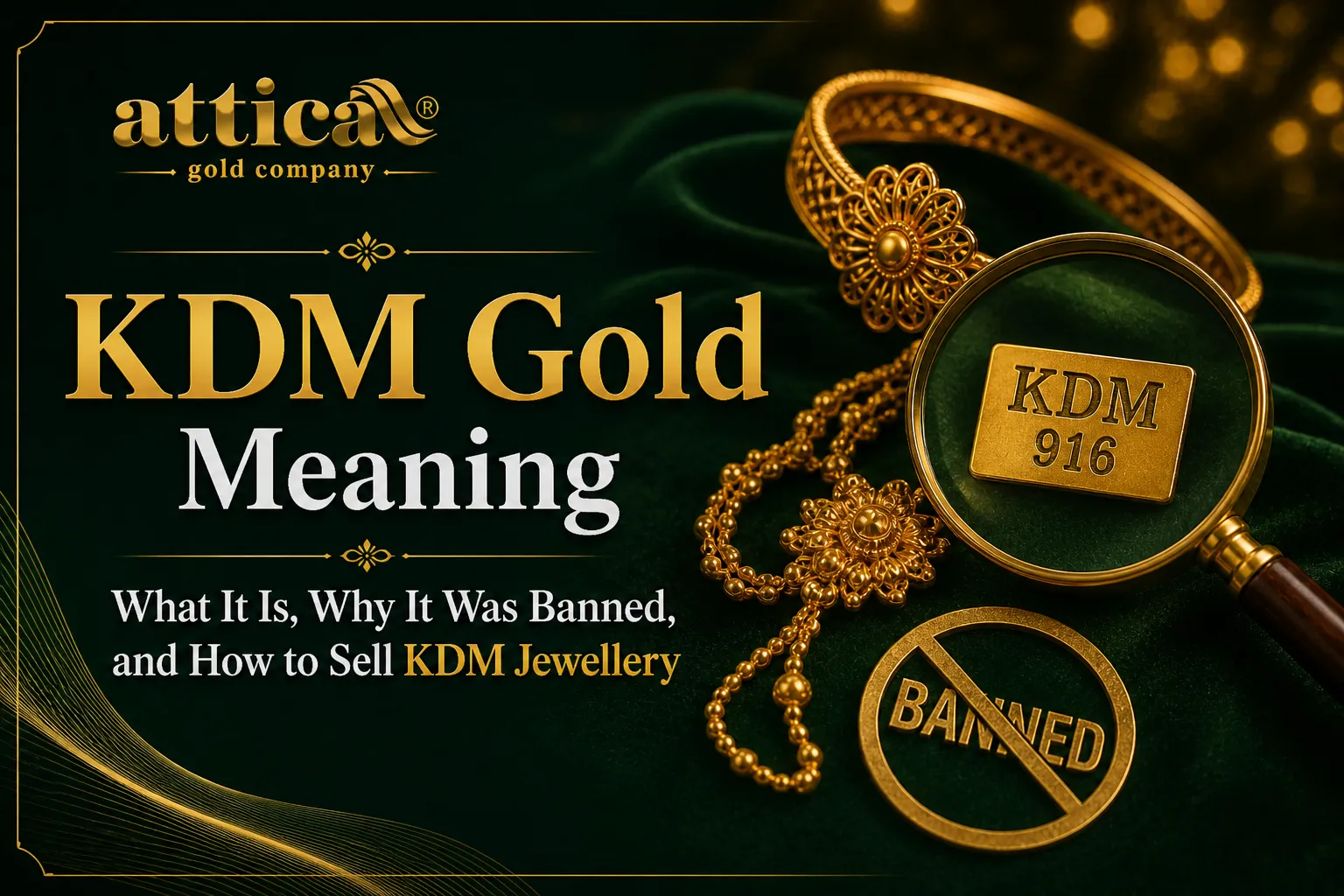
KDM gold meaning is straightforward but often misunderstood: KDM stands for ‘Cadmium-soldered gold’ — gold jewellery joined together using a cadmium-based solder rather than the traditional gold solder. KDM jewellery typically used 92% gold with the solder portion containing cadmium to fuse parts at a lower melting temperature. Until around 2017, KDM was the dominant standard for South Indian gold jewellery, especially for intricate temple jewellery, kasu malas, and ornate wedding sets. The KDM mark was a guarantee that the piece would not need to be re-soldered for everyday wear and that the solder joints would hold over decades. However, KDM is no longer permitted in new gold sales — and the reason is health safety, not gold purity.
This guide covers everything you need to know about KDM gold: what KDM means, why it was phased out, how it differs from BIS hallmark gold, whether your old KDM jewellery is still valuable, and exactly what cash value KDM pieces fetch when sold. By the end, you will know how to identify KDM jewellery and how to sell it confidently in today’s hallmark-only market.
KDM Gold at a Glance
| Attribute | KDM Gold |
| Full Form | Cadmium-soldered gold (Cd = chemical symbol; KDM is industry shorthand) |
| Typical Purity | 91.6% to 92% gold (similar to 22K) |
| Solder Content | Cadmium-based alloy (banned for new gold since 2017) |
| Replaced By | BIS hallmark gold using gold solder (no cadmium) |
| Status Today | Cannot be sold as new; old KDM jewellery still legal to own and sell |
| Resale Value | Same per-gram rate as 22K once XRF-tested for actual purity |
Why KDM Gold Was Banned in India
KDM jewellery was popular for one practical reason: cadmium solder melts at a lower temperature than gold solder, making it easier and cheaper for jewellers to fuse intricate parts without damaging the surrounding gold. For ornate temple jewellery, kasu malas, vaddanams, and detailed bridal sets, KDM allowed designs that were difficult or expensive to achieve with pure gold solder. The cost saving was passed to customers in the form of lower making charges. However, cadmium fumes released during the soldering process are highly toxic and can cause serious lung disease in jewellery workers exposed to them over years.
- Also Read: Live Gold Price Today
Around 2016–2017, India began phasing out KDM jewellery in line with global health and safety standards. The Bureau of Indian Standards (BIS) made cadmium-soldered jewellery non-compliant with the hallmarking system, and from June 2021 onward, BIS hallmarking became mandatory for all new gold jewellery sold in India. KDM jewellery cannot be hallmarked under the current system. Existing KDM pieces are still legal to own, wear, and sell — but no new KDM pieces can be manufactured or sold as new.
KDM vs BIS Hallmark Gold: The Real Difference
The difference between KDM and BIS hallmark gold is in the solder, not the gold purity. Both are typically 91.6% pure gold (22K equivalent). What changed is the metal used to join parts:
| Attribute | KDM Gold (Old) | BIS Hallmark Gold (Modern) |
| Gold Purity | 91.6% (22K) | 91.6% (22K) |
| Solder Used | Cadmium-based alloy | Pure gold solder (or BIS-approved alternatives) |
| Health Safety | Cadmium fumes harmful to workers | Safer for workers and environment |
| Hallmark Status | Cannot be BIS hallmarked | Carries BIS triangle, 916 mark, HUID |
| Sale Status (New) | Banned since 2021 | Mandatory since June 2021 |
| Resale Value | Same as 22K (XRF-tested) | Same as 22K (XRF-tested) |
From a buyer’s perspective, the only difference that affects you when selling is verification. KDM jewellery cannot be verified through BIS hallmark databases (no HUID, no BIS Care app entry). Reputable buyers verify it via XRF testing instead — the same machine that verifies hallmarked gold. The result: you are paid for the actual gold content (typically 91.6%), with no penalty for the absence of a BIS hallmark.
Is My Old KDM Jewellery Still Valuable?
Yes — and the answer is more reassuring than most KDM owners assume. Your old KDM jewellery is gold first and KDM second. The solder type does not affect the gold content of the piece; it only affects the manufacturing method. So a 50-gram KDM bangle holds approximately 50 grams of 22K gold (minus a small percentage for the solder weight, typically 2–5% of total weight depending on the design). When you sell, the buyer’s XRF test measures the actual gold content, weighs the piece, and applies today’s 24K rate to that gold weight.
There is no ‘KDM penalty’ applied by reputable buyers. Some unorganised buyers may try to underprice KDM by claiming it is ‘low purity’ or ‘outdated’ — this is unfair and inaccurate. The XRF reading is the truth: if your piece tests at 91.6%, you are paid for 91.6% gold at today’s per-gram rate. The age of the piece, the absence of a BIS hallmark, and the cadmium solder content do not reduce the per-gram resale value of the gold.
💰 Get the Best Price for Your Gold Today
Instant valuation • Transparent pricing • 100% secure & trusted
How Much Solder Does KDM Jewellery Contain?
Solder weight varies by design. Plain pieces (simple chains, bangles, rings) typically have 1–3% solder by weight. Intricate pieces (temple jewellery, kasu malas, vaddanams) can have 5–10% solder, since each component is joined separately. The cadmium solder itself contains some gold, but the percentage is typically 50–60% (lower than the body of the piece). When XRF-tested, the overall purity reading reflects the weighted average of body gold and solder gold.
For example, a 50g temple necklace might have 47g of 22K body gold (91.6% pure) and 3g of solder (60% gold). The XRF reading would show approximately 89.7% overall purity — slightly below pure 22K. Reputable buyers price this at 89.7% × 50g × today’s 24K rate, which is the correct amount for what the piece actually contains. The slight reduction from 91.6% is the honest cost of the solder content; it is not a penalty, just the reality of what the piece is made of.
Resale Value: What KDM Jewellery Actually Fetches Today
The KDM gold price for resale is direct: tested purity × weight × today’s 24K rate, minus deductions for stones and any clearly non-gold elements. For a 22K KDM piece weighing 10g that tests at 90% (slightly below 91.6% due to solder), the resale value at today’s ₹15,250/g 24K rate works out to: 10 × 0.90 × ₹15,250 = ₹1,37,250 gross. Compare that to a similar 10g piece of pure 22K hallmarked gold (no solder) at 91.6%: 10 × 0.916 × ₹15,250 = ₹1,39,690 — a difference of about ₹2,440 for the solder content. This is fair and transparent, not a penalty.
The 916 gold rate today and KDM gold rate today are calculated from the same IBJA benchmark. The only price difference between hallmarked and KDM is the small purity variation caused by solder content. There is no ‘KDM is worth less’ rule. Reputable buyers verify with XRF and pay the exact gold content at today’s per-gram rate.
What to Watch For When Selling KDM Jewellery
Three issues are specific to KDM sellers. First, some buyers may quote significantly below today’s rate, claiming KDM is ‘no longer accepted’ or ‘difficult to sell’. This is misleading — KDM jewellery is fully legal to sell, and any reputable buyer accepts it without any penalty beyond the natural solder-content adjustment. If a buyer rejects your KDM piece outright or offers a significantly low rate, walk away. Second, KDM jewellery often includes precious or semi-precious stones (rubies, emeralds, polki, kundan, beads). Insist that stones be removed and returned to you before the gold is weighed. Stones have their own resale market and should not be sold along with the gold.
Third, very ornate KDM pieces (heavy temple jewellery, kasu malas with many components) can have high solder content (8–10%). The XRF reading on these pieces will show lower overall purity than the gold body alone. This is normal and reflects the actual gold content of the piece. Ask your buyer to break down the calculation: tested purity × weight × today’s 24K rate. If the math is transparent and the rate is close to IBJA, the deal is fair.
Why Choose Attica Gold to Sell Your KDM Jewellery
KDM jewellery is a piece of South Indian heritage — and selling it deserves a buyer who recognises its value rather than dismissing it as ‘outdated’. The cadmium solder is why KDM was phased out for health reasons; it is not a reason to underprice your piece. The 91.6% gold content (or whatever the XRF reading shows) has the same per-gram value at today’s IBJA rate as any other 22K gold. The right buyer will accept KDM without surcharge, run a transparent XRF test in your presence, and pay the exact gold content at today’s rate.
Attica Gold accepts KDM jewellery at every branch across Karnataka, Tamil Nadu, Andhra Pradesh, Telangana and Pondicherry — no minimum weight, no maximum, no ‘KDM penalty’, no pressure to convert into a hallmark exchange. The price is calculated transparently: weight × tested purity × today’s IBJA 24K rate − fair deductions for stones, listed line by line on your written receipt. Payment is instant in your chosen mode — cash, UPI, NEFT, RTGS, or IMPS. ISO 9001:2015 certification means the same standard at every branch, every day. Your wait is over — walk into your nearest Attica Gold branch for a free XRF test and a written quote at today’s rate, and see for yourself.
Frequently Asked Questions
What does KDM gold mean?
KDM gold meaning is cadmium-soldered gold — gold jewellery joined together using a cadmium-based solder rather than traditional gold solder. KDM jewellery is typically 91.6% pure gold (22K equivalent), with the solder portion containing cadmium to fuse parts at lower temperatures. KDM was the dominant standard for South Indian gold jewellery until 2017 and was phased out due to cadmium fume health risks for jewellery workers.
Is KDM gold the same as 22K or 916 gold?
KDM gold typically contains the same 91.6% gold purity as 22K (916 hallmark) jewellery. The difference is in the solder — KDM uses cadmium-based solder, while modern hallmark gold uses pure gold or BIS-approved solder. The gold body of both KDM and 916 jewellery is the same purity. KDM jewellery may have a slightly lower overall XRF reading due to the solder content, typically 89–91% rather than the full 91.6%.
Why was KDM gold banned in India?
KDM was phased out around 2016–2017 due to health safety concerns. Cadmium fumes released during the soldering process can cause serious lung disease in jewellery workers exposed over years. The Bureau of Indian Standards (BIS) made cadmium-soldered jewellery non-compliant with the hallmarking system, and from June 2021 onward, all new gold jewellery sold in India must be BIS hallmarked using cadmium-free solder. KDM was banned for worker safety reasons, not because the gold purity was inferior.
Can I still sell my old KDM jewellery?
Yes. Existing KDM jewellery is fully legal to own, wear, and sell — only the manufacture and sale of new KDM pieces is banned. Reputable buyers like Attica Gold accept KDM jewellery at every branch and value it by XRF-testing the actual gold content. The KDM gold price is the tested purity × weight × today’s 24K rate, with no ‘KDM penalty’ applied.
What is the KDM gold rate today?
The KDM gold rate today is calculated as the actual XRF-tested purity × today’s 24K rate per gram. For a typical KDM piece testing at 90% purity, with 24K at ₹15,250/g, the per-gram rate works out to approximately ₹13,725. The exact rate depends on the specific piece — XRF testing measures the actual gold content (body gold + solder gold combined), and the rate is applied to that figure.
What is the difference between KDM and hallmark gold?
KDM uses cadmium-based solder; BIS hallmark gold uses cadmium-free solder (typically pure gold solder or other approved alternatives). Both are typically 91.6% pure gold (22K equivalent). KDM cannot be BIS hallmarked under the current system. Hallmark gold carries the BIS triangle, 916 mark, HUID, and jeweller’s identification. Resale value depends on actual gold content, not on hallmark status — both are paid based on XRF-tested purity at today’s IBJA rate.
Will I get less money for KDM jewellery than for hallmark jewellery?
Slightly less, but only because of the solder content — not because of any ‘KDM penalty’. KDM pieces typically test at 89–91% overall purity (slightly below the 91.6% of pure 22K) because the cadmium solder contains less gold than the body. The difference for a 10g piece is typically ₹2,000–₹3,000 at today’s rate. Reputable buyers calculate the exact gold content via XRF and pay accordingly. There is no extra penalty beyond the natural purity adjustment for solder.
How can I tell if my old jewellery is KDM?
KDM jewellery typically carries the ‘KDM’ stamp somewhere on the piece — often on the clasp, the back, or near a hidden joint. Pieces sold before 2017 in South India (especially Tamil Nadu, Karnataka, and Andhra Pradesh) are very likely KDM, even if the stamp is faded. If your piece does not carry a BIS triangle and HUID, and was bought before 2021, it is most likely either KDM or older 22K. XRF testing at any reputable buyer will confirm the actual gold content regardless.
{ “@context”: “https://schema.org”, “@type”: “FAQPage”, “mainEntity”: [ { “@type”: “Question”, “name”: “What does KDM gold mean?”, “acceptedAnswer”: { “@type”: “Answer”, “text”: “KDM gold meaning is cadmium-soldered gold — gold jewellery joined together using a cadmium-based solder rather than traditional gold solder. KDM jewellery is typically 91.6% pure gold (22K equivalent), with the solder portion containing cadmium to fuse parts at lower temperatures. KDM was the dominant standard for South Indian gold jewellery until 2017 and was phased out due to cadmium fume health risks for jewellery workers.” } }, { “@type”: “Question”, “name”: “Is KDM gold the same as 22K or 916 gold?”, “acceptedAnswer”: { “@type”: “Answer”, “text”: “KDM gold typically contains the same 91.6% gold purity as 22K (916 hallmark) jewellery. The difference is in the solder — KDM uses cadmium-based solder, while modern hallmark gold uses pure gold or BIS-approved solder. The gold body of both KDM and 916 jewellery is the same purity. KDM jewellery may have a slightly lower overall XRF reading due to the solder content, typically 89–91% rather than the full 91.6%.” } }, { “@type”: “Question”, “name”: “Why was KDM gold banned in India?”, “acceptedAnswer”: { “@type”: “Answer”, “text”: “KDM was phased out around 2016–2017 due to health safety concerns. Cadmium fumes released during the soldering process can cause serious lung disease in jewellery workers exposed over years. The Bureau of Indian Standards (BIS) made cadmium-soldered jewellery non-compliant with the hallmarking system, and from June 2021 onward, all new gold jewellery sold in India must be BIS hallmarked using cadmium-free solder. KDM was banned for worker safety reasons, not because the gold purity was inferior.” } }, { “@type”: “Question”, “name”: “Can I still sell my old KDM jewellery?”, “acceptedAnswer”: { “@type”: “Answer”, “text”: “Yes. Existing KDM jewellery is fully legal to own, wear, and sell — only the manufacture and sale of new KDM pieces is banned. Reputable buyers like Attica Gold accept KDM jewellery at every branch and value it by XRF-testing the actual gold content. The KDM gold price is the tested purity × weight × today’s 24K rate, with no ‘KDM penalty’ applied.” } }, { “@type”: “Question”, “name”: “What is the KDM gold rate today?”, “acceptedAnswer”: { “@type”: “Answer”, “text”: “The KDM gold rate today is calculated as the actual XRF-tested purity × today’s 24K rate per gram. For a typical KDM piece testing at 90% purity, with 24K at ₹15,250/g, the per-gram rate works out to approximately ₹13,725. The exact rate depends on the specific piece — XRF testing measures the actual gold content (body gold + solder gold combined), and the rate is applied to that figure.” } }, { “@type”: “Question”, “name”: “What is the difference between KDM and hallmark gold?”, “acceptedAnswer”: { “@type”: “Answer”, “text”: “KDM uses cadmium-based solder; BIS hallmark gold uses cadmium-free solder (typically pure gold solder or other approved alternatives). Both are typically 91.6% pure gold (22K equivalent). KDM cannot be BIS hallmarked under the current system. Hallmark gold carries the BIS triangle, 916 mark, HUID, and jeweller’s identification. Resale value depends on actual gold content, not on hallmark status — both are paid based on XRF-tested purity at today’s IBJA rate.” } }, { “@type”: “Question”, “name”: “Will I get less money for KDM jewellery than for hallmark jewellery?”, “acceptedAnswer”: { “@type”: “Answer”, “text”: “Slightly less, but only because of the solder content — not because of any ‘KDM penalty’. KDM pieces typically test at 89–91% overall purity (slightly below the 91.6% of pure 22K) because the cadmium solder contains less gold than the body. The difference for a 10g piece is typically ₹2,000–₹3,000 at today’s rate. Reputable buyers calculate the exact gold content via XRF and pay accordingly. There is no extra penalty beyond the natural purity adjustment for solder.” } }, { “@type”: “Question”, “name”: “How can I tell if my old jewellery is KDM?”, “acceptedAnswer”: { “@type”: “Answer”, “text”: “KDM jewellery typically carries the ‘KDM’ stamp somewhere on the piece — often on the clasp, the back, or near a hidden joint. Pieces sold before 2017 in South India (especially Tamil Nadu, Karnataka, and Andhra Pradesh) are very likely KDM, even if the stamp is faded. If your piece does not carry a BIS triangle and HUID, and was bought before 2021, it is most likely either KDM or older 22K. XRF testing at any reputable buyer will confirm the actual gold content regardless.” } } ] }Have old KDM jewellery you want to value?
Visit your nearest Attica Gold branch for a free XRF purity test and a transparent written quote at today’s live rate — no KDM penalty, no surcharges, no pressure.
Get Instant Valuation
Free evaluation · No obligation · Instant offer
🔒 Your details are safe and confidential