Why 1 Gram Gold Rate Matters for Every Indian Buyer and Seller
The 1 gram gold rate today is the most fundamental price reference in the Indian gold market – and the one that drives every other calculation. Whether you are buying a 5g coin, selling a 25g chain, or valuing a 100g bullion bar, the underlying math is always the same: per-gram rate × weight × tested purity. The 1 gram gold rate today for 24K (the master benchmark) is approximately ₹15,250 in India today; for 22K it is around ₹13,965; for 18K it is around ₹11,438. These rates change twice daily based on IBJA (India Bullion and Jewellers Association) updates and intraday based on MCX moves.
This guide covers everything you need to know about the 1 gram gold rate today: live rates across 22K, 24K, 18K, and 14K; what drives daily and intraday changes; whether 1 gram coins are good investment; how to calculate the exact resale value of any gold piece you own; and what to watch for when comparing buyer quotes against the live 1 gram gold price. By the end, you will know exactly what your gold is worth per gram – and you will never again accept a quote without verifying it against today’s IBJA rate.
1 Gram Gold Rate at a Glance
| Purity | 1 Gram Rate (Reference, Today) | BIS Hallmark | Common Use |
| 24K (pure) | ₹15,250/g | 999 | Coins, bars, investment bullion |
| 22K | ₹13,965/g | 916 | Wedding gold, traditional jewellery |
| 18K | ₹11,438/g | 750 | Diamond jewellery, designer pieces |
| 14K | ₹8,921/g | 585 | Lightweight chains, fashion pieces |
Today’s Live 1 Gram Gold Rate Across Purities
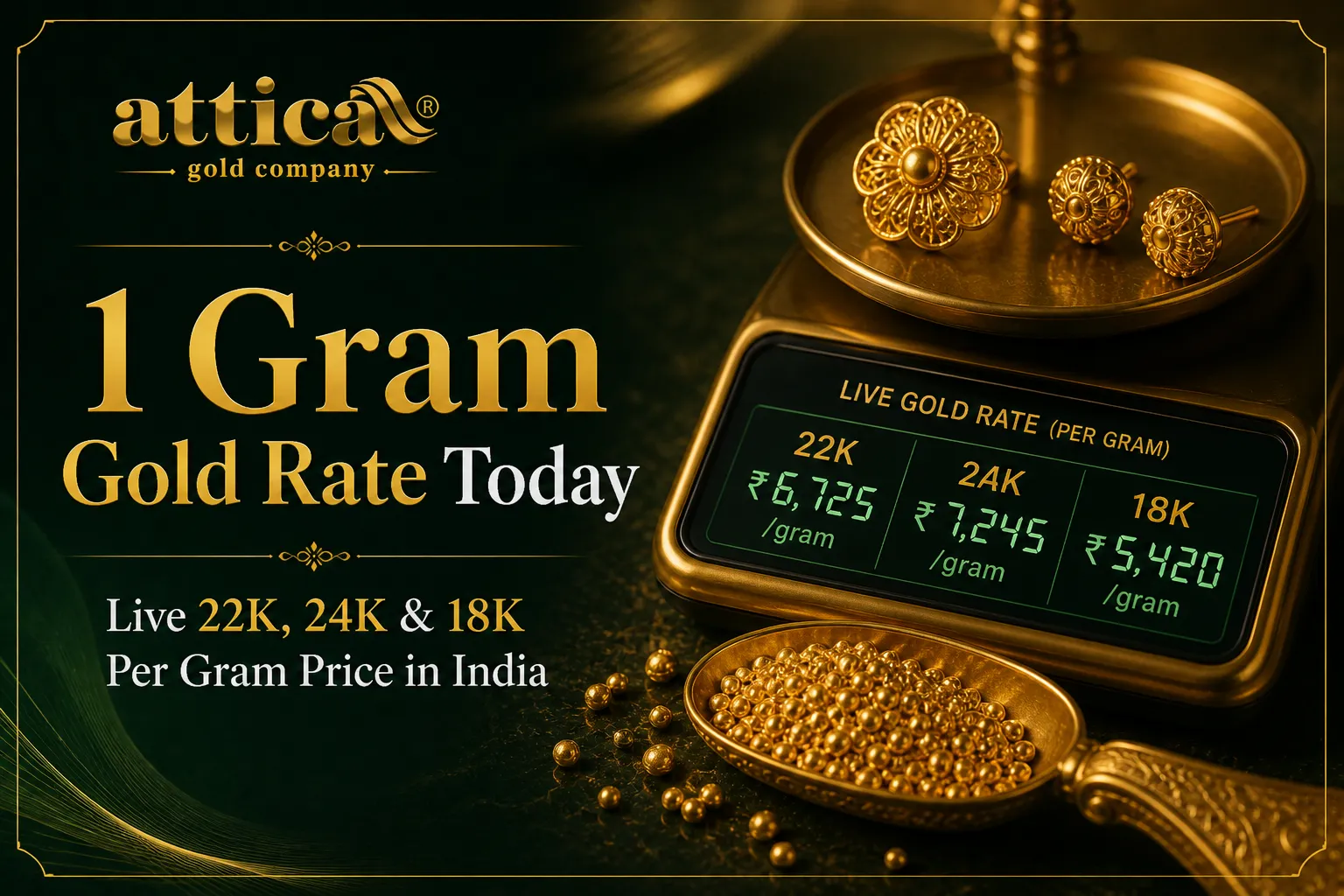
The 1 gram gold rate today is set by IBJA each morning and evening, and refined intraday based on MCX moves. As of today’s reference: 24K trades at approximately ₹15,250 per gram, 22K at ₹13,965 per gram, 18K at ₹11,438 per gram, and 14K at ₹8,921 per gram. These figures change with international gold spot prices, the rupee–dollar exchange rate, and Indian import duty (currently around 6%). When international gold rises by 1%, the 1 gram gold price in India typically rises by a slightly larger margin due to currency translation.
Use the widget below to verify the 1 gram gold rate today in real time. Reputable buyers reference the IBJA twice-daily benchmark plus live MCX intraday moves. The 1 gram gold rate today is largely uniform city-to-city – the per-gram price in Bangalore, Chennai, Hyderabad, Mumbai, and Delhi tracks the same IBJA benchmark with only minor handling differences (₹10–₹50/g).
How the 1 Gram Gold Rate Today Is Calculated
The 1 gram gold price today is derived through a transparent four-step process. First, the international gold spot price (quoted in US dollars per troy ounce on COMEX, LBMA, and Asian markets) is converted to grams: 1 troy ounce = 31.1035 grams. Second, the dollar price is converted to rupees using the prevailing USD/INR exchange rate. Third, Indian import duty (currently 6%) and GST (3% for buyers, not applicable to sellers) are added. Fourth, the IBJA averages the buy/sell quotes from major Indian bullion dealers and publishes the morning and evening reference rates.
All other purity rates are derived as percentages of the 24K rate: 22K = 91.6%, 18K = 75%, 14K = 58.5%. So when 24K is at ₹15,250, the 1 gram gold rate for 22K is 0.916 × ₹15,250 = ₹13,969. The slight rounding differences you see between publications (₹13,965 vs ₹13,970) are normal and reflect different rounding conventions, not different actual rates.
What Drives the 1 Gram Gold Rate to Move
The 1 gram gold rate today changes for four main reasons, each with different time horizons:
- International gold spot price: Moves continuously during trading hours and is influenced by factors like US Federal Reserve policy, geopolitical events, equity market volatility, and central bank gold buying.
- Rupee–dollar exchange rate: When the rupee weakens against the dollar, the per-gram gold price in India rises, since gold is globally priced in dollars.
- Indian import duty: Periodic budget changes can adjust duty rates, directly impacting the final per-gram price for consumers.
- Local supply and demand: Festival seasons (Akshaya Tritiya, Diwali, Dhanteras), wedding periods (October–February), and harvest cycles in rural India can create demand spikes, temporarily widening the IBJA margin.
Most days, the 1 gram gold rate moves by ₹50–₹200 per gram. Occasionally, on major news days (Fed announcements, geopolitical escalation, surprise budget changes), the rate can move ₹500+ per gram in a single session. Long-term, gold has averaged 8–10% annual returns in rupee terms over the last 20 years, with cyclical volatility.
💰 Get the Best Price for Your Gold Today
Instant valuation • Transparent pricing • 100% secure & trusted
Are 1 Gram Gold Coins a Good Investment?
1 gram gold coins are popular as gifts and small investments – they are affordable (around ₹15,000–₹16,000 each at today’s rates), portable, and easy to store. RBI sovereign coins, MMTC-PAMP coins, and bank-issued festival coins all come in 1g denominations. They are also popular for Akshaya Tritiya, Dhanteras, and as wedding gifts. From an investment standpoint, however, 1g coins typically have higher per-gram premiums than larger denominations: a 1g coin may carry a 5–8% making/refining premium over the spot rate, while a 10g bar may carry only 2–3%.
When selling 1g coins back, the same per-gram refining margin (1–2%) applies. So if you bought a 1g coin at a 5% premium and sell it at a 1.5% margin, you effectively lose about 6.5% on the round-trip – significant for short-term holdings, but manageable for long-term investment over 5+ years where gold appreciation typically far exceeds these spreads. For pure investment, 10g or larger bars are more efficient than multiple 1g coins.
How to Calculate Resale Value Using the 1 Gram Gold Rate
The formula every buyer uses is the same: Resale Value = Weight (g) × Tested Purity × Today’s 24K Rate − Fair Deductions. Worked examples at today’s reference rates:
- 5g of 22K chain: 5 × 0.916 × ₹15,250 = ₹69,845 gross.
- 10g of 22K bangle: 10 × 0.916 × ₹15,250 = ₹1,39,690 gross.
- 20g of 18K diamond ring (gold portion): 20 × 0.75 × ₹15,250 = ₹2,28,750 (stone weight excluded; stones valued separately).
- 50g of 24K coin collection: 50 × 0.999 × ₹15,250 = ₹7,61,738 (subject to a small refining margin).
- 100g of 14K fashion chains: 100 × 0.585 × ₹15,250 = ₹8,92,125 gross.
Fair deductions include: stones (removed and returned to you separately), solder weight (1–5% for plain pieces, 5–10% for ornate temple jewellery), and any non-gold elements like beads or enamel. Making charges, wastage, and design premiums you originally paid are NOT refunded – those are sunk costs of the original purchase.
What to Watch For When Comparing Buyer Quotes
When comparing 1 gram gold rate quotes from different buyers, three checks separate fair offers from underpriced ones. First, check the per-gram rate against the live IBJA benchmark. Anything more than ₹100–₹200/g below the published rate (for 22K or 24K) should be questioned. Second, ask for purity testing by XRF – not just touchstone or acid. XRF measures actual purity to within 0.1% in seconds; touchstone and acid are less accurate and easier to manipulate. Third, ask for a written quote with line-by-line breakdown: gross weight, stone weight, net gold weight, tested purity, today’s per-gram rate applied, and any deductions.
If a buyer quotes a flat percentage cut (like ‘5% off the rate’) without a line-by-line breakdown, walk away. Reputable buyers like Attica Gold show every component of the calculation in writing. Following these three rules consistently ensures you are paid the correct amount based on the live 1 gram gold rate today, not a quietly underpriced offer.
Why Choose Attica Gold for Today’s Live 1 Gram Gold Rate
The 1 gram gold rate today is the most transparent benchmark in the Indian gold market – and selling your gold deserves a buyer who matches that transparency. The IBJA twice-daily rate is published openly; XRF testing measures your gold’s actual purity in seconds; today’s per-gram rate is multiplied by your tested gold weight to produce the final amount. There is no scope for hidden margins or ‘making charges’ on resale. The right buyer will be open about every line on the receipt and pay you the correct amount based on today’s live rate.
Attica Gold publishes today’s 1 gram gold rate openly at every branch across Karnataka, Tamil Nadu, Andhra Pradesh, Telangana and Pondicherry. Free XRF purity testing in your presence, transparent line-by-line written quotes, no hidden percentage cuts, and instant payment in cash, UPI, NEFT, RTGS, or IMPS – your choice. ISO 9001:2015 certification means the same standard at every branch, every day. Your wait is over – walk into your nearest Attica Gold branch for a free XRF test and a written quote at today’s exact 1 gram gold rate.
Frequently Asked Questions
What is the 1 gram gold rate today in India?
The 1 gram gold rate today varies by purity. For 24K (pure gold), it is approximately ₹15,250 per gram; for 22K it is around ₹13,965 per gram; for 18K it is around ₹11,438 per gram; and for 14K it is around ₹8,921 per gram. These rates are set by IBJA twice daily and adjusted intraday based on MCX moves. Use the live rate widget above for the exact 1 gram gold price right now.
How is the 1 gram gold price calculated?
The 1 gram gold price is calculated from international gold spot prices in US dollars per troy ounce, converted to rupees per gram using the current USD/INR exchange rate, with Indian import duty (currently 6%) added. IBJA averages the buy/sell quotes from major bullion dealers and publishes the reference rate. Other purities are derived as percentages: 22K = 91.6% of 24K, 18K = 75%, 14K = 58.5%.
Is the 1 gram gold rate today the same in all Indian cities?
Largely yes. The 1 gram gold rate today is set by IBJA nationally, with minor city-to-city differences (₹10–₹50/g) for local handling. The bigger differences come from buyer-to-buyer margins, not city-to-city changes. Bangalore, Chennai, Hyderabad, Mumbai, and Delhi all trade within a narrow band, with the same IBJA benchmark applied across all major buyers.
Are 1 gram gold coins a good investment?
1 gram gold coins are good for gifts and small investments due to their portability and affordability (around ₹15,000–₹16,000 each at today’s rates). However, they typically carry a higher per-gram making/refining premium (5–8%) compared to larger 10g+ bars (2–3%). For pure long-term investment, larger denominations are more efficient. For gifting, festival purchases, or starter investments, 1g coins are ideal.
How much will I get for 1 gram of 22K gold today?
For 1 gram of 22K gold at today’s ₹15,250/g 24K rate, the gross resale value is 1 × 0.916 × ₹15,250 = ₹13,969. The actual amount you receive depends on tested purity (XRF measures actual gold content), any deductions for stones or solder, and the buyer’s refining margin (typically minimal on standard hallmarked jewellery).
Can I buy 1 gram gold below today’s market rate?
No – buying gold below the live IBJA rate is generally not possible from reputable sellers. Any offer significantly below the 1 gram gold rate today should be treated with suspicion (it could be counterfeit or stolen gold). Festive promotions sometimes waive making charges or offer GST discounts on 1g coins, which effectively reduces the total cost, but the underlying gold price stays close to IBJA.
Why does the 1 gram gold rate change every day?
The 1 gram gold rate today changes due to four factors: (1) international gold spot price moves continuously during global trading hours, (2) rupee-dollar exchange rate fluctuations affect the rupee equivalent, (3) Indian import duty (currently 6%) is set by the government and changes periodically, and (4) local supply-demand from festival and wedding seasons creates short-term margin shifts. Most days the rate moves ₹50–₹200/g; major news days can move it ₹500+/g.
Where can I check today’s 1 gram gold rate before selling?
The most reliable sources are IBJA’s official rate (published twice daily on ibja.co), MCX gold futures (for intraday spot reference), and reputable gold buyers’ websites that publish their day’s rate openly. Avoid relying on jeweller-specific rates (which often include retail markups) or social media forwards (which may be outdated). Cross-check at least two sources before walking into a branch to sell.
{ “@context”: “https://schema.org”, “@type”: “FAQPage”, “mainEntity”: [ { “@type”: “Question”, “name”: “What is the 1 gram gold rate today in India?”, “acceptedAnswer”: { “@type”: “Answer”, “text”: “The 1 gram gold rate today varies by purity. For 24K (pure gold), it is approximately ₹15,250 per gram; for 22K it is around ₹13,965 per gram; for 18K it is around ₹11,438 per gram; and for 14K it is around ₹8,921 per gram. These rates are set by IBJA twice daily and adjusted intraday based on MCX moves. Use the live rate widget above for the exact 1 gram gold price right now.” } }, { “@type”: “Question”, “name”: “How is the 1 gram gold price calculated?”, “acceptedAnswer”: { “@type”: “Answer”, “text”: “The 1 gram gold price is calculated from international gold spot prices in US dollars per troy ounce, converted to rupees per gram using the current USD/INR exchange rate, with Indian import duty (currently 6%) added. IBJA averages the buy/sell quotes from major bullion dealers and publishes the reference rate. Other purities are derived as percentages: 22K = 91.6% of 24K, 18K = 75%, 14K = 58.5%.” } }, { “@type”: “Question”, “name”: “Is the 1 gram gold rate today the same in all Indian cities?”, “acceptedAnswer”: { “@type”: “Answer”, “text”: “Largely yes. The 1 gram gold rate today is set by IBJA nationally, with minor city-to-city differences (₹10–₹50/g) for local handling. The bigger differences come from buyer-to-buyer margins, not city-to-city changes. Bangalore, Chennai, Hyderabad, Mumbai, and Delhi all trade within a narrow band, with the same IBJA benchmark applied across all major buyers.” } }, { “@type”: “Question”, “name”: “Are 1 gram gold coins a good investment?”, “acceptedAnswer”: { “@type”: “Answer”, “text”: “1 gram gold coins are good for gifts and small investments due to their portability and affordability (around ₹15,000–₹16,000 each at today’s rates). However, they typically carry a higher per-gram making/refining premium (5–8%) compared to larger 10g+ bars (2–3%). For pure long-term investment, larger denominations are more efficient. For gifting, festival purchases, or starter investments, 1g coins are ideal.” } }, { “@type”: “Question”, “name”: “How much will I get for 1 gram of 22K gold today?”, “acceptedAnswer”: { “@type”: “Answer”, “text”: “For 1 gram of 22K gold at today’s ₹15,250/g 24K rate, the gross resale value is 1 × 0.916 × ₹15,250 = ₹13,969. The actual amount you receive depends on tested purity (XRF measures actual gold content), any deductions for stones or solder, and the buyer’s refining margin (typically minimal on standard hallmarked jewellery).” } }, { “@type”: “Question”, “name”: “Can I buy 1 gram gold below today’s market rate?”, “acceptedAnswer”: { “@type”: “Answer”, “text”: “No – buying gold below the live IBJA rate is generally not possible from reputable sellers. Any offer significantly below the 1 gram gold rate today should be treated with suspicion (it could be counterfeit or stolen gold). Festive promotions sometimes waive making charges or offer GST discounts on 1g coins, which effectively reduces the total cost, but the underlying gold price stays close to IBJA.” } }, { “@type”: “Question”, “name”: “Why does the 1 gram gold rate change every day?”, “acceptedAnswer”: { “@type”: “Answer”, “text”: “The 1 gram gold rate today changes due to four factors: (1) international gold spot price moves continuously during global trading hours, (2) rupee-dollar exchange rate fluctuations affect the rupee equivalent, (3) Indian import duty (currently 6%) is set by the government and changes periodically, and (4) local supply-demand from festival and wedding seasons creates short-term margin shifts. Most days the rate moves ₹50–₹200/g; major news days can move it ₹500+/g.” } }, { “@type”: “Question”, “name”: “Where can I check today’s 1 gram gold rate before selling?”, “acceptedAnswer”: { “@type”: “Answer”, “text”: “The most reliable sources are IBJA’s official rate (published twice daily on ibja.co), MCX gold futures (for intraday spot reference), and reputable gold buyers’ websites that publish their day’s rate openly. Avoid relying on jeweller-specific rates (which often include retail markups) or social media forwards (which may be outdated). Cross-check at least two sources before walking into a branch to sell.” } } ] }Want to know your 1 gram gold rate today and exactly how much your gold piece is worth?
Visit your nearest Attica Gold branch for a free XRF purity test and a transparent written quote at today’s live rate.
Get Instant Valuation
Free evaluation · No obligation · Instant offer
🔒 Your details are safe and confidential