
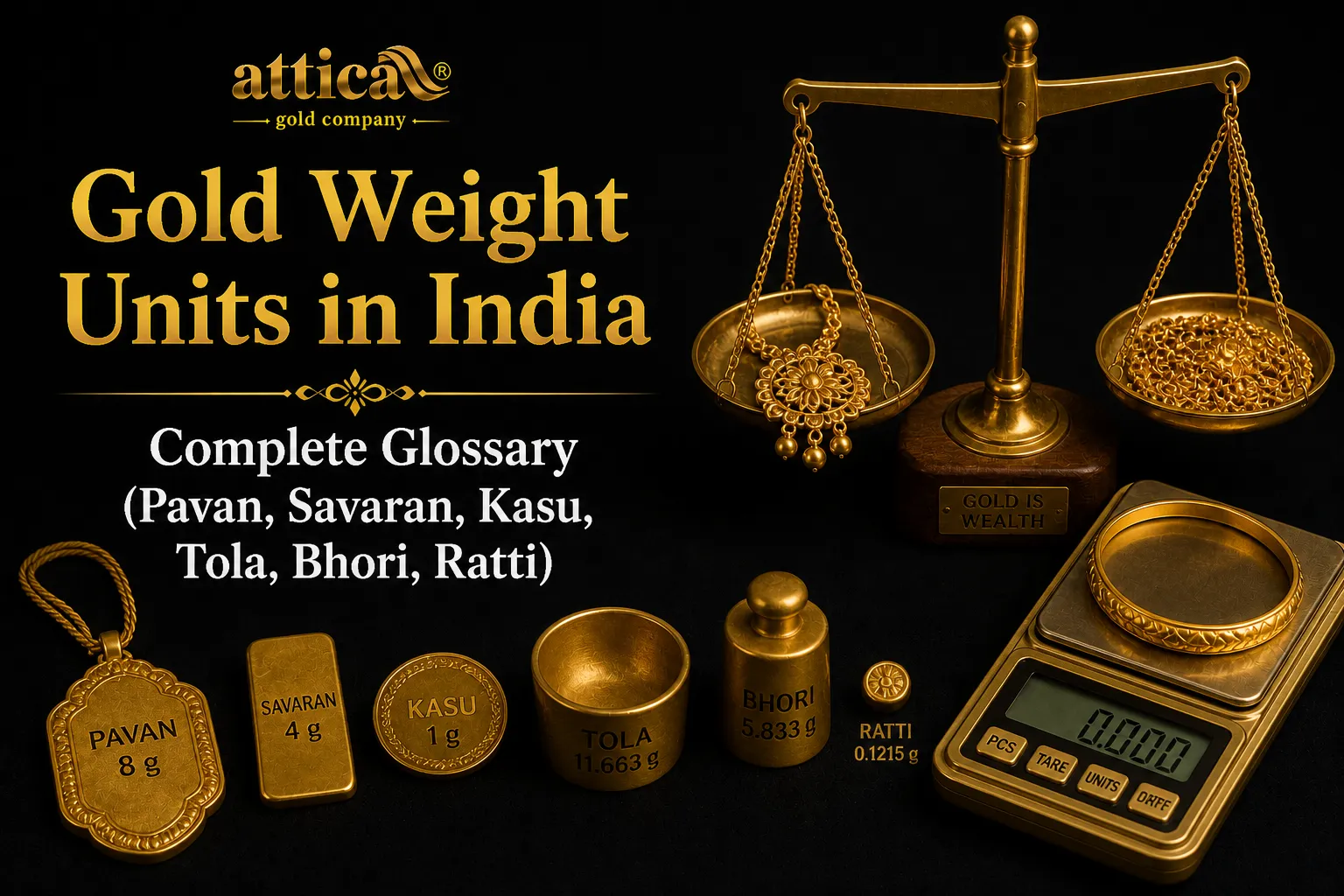
Why 1 Pavan Gold Rate and Other Indian Weight Units Still Matter
India uses more gold weight units in everyday conversation than almost any other country, and the most searched of all is the 1 pavan gold rate – over 22,000 monthly searches, dominated by buyers and sellers in Karnataka and Tamil Nadu. The 1 pavan gold rate is calculated simply: today’s per-gram IBJA rate × 8 (because 1 pavan equals 8 grams). So when 22K trades at ₹6,225 per gram, the 1 pavan gold rate is ₹49,800. The same per-gram-times-eight formula works for sovereign and savaran in Tamil Nadu and Kerala, since all three are 8-gram units – making the 1 pavan gold rate a useful reference for sovereign-measured and savaran-measured gold too.
This guide is the complete glossary of Indian gold weight units: the 1 pavan gold rate today, plus savaran, kasu, tola, bhori, and ratti. Each unit’s gram conversion, regional usage, historical origin, and live rate. Whether your family records are in pavan in Mysore, savaran in Coimbatore, tola in Lucknow, bhori in Kolkata, or kasu in Vijayawada, this guide tells you exactly what those numbers mean in modern grams and what they are worth at today’s live market rate – anchored to the 1 pavan gold rate as the most common South Indian benchmark.
- Also Read: Live Gold Price Today
Indian Gold Weight Units: Master Conversion Table
| Unit | Grams | Region | Used For | Equivalent in Tola |
| 1 pavan | 8 g | Karnataka, Tamil Nadu, Kerala | Wedding gold, household pieces | 0.686 tola |
| 1 savaran | 8 g | Tamil Nadu, Kerala | Same as pavan, regional name | 0.686 tola |
| 1 sovereign | 8 g | Tamil Nadu, Kerala, Sri Lanka | Heirloom jewellery, wedding sets | 0.686 tola |
| 1 kasu | Variable: ~0.6–8 g | Tamil Nadu, Andhra Pradesh | Coin-based jewellery (kasu malai) | Varies |
| 1 tola | 11.664 g | North India, pan-India | Heirloom records, bullion trade | 1.000 tola |
| 1 bhori | 11.664 g | West Bengal and Odisha | Same as tola in Bengal/Odisha | 1.000 tola |
| 1 ratti | ~0.121 g | Pan-India (gemstone trade) | Small stones, gold bead weight | 0.0104 tola |
This table is the definitive reference for converting between Indian gold weight units. Use it alongside the live rate widget below to value any piece described in any of these units.
Pavan: The 8-Gram Standard in Karnataka and Tamil Nadu
The 1 pavan gold rate is one of India’s most-searched gold weight queries, and the underlying conversion is simple: 1 pavan in grams = 8 grams. The pavan is the most widely used gold weight unit in Karnataka and parts of Tamil Nadu – particularly for wedding jewellery, where a bride’s set is typically described as ’20 pavan’ (160 g) or ’50 pavan’ (400 g). The 1 pavan gold price today = today’s per-gram rate × 8. So if 22K trades at ₹6,225/g, 1 pavan gold = ₹6,225 × 8 = ₹49,800. The pavan to grams conversion is fixed at 8 – it does not change with market or city.
The 1 pavan gold rate today moves with the daily IBJA per-gram rate, plus international gold spot, the rupee–dollar rate, and Indian import duty. The 1 pavan gold rate today is essentially identical across Bangalore, Mysore, Mangalore, Hubli, Coimbatore, and Chennai – all derived from the same IBJA benchmark with minor handling differences. The 1 pavan gold in grams (8 g) is universal.
Note: in Karnataka and Tamil Nadu, 1 pavan gold is the conversational equivalent of 1 sovereign – both are 8 grams. Pavan is the more common Kannada-language term; sovereign is the more common English-language and Tamil term. Use whichever your family is comfortable with – the weight is identical.
Savaran: The Tamil Nadu and Kerala Equivalent
1 savaran gold = 8 grams. The savaran (sometimes spelt ‘savaranam’) is the Tamil-language gold weight unit, used heavily in Tamil Nadu and parts of Kerala. The 1 savaran gold price today is calculated as today’s per-gram rate × 8 – identical to the 1 pavan or 1 sovereign rate. So 1 savaran gold = 1 pavan = 1 sovereign = 8 grams.
1 savaran in grams (8 g) and savaran to grams conversions are identical to the pavan/sovereign tables above. The savaran gold rate today follows IBJA’s twice-daily benchmark plus intraday MCX moves. Tamil Nadu jewellery shops often use ‘savaran’ and ‘sovereign’ interchangeably on bills and conversation; either way, you’re looking at 8 g of gold.
If you have family records that mention savaran gold, treat the figures the same way you would treat sovereign or pavan figures: multiply by 8 to get grams, then by today’s per-gram rate to get value. Watch for the same caution that applies to all heirloom unit conversions – actual digital scale weight in grams is the legally binding figure for any sale.
Kasu: Variable-Weight Coin-Based Jewellery
Kasu is unique among Indian gold weight units because it isn’t a fixed-weight unit – it’s a coin-based unit that varies. Originally, ‘kasu’ meant a small gold coin (the word derives from the old Tamil/Telugu word for coin), and traditional Tamil and Andhra jewellery like kasu malai (coin necklace) and kasu mala consisted of multiple small gold coins strung together. Each kasu coin can weigh anywhere from 0.6 g to 8 g, depending on the design and era.
The kasu in grams figure depends entirely on which type of kasu you have. Modern kasu malai pieces typically use small coins of 1 g, 2 g, or 4 g each – but older heirloom pieces can have heavier coins. The kasu gold rate today is calculated based on the actual measured weight of each coin × tested purity × today’s 24K rate. Don’t assume ‘kasu = 8 g’ the way pavan does.
Practical advice: if you own a kasu malai or kasu mala and want to value it, the buyer will weigh the entire piece (or each coin separately) on a digital scale and apply the per-gram rate to the actual weight. The kasu count on the original bill is not a reliable weight indicator.
Tola and Bhori: The 11.664-Gram Unit
Tola = 11.664 grams. Used pan-India in older bills and bullion trade, but particularly common in North India (UP, Bihar, MP, Punjab, Rajasthan). The 1 tola gold price = today’s per-gram rate × 11.664. So at ₹6,225/g (22K), 1 tola = ₹72,608. See our complete tola guide for live conversions.
Bhori = 11.664 grams (same as tola). Used in West Bengal and Odisha. The 1 bhori in grams figure is identical to 1 tola in grams. Older Bengali jewellers and family records measure weight in bhori; modern bills usually print grams, but the bhori unit survives in conversation. If your family is from West Bengal or Odisha and the records say ‘5 bhori’, that’s 5 × 11.664 = 58.32 g – same as 5 tola.
💰 Get the Best Price for Your Gold Today
Instant valuation • Transparent pricing • 100% secure & trusted
Ratti: The Smallest Indian Weight Unit
1 ratti ≈ 0.121 grams. The ratti (or rati) is one of the oldest Indian weight units, originally based on the weight of a single seed of the Abrus precatorius plant (gunja seed). It’s much too small to be useful for modern jewellery weight, but it survives in two contexts: gemstone trade (rubies, emeralds, sapphires are still sometimes graded by ratti) and very small gold beads in traditional jewellery.
Older Indian jewellers (especially in North India) used ratti as a sub-unit of tola: 96 ratti = 1 tola. So 1 ratti = 11.664 ÷ 96 = 0.1215 g. Modern usage of ratti is mostly in astrology-linked gemstone weight references; for any commercial gold transaction, grams is the only practical unit.
Which Unit Should You Use When Selling Gold?
Regardless of which traditional unit your family uses, every modern Indian gold buyer will weigh and price your gold in grams. The buyer’s digital scale displays grams to two decimal places. The IBJA per-gram rate is the legal benchmark. So when you walk in to sell, the practical answer is: grams. Always grams.
But the traditional unit still matters for verification. If your locker register says ’15 sovereign’, verify: 15 × 8 = 120 g – does the scale read close to 120 g? If your old bill says ‘8 tola’ (= 93.3 g), does it match? These cross-checks protect you against weighing errors. Reputable buyers like Attica Gold print both the gram weight and the equivalent in your traditional unit (sovereign, pavan, tola – whichever you prefer) on the receipt, so the family record reconciliation is straightforward.
Quick Regional Reference
- Karnataka: 1 pavan gold = 8 g (look up 1 pavan gold rate in any Bangalore or Mysore branch). Most heirloom and wedding gold described in pavan.
- Tamil Nadu: 1 sovereign or 1 savaran gold = 8 g. Pavan also used. Kasu used for coin-based pieces (variable weight).
- Kerala: 1 sovereign or 1 pavan = 8 g. Same conventions as Tamil Nadu.
- Coastal Karnataka and Sri Lanka: Sovereign dominant.
- North India (UP, Bihar, Punjab, MP): Tola = 11.664 g.
- West Bengal and Odisha: Bhori = 11.664 g (same as tola).
- Andhra Pradesh and Telangana: Mixed – pavan, sovereign, and tola all used. Kasu used for traditional coin pieces.
- Pan-India (gemstone and astrology): Ratti = ~0.121 g.
At a Glance Why Choose Attica Gold Across Every Regional Unit
India’s many gold weight units – pavan, savaran, kasu, tola, bhori, ratti, sovereign – survive because gold has been part of family tradition long before the metric system arrived. None of them is more ‘correct’ than another; they’re all valid in their regions. What matters is that whatever unit your family uses, the underlying value is the same: tested purity × measured grams × today’s IBJA rate. The unit is a convenience; the calculation is universal. The buyer who respects your traditional unit while paying today’s live national rate is the buyer worth choosing.
Attica Gold’s 200+ branches across Karnataka, Tamil Nadu, Andhra Pradesh, Telangana and Pondicherry are equipped to handle all regional unit conventions. Receipts print both the gram weight and the equivalent in your traditional unit – pavan in Bangalore, savaran or sovereign in Chennai, tola if your records use it, bhori for Bengali heritage families. Free XRF testing, today’s live IBJA rate, transparent written quotes, instant payment in your chosen mode. ISO 9001:2015 certification means the same standard at every branch. If you’ve been waiting for a buyer who respects regional tradition while paying full national-market value, your wait is over. Visit your nearest Attica Gold branch today for a free, no-obligation valuation.
Frequently Asked Questions
What is 1 pavan in grams?
The 1 pavan gold rate is calculated using the formula: today’s per-gram rate × 8, because 1 pavan in grams = 8 grams. This is the standard Karnataka and Tamil Nadu conversion. So 5 pavan = 40 g, 10 pavan = 80 g, 20 pavan (a typical wedding gold quantity) = 160 g. The 1 pavan gold in grams figure does not vary by city.
What is the 1 pavan gold rate today?
The 1 pavan gold rate today = today’s per-gram rate × 8. For 22K at ₹6,225/g, 1 pavan gold price is ₹49,800; for 24K at ₹6,800/g, 1 pavan = ₹54,400. The pavan gold rate moves with daily IBJA updates. Use the live widget above for today’s exact figure.
Is 1 pavan gold the same as 1 sovereign gold?
Yes. 1 pavan gold = 1 sovereign gold = 8 grams. The two terms are regional variations of the same weight unit. ‘Pavan’ is the Kannada/Tamil term; ‘sovereign’ is the English/Tamil term inherited from the British sovereign coin. The weight (8 g) is identical.
What is 1 savaran gold price today?
1 savaran gold price today = today’s per-gram rate × 8. Savaran is the Tamil term for the same 8-gram unit as pavan and sovereign. So 1 savaran in grams = 8 g, and the 1 savaran gold price for 22K at ₹6,225/g works out to ₹49,800 today. Savaran to grams conversions follow the same 8 g rule.
How many grams is 1 kasu gold?
Kasu in grams varies – it is not a fixed unit. Kasu refers to small gold coins used in traditional Tamil and Andhra jewellery (kasu malai). Each coin can weigh anywhere from 0.6 g to 8 g depending on the era and design. The kasu gold rate is calculated by weighing the actual piece on a digital scale, not by assuming a fixed kasu weight.
What is 1 bhori in grams?
1 bhori in grams = 11.664 grams – the same as 1 tola. Bhori is the West Bengali and Odiya term for the tola unit. Older bills and family records in eastern India use bhori; the conversion is identical to tola.
What is the savaran gold rate today vs the pavan gold rate?
Identical. The savaran gold rate today = the pavan gold rate today = the sovereign gold rate today = the 8 gram gold rate. All three are different regional names for the same 8-gram weight unit, priced as today’s per-gram rate × 8.
What is the kasu gold rate today?
The kasu gold rate today depends on the actual weight of each kasu coin in your jewellery. Modern kasu malai pieces typically have 1 g, 2 g, or 4 g coins. Multiply each coin’s weight by today’s per-gram 22K rate (kasu malai is usually 22K). The buyer will measure each coin on a digital scale to confirm.
How is 1 pavan gold price calculated by Indian buyers?
Reputable buyers calculate 1 pavan gold price as: 8 grams × tested purity × today’s 24K rate. So a 22K piece weighing 1 pavan = 8 × 0.916 × today’s 24K rate. The piece is weighed on a digital scale, tested by XRF for actual purity, and priced at the live IBJA rate.
Why does India have so many gold weight units?
India has multiple gold weight units because gold trade pre-dates the metric system by centuries, and each region developed its own conventions. The British sovereign coin (8 g, 22K) became standard in South India. The Mughal-era tola became standard in North India. After the metric switch in 1958, all these units survived in family conversation, locker records, and older bills – even though modern transactions all use grams.
{ “@context”: “https://schema.org”, “@type”: “FAQPage”, “mainEntity”: [ { “@type”: “Question”, “name”: “What is 1 pavan in grams?”, “acceptedAnswer”: { “@type”: “Answer”, “text”: “The 1 pavan gold rate is calculated using the formula: today’s per-gram rate × 8, because 1 pavan in grams = 8 grams. This is the standard Karnataka and Tamil Nadu conversion. So 5 pavan = 40 g, 10 pavan = 80 g, 20 pavan (a typical wedding gold quantity) = 160 g. The 1 pavan gold in grams figure does not vary by city.” } }, { “@type”: “Question”, “name”: “What is the 1 pavan gold rate today?”, “acceptedAnswer”: { “@type”: “Answer”, “text”: “The 1 pavan gold rate today = today’s per-gram rate × 8. For 22K at ₹6,225/g, 1 pavan gold price is ₹49,800; for 24K at ₹6,800/g, 1 pavan = ₹54,400. The pavan gold rate moves with daily IBJA updates. Use the live widget above for today’s exact figure.” } }, { “@type”: “Question”, “name”: “Is 1 pavan gold the same as 1 sovereign gold?”, “acceptedAnswer”: { “@type”: “Answer”, “text”: “Yes. 1 pavan gold = 1 sovereign gold = 8 grams. The two terms are regional variations of the same weight unit. ‘Pavan’ is the Kannada/Tamil term; ‘sovereign’ is the English/Tamil term inherited from the British sovereign coin. The weight (8 g) is identical.” } }, { “@type”: “Question”, “name”: “What is 1 savaran gold price today?”, “acceptedAnswer”: { “@type”: “Answer”, “text”: “1 savaran gold price today = today’s per-gram rate × 8. Savaran is the Tamil term for the same 8-gram unit as pavan and sovereign. So 1 savaran in grams = 8 g, and the 1 savaran gold price for 22K at ₹6,225/g works out to ₹49,800 today. Savaran to grams conversions follow the same 8 g rule.” } }, { “@type”: “Question”, “name”: “How many grams is 1 kasu gold?”, “acceptedAnswer”: { “@type”: “Answer”, “text”: “Kasu in grams varies – it is not a fixed unit. Kasu refers to small gold coins used in traditional Tamil and Andhra jewellery (kasu malai). Each coin can weigh anywhere from 0.6 g to 8 g depending on the era and design. The kasu gold rate is calculated by weighing the actual piece on a digital scale, not by assuming a fixed kasu weight.” } }, { “@type”: “Question”, “name”: “What is 1 bhori in grams?”, “acceptedAnswer”: { “@type”: “Answer”, “text”: “1 bhori in grams = 11.664 grams – the same as 1 tola. Bhori is the West Bengali and Odiya term for the tola unit. Older bills and family records in eastern India use bhori; the conversion is identical to tola.” } }, { “@type”: “Question”, “name”: “What is the savaran gold rate today vs the pavan gold rate?”, “acceptedAnswer”: { “@type”: “Answer”, “text”: “Identical. The savaran gold rate today = the pavan gold rate today = the sovereign gold rate today = the 8 gram gold rate. All three are different regional names for the same 8-gram weight unit, priced as today’s per-gram rate × 8.” } }, { “@type”: “Question”, “name”: “What is the kasu gold rate today?”, “acceptedAnswer”: { “@type”: “Answer”, “text”: “The kasu gold rate today depends on the actual weight of each kasu coin in your jewellery. Modern kasu malai pieces typically have 1 g, 2 g, or 4 g coins. Multiply each coin’s weight by today’s per-gram 22K rate (kasu malai is usually 22K). The buyer will measure each coin on a digital scale to confirm.” } }, { “@type”: “Question”, “name”: “How is 1 pavan gold price calculated by Indian buyers?”, “acceptedAnswer”: { “@type”: “Answer”, “text”: “Reputable buyers calculate 1 pavan gold price as: 8 grams × tested purity × today’s 24K rate. So a 22K piece weighing 1 pavan = 8 × 0.916 × today’s 24K rate. The piece is weighed on a digital scale, tested by XRF for actual purity, and priced at the live IBJA rate.” } }, { “@type”: “Question”, “name”: “Why does India have so many gold weight units?”, “acceptedAnswer”: { “@type”: “Answer”, “text”: “India has multiple gold weight units because gold trade pre-dates the metric system by centuries, and each region developed its own conventions. The British sovereign coin (8 g, 22K) became standard in South India. The Mughal-era tola became standard in North India. After the metric switch in 1958, all these units survived in family conversation, locker records, and older bills – even though modern transactions all use grams.” } } ] }Ready to Sell Your Gold at the Right Rate?
Whether your gold is measured in pavan, savaran, kasu, tola, bhori, or sovereigns – the value is the same, calculated as gram weight × tested purity × today’s IBJA rate. Visit your nearest Attica Gold branch for free XRF testing and a transparent quote.
Get Instant Valuation
Free evaluation · No obligation · Instant offer
🔒 Your details are safe and confidential