
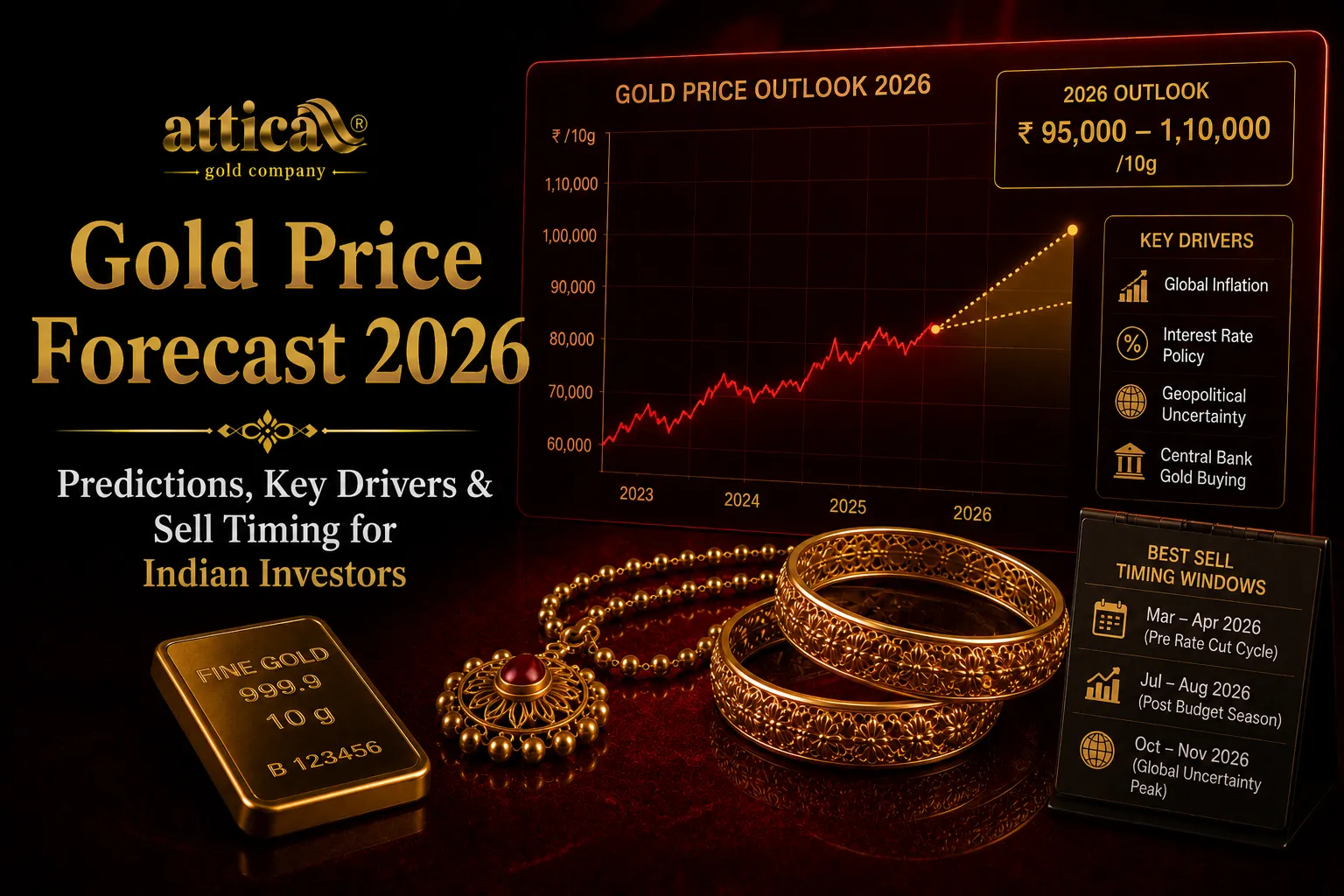
Why Gold Rate Predictions for 2026 Matter for Indian Sellers
Gold rate prediction queries spike during periods of price uncertainty – and 2026 is one of those periods. After a multi-year bull run that took 24K gold from around ₹6,400/g three years ago to a Q1 2026 peak of ₹16,200/g, the recent pullback to ₹15,250/g has Indian sellers asking the same question: where does gold go from here? The honest answer is that no one can predict short-term gold prices reliably – markets are influenced by hundreds of factors, many unpredictable. But there is value in understanding what major analysts are forecasting, what the underlying drivers are, and how these forecasts should (or should not) influence your decision to sell.
This guide covers everything you need to know about gold price forecast 2026: today’s reference rate, what major banks and research houses are predicting for year-end 2026, the four big drivers that will shape the next 12 months, why short-term forecasts often fail, and how to make your sell-or-hold decision without relying on any single prediction. By the end, you will have a balanced framework – neither blindly optimistic nor pessimistic – for navigating 2026 with the gold you own.
Gold Price Forecast 2026 at a Glance
| Time Frame | 24K Rate Forecast Range | Implied Move from Today |
| Today’s reference | ₹15,250/g | Baseline |
| End-Q3 2026 (consensus midpoint) | ₹15,000–₹16,500/g | −2% to +8% |
| End-Q4 2026 (consensus midpoint) | ₹15,500–₹17,500/g | +2% to +15% |
| End of 2026 (bullish case) | ₹17,500–₹19,000/g | +15% to +25% |
| End of 2026 (bearish case) | ₹13,500–₹14,500/g | −5% to −11% |
Today’s Live Gold Rate as the Forecast Baseline
Every forecast starts from today’s actual rate – and today’s reference for 24K gold in India is approximately ₹15,250 per gram. From this baseline, 22K is at ₹13,965/g, 18K at ₹11,438/g, and 14K at ₹8,921/g. Forecasts express where gold may move from this baseline over different time horizons: 3 months, 6 months, 12 months, and longer.
- Also Read: Live Gold Price Today
Important context: forecasts are probabilistic, not deterministic. A ’12-month target of ₹17,000/g’ does not mean gold will reach exactly ₹17,000/g – it means major analysts believe that level is plausible given current conditions. Forecasts get revised constantly as conditions change. Use them as a frame of reference, not a guarantee.
What Major Analysts Forecast for 2026
Gold price predictions for 2026 from major analysts cluster into three rough scenarios:
- Bullish case (₹17,500–₹19,000/g by end-2026): assumes US Federal Reserve resumes rate cuts, geopolitical tensions remain elevated, central bank gold buying continues, and rupee weakens against dollar. Cites continued de-dollarisation by emerging market central banks, lingering geopolitical fault lines, and structural inflation as long-term tailwinds.
- Base case (₹15,500–₹17,500/g by end-2026): assumes mixed conditions – some Fed cuts but slower than 2024-2025, geopolitical stability without major escalation, modest central bank buying, stable rupee. Represents the consensus midpoint and aligns with 8-15% annual appreciation that gold has averaged over the past 5 years.
- Bearish case (₹13,500–₹14,500/g by end-2026): assumes Fed maintains higher rates for longer, geopolitical peace agreements reduce safe-haven demand, profit-taking continues from retail and institutional investors, and stronger global recovery diverts capital from gold to equities.
Notably, even the bearish 2026 forecasts have gold staying close to today’s levels rather than crashing. The conviction among analysts is that gold’s structural drivers (inflation hedge, central bank buying, geopolitical insurance) remain intact. Disagreement is about magnitude and timing of further upside, not whether gold’s long-term floor has shifted higher.
Four Drivers That Will Shape Gold in 2026
Gold price predictions for 2026 hinge on four main forces – knowing which way each is leaning helps you interpret news as it unfolds:
- US Federal Reserve interest rate path – the single biggest driver. When real interest rates fall (Fed cuts), gold rises; when real rates rise, gold falls. Fed signals through 2026 will move gold daily. Watch FOMC meetings, dot plot updates, and CPI inflation data closely.
- Geopolitical conditions – major conflict de-escalation reduces safe-haven premium; new flare-ups raise it. Russia-Ukraine, Middle East tensions, US-China trade and Taiwan dynamics, and India-Pakistan are the key watch-points.
- Central bank gold buying – emerging market central banks (China, India, Russia, Turkey) have been net buyers of gold for over 15 years, accelerating after 2022. Sustained buying supports prices; if buying slows, the support weakens.
- Indian rupee strength – when the rupee weakens against the dollar, gold price in India rises mechanically (gold is dollar-priced). Watch RBI policy, current account deficit, FII flows, and oil prices, as these drive USD/INR.
Most days, all four factors push and pull simultaneously, often in opposite directions. The net result is the daily IBJA rate change. Major news (Fed decision, war escalation, surprise budget) can override all four briefly with a sharp move.
Why Short-Term Gold Price Predictions Often Fail
Gold rate prediction accuracy over short horizons (1-3 months) is notoriously poor – roughly equal to coin-flip odds for most analysts. The reasons: gold is influenced by hundreds of macro factors, many of which cannot be predicted; market sentiment shifts faster than fundamental conditions; and flash events (sudden conflict, surprise central bank action) move gold ₹500+/g in a single day. Even Goldman Sachs, JP Morgan, and HSBC – the most respected gold forecasters – frequently revise their 12-month targets every quarter based on changing conditions.
What is more reliable: long-term direction (gold has averaged 8-10% annual rupee returns over 20 years) and structural trend identification (multi-year bull markets often last 5-10 years before extended consolidation). For sellers, this means short-term forecasts should NOT be the primary basis for the sell-or-hold decision. The decision should be driven by your own purpose, time horizon, and tax situation – with forecasts as a soft input, not a hard guide.
💰 Get the Best Price for Your Gold Today
Instant valuation • Transparent pricing • 100% secure & trusted
How to Use Gold Price Forecasts Without Being Misled
Three rules for using gold price forecasts wisely:
- Read the range, not the point – ‘₹15,500–₹17,500 by end-2026’ is far more honest than ‘gold will hit ₹17,000 by December’. Ranges acknowledge uncertainty; point estimates create false precision.
- Compare multiple sources – Goldman Sachs, JP Morgan, World Gold Council, Indian banks (HDFC, ICICI, Kotak), and independent analysts (LKP Securities, Motilal Oswal). When 70%+ of major sources agree on a direction, the conviction is meaningful; when they diverge, take all forecasts with extra caution.
- Track forecast revisions – if major analysts have raised year-end targets in the past 3 months, momentum is bullish; if they have cut targets, momentum is bearish. Pay attention to direction of revision, not just current target levels.
Most importantly, never let a forecast override your own situation. If you need cash now and gold is at a historically high rate, the forecast that ‘gold may go higher next year’ is irrelevant to your immediate need. Sell when it makes sense for you, hold when it makes sense for you.
What If You Decide to Hold Through 2026?
Many Indian gold owners decide to hold rather than sell, especially with bullish 2026 forecasts in the air. If you hold, three considerations are worth knowing. First, storage and insurance – gold in a bank locker costs ₹2,000-₹10,000/year in locker fees; home storage carries security risk. Second, opportunity cost – capital tied up in gold cannot earn fixed deposit interest, equity returns, or be used for other purposes. Third, exit liquidity – you can always sell gold quickly at any reputable buyer at today’s rate, with no notice period or holding lock-in.
Holding gold is a reasonable choice, but it is not a ‘free’ choice. The annual costs (storage, insurance, opportunity cost) typically run 2-5% of the gold’s current value. For your holding to make financial sense, gold needs to appreciate by at least this much annually just to break even – beyond which you have actual real returns. Gold has historically beaten this hurdle over 5+ year periods, but not always over 1-2 year periods.
What If You Decide to Sell Based on Today’s Forecast?
If your honest analysis points toward selling – perhaps because forecasts feel uncertain, today’s rate is historically high, or you have a specific cash need – the process is straightforward. The 2026 forecast should not change how you sell, only whether you sell. The selling process is: check the live IBJA rate, walk into a reputable dedicated buyer, insist on free XRF purity testing in your presence, demand a written line-by-line quote, and accept payment instantly in your preferred mode.
Selling does not lock you out of future gold purchases. If gold rises to ₹17,000/g later in 2026 and you change your mind, you can always buy back at the new rate. The sell-and-buy-back round trip costs roughly 5-8% in spreads (1-2% selling margin + 3-6% buying premium), which is the price of having flexibility. For investors who do not want this flexibility cost, holding through is simpler.
Why Choose Attica Gold for Today’s Live Rate Beyond Forecasts
Gold price forecasts for 2026 may shape your decision about whether to sell – but they should not shape what rate you receive when you do sell. Whatever the year-end target, today’s live IBJA rate is the only number that matters at the moment of your transaction. The right buyer pays this live rate without applying their own ‘forecast adjustments’ or ‘future-expectations discounts’. Such manipulations are red flags – gold’s value at the moment of sale is the moment-of-sale IBJA rate, full stop.
Attica Gold pays today’s live IBJA rate at every branch across Karnataka, Tamil Nadu, Andhra Pradesh, Telangana and Pondicherry – every day, regardless of forecasts, regardless of price direction, regardless of market commentary. Free XRF purity testing in your presence, transparent line-by-line written quotes, and instant payment in cash, UPI, NEFT, RTGS, or IMPS – your choice. ISO 9001:2015 certification means the same standard at every branch, every day. Your wait is over – walk into your nearest Attica Gold branch for a free XRF test and a written quote at today’s exact live rate.
Frequently Asked Questions
What is the gold price forecast for 2026?
Gold price forecasts for end-2026 from major analysts cluster into three scenarios: bullish (₹17,500–₹19,000/g), base case (₹15,500–₹17,500/g), and bearish (₹13,500–₹14,500/g). The consensus midpoint is around ₹16,500/g – about 8% above today’s rate. Even the bearish case keeps gold near today’s levels rather than crashing. No one can reliably predict the exact figure; these are probabilistic ranges.
Will gold price increase or decrease in 2026?
Most major analysts forecast gold to end 2026 at or above today’s reference rate of ₹15,250/g. Bullish forecasts cite continued central bank buying, structural inflation, and potential further Fed rate cuts. Bearish forecasts cite ongoing profit-taking and stronger USD. The base-case consensus (₹15,500–₹17,500/g by year-end) implies modest appreciation, but the path will not be straight – expect volatility either way.
What are the main drivers of gold prices in 2026?
Four main drivers: (1) US Federal Reserve interest rate path – Fed cuts boost gold, Fed pauses or hikes weigh on gold; (2) geopolitical conditions – escalation raises gold, peace reduces it; (3) central bank gold buying – emerging market central banks remain net buyers; (4) Indian rupee strength – weaker rupee mechanically raises gold price in India. All four push and pull simultaneously most days.
Can I trust gold price predictions?
Trust them as a frame of reference, not a guarantee. Short-term forecasts (1-3 months) have poor accuracy; long-term direction (1-3 years) is more reliable based on structural trends. Compare multiple sources (Goldman, JP Morgan, World Gold Council, Indian banks), look at ranges rather than point estimates, and track forecast revisions over time. Never let a single forecast drive your decision.
Should I wait to sell gold based on 2026 forecasts?
Only if your situation allows it. If you need cash within 12 months, today’s still-historically-high rate is a reasonable lock-in regardless of forecasts. If you can wait 12-24 months and have no immediate need, holding is reasonable. The forecast itself should not be the deciding factor – your own purpose, time horizon, and tax situation should be primary.
What’s the highest gold price could reach in 2026?
Bullish 2026 forecasts target ₹17,500–₹19,000/g for 24K gold by year-end (about 15-25% above today’s rate). The highest individual forecasts go to ₹20,000/g, contingent on aggressive Fed rate cuts, major geopolitical escalation, or significant rupee weakness. These are upper-bound scenarios, not consensus expectations.
What’s the lowest gold price could fall to in 2026?
Bearish 2026 forecasts target ₹13,500–₹14,500/g for 24K gold by year-end (about 5-11% below today’s rate). The lowest individual forecasts go to ₹13,000/g, contingent on Fed maintaining high rates, major geopolitical de-escalation, and strong global growth diverting capital to equities. Even bearish scenarios keep gold significantly above 2-3 year lows.
Is gold a good investment for 2026 and beyond?
Gold has averaged 8-10% annual returns in rupee terms over the past 20 years, with cyclical volatility. As a portfolio diversifier (5-15% allocation), it remains widely recommended by financial advisors. As a concentrated bet (50%+ of net worth), it carries the same risk as any concentrated asset. For 2026 specifically, the consensus forecast is for modest appreciation, but with significant uncertainty in either direction.
Want to lock in today’s gold rate beyond 2026 forecasts?
Visit your nearest Attica Gold branch for a free XRF purity test and a transparent written quote at today’s live IBJA rate.