
⚡ Quick Answer
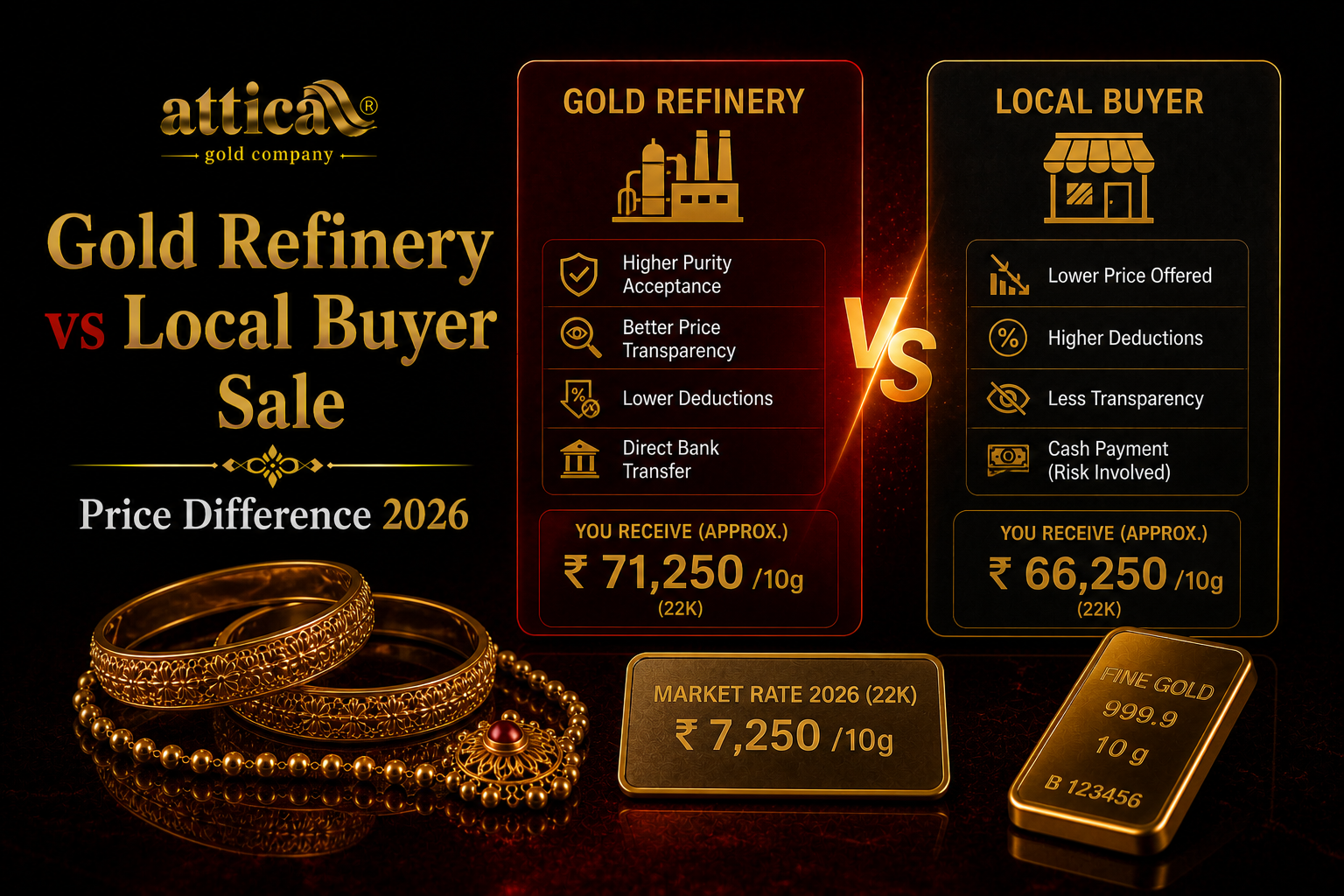
For most individual sellers, a local buyer (chain like Attica Gold) gives a faster, simpler, and often equally competitive sell gold rate today compared to selling directly to a gold refinery india. Refineries (MMTC, RGI, etc.) offer marginally higher per-gram payouts (1–2% above retail buyers) but require: minimum quantities (often 100g+), multi-day settlement, courier or in-person travel to refinery cities (Mumbai, Ahmedabad, Bangalore), and complex paperwork. Local buyers pay slightly less per gram but settle in 30–60 minutes with full XRF testing, IBJA-linked rate, and instant NEFT/cash. For under 100g, local buyer wins. For 500g+, the refinery route may be worth the extra hassle.
📌 Key Facts At A Glance
- Refinery sale: typically pays 1–2% more per gram than local buyer; settles in 3–7 days.
- Local buyer (Attica, ISO 9001:2015): pays IBJA rate minus 0.5–2% for refining margin; settles in 30–60 mins.
- Refinery minimum lot: usually 100g or 1 lakh value; many refuse smaller lots.
- Sell gold to refinery process requires: AML/PMLA-compliant KYC, source documents, and direct refinery account.
- MMTC gold buyback: only for MMTC-PAMP coins/bars purchased originally from MMTC; not for ornaments.
- Refining margin captured by refinery: 0.5–1% (vs 1–2% retained by local buyers as their margin).
- Refinery payment: always bank transfer (NEFT/RTGS); no cash for transactions over ₹2 lakh per RBI rules.
Why the Sell Gold Rate Today Differs Between Refinery and Local Buyer
When you have idle gold to sell, you have two channels: (1) a local buyer – chain like Attica Gold, neighbourhood jeweller, or pawnshop – or (2) direct sale to a gold refinery india like MMTC-PAMP, Rajesh Exports, or one of the BIS-licensed refineries. Both are legitimate. Both ultimately result in your gold being melted and refined back to bullion. But the gold sell price today, the process, the paperwork, and the time-to-cash differ meaningfully between the two.
This guide explains why the two channels exist, what the price gap is and why, when a refinery sale is worth the effort vs when a local buyer is the smarter choice, and how the sell gold to refinery process actually works step-by-step.
How the Indian Gold Refining Chain Works
Almost all old gold ornaments in India eventually end up at a BIS-licensed refinery to be melted, purified to 99.5%+ bullion, and re-cast into bars or new jewellery. The chain looks like this:
- Individual seller (you) – has 10–500g of old ornaments.
- Local buyer (Attica Gold or similar) – XRF-tests, pays you the sell gold rate today minus a small refining margin, aggregates to 5–50 kg lots.
- Bullion dealer / wholesaler – buys aggregated lots from local buyers, ships to refinery.
- BIS-licensed refinery (MMTC-PAMP, Rajesh Exports, etc.) – melts, refines to 99.5%+, casts bars.
- Bank / jeweller / investor – buys refined bullion from refinery to make new jewellery or hold as investment.
Each step takes a small margin. The refinery captures ~0.5–1%; the wholesaler ~0.5%; the local buyer ~1–2%. When you sell direct to a refinery you skip the wholesaler and local buyer margins – but pay in time, paperwork, and minimum-lot requirements.
Sell Gold Rate Today – Direct Comparison
| Factor | Local Buyer (Attica) | Refinery Direct (MMTC etc) |
| Per-gram payout | IBJA rate × purity − 0.5–2% | IBJA rate × purity − 0.3–0.8% |
| Minimum quantity | No minimum (sell 1g) | Usually 100g or ₹1 lakh |
| Time to cash | 30–60 mins to NEFT | 3–7 working days |
| XRF testing | In-branch, free, watch live | At refinery, you may not see it |
| Travel required | Local branch (200+ in South India) | Refinery city (Bangalore/Mumbai/Ahmedabad) |
| KYC complexity | Standard (PAN+Aadhaar) | Enhanced (PMLA, source proof) |
| Receipt | GSTIN invoice, IBJA-linked | Refinery purchase contract |
On a 50g 22K piece worth ~₹3.6 lakh today, the absolute price difference between a local buyer and direct refinery is roughly ₹3,600–₹7,200 – meaningful but rarely worth the 3–7 days of paperwork plus travel.
- Also Read: Live Gold Price Today
When Selling to a Refinery Makes Sense
- You hold 500g+ of pure gold (bars or coins) – the absolute price difference is large enough to justify the effort.
- Your gold is already refined (24K bars or MMTC coins) – refineries pay near-spot for already-pure gold.
- You’re in or near a refinery city (Mumbai, Bangalore, Ahmedabad) – travel cost is zero.
- You have time (3–7 days is acceptable; cash is not urgent).
- You can produce full source documentation – purchase invoices, prior MMTC receipts, customs declarations for imported gold.
When a Local Buyer Wins
- Your gold is ornamental (chains, bangles, rings, pendants) with stones/solder – refineries hate these because of variable purity; local buyers handle them daily.
- Quantity is under 100g – below most refinery minimums.
- You need cash same-day or within 24 hours.
- You’re not in a refinery city – interstate courier of gold is high-risk and adds insurance cost.
- You don’t have detailed source documentation – refineries demand stricter PMLA compliance than local buyers.
- You want in-person XRF testing you can watch – local chains do this in front of you; refineries process behind closed doors.
MMTC Gold Buyback: A Special Case
MMTC gold buyback is a specific programme for gold coins and bars originally purchased from MMTC-PAMP retail outlets or partner banks. If you bought a 10g MMTC coin in 2019 with the original MMTC purchase invoice, MMTC will buy it back at near-spot rates with minimal paperwork. The catch: it must be MMTC-issued bullion. Random old jewellery, even pure ornaments, are not eligible for the buyback programme – they’d go through the standard sell gold to refinery process with full PMLA compliance instead.
If you’re holding MMTC coins specifically, the buyback route is the optimal channel – better rate than any local buyer, low friction, government PSU counterparty.
💰 Get the Best Price for Your Gold Today
Instant valuation • Transparent pricing • 100% secure & trusted
Sell Gold to Refinery: Step-by-Step Process
- Identify a BIS-licensed refinery near you (MMTC-PAMP in Mumbai/Bangalore, Rajesh Exports in Bangalore, etc.). Confirm they buy from individuals (some only buy from registered dealers).
- Pre-register on the refinery’s customer portal; complete enhanced KYC (PAN, Aadhaar, current address proof, photograph, source-of-funds declaration).
- Provide source documentation for the gold – old purchase invoices, family heirloom affidavit, gift deed, or prior bullion purchase receipts.
- Schedule an appointment; physically deliver the gold to the refinery (or use insured courier – additional cost ₹500–2,000).
- Refinery does its own XRF/fire-assay testing; results typically available in 24–48 hours.
- You receive a price quote based on assayed purity × refinery’s discounted rate; accept or negotiate.
- Sign the purchase contract; the refinery initiates NEFT/RTGS payment within 3–5 working days from acceptance.
- Get a digital and physical copy of the refinery’s purchase invoice with their license number, BIS certification, and assayed purity result.
What About Cash for Gold and Sell Gold Near Me Searches?
When most people search cash for gold or sell gold near me, they’re looking for local buyers – and local buyers are the right answer for the vast majority of transactions. The refinery route exists for specific scenarios (large lots, pure bullion, refinery-city sellers) but isn’t the default for the typical 30g–200g household gold sale. Don’t let the marginally higher refinery payout tempt you into a 7-day, multi-step process when a 60-minute local sale captures 98% of the same value with none of the hassle.
Why Choose Attica Gold as Your Local Buyer – Your Wait Is Over
For 95% of individual sellers, a trusted local buyer gives the right combination of price, speed, and simplicity. Direct refinery sale is a niche option – useful for large-lot or already-refined gold, where the seller has time, documentation, and refinery proximity.
Attica Gold is built specifically as the local-buyer answer to cash for gold and sell gold near me searches: ISO 9001:2015-certified, ~200+ branches across Karnataka, Tamil Nadu, Andhra Pradesh, Telangana, and Pondicherry, free in-branch XRF testing you watch live, IBJA-linked sell gold rate today updated by 11 AM daily, transparent line-by-line deductions, full GSTIN-stamped invoice, NEFT/RTGS payment within 24 hours. Bring your gold today – no minimum, no appointment needed for under 1kg, no multi-day wait. Your wait is over.
Frequently Asked Questions
What’s the actual price difference between selling to a refinery vs a local buyer?
Typically 1–2% per gram. On a 50g 22K piece worth ~₹3.6 lakh, that’s ₹3,600–₹7,200 absolute. The refinery extracts less margin (it’s the end of the chain) but charges you in time, travel, and paperwork. For most retail sellers the time-cost exceeds the price-cost.
Can any individual sell gold to a refinery in India?
Yes, but with conditions. BIS-licensed refineries (MMTC-PAMP, Rajesh Exports, etc.) accept individual sellers if you can pass enhanced PMLA KYC (PAN, Aadhaar, source-of-funds proof, in some cases income tax returns) and meet minimum lot size (typically 100g+). Smaller sellers and ornamental gold are routed to local buyers.
Is MMTC gold buyback the same as sell gold to refinery?
No. MMTC gold buyback is a specific buyback programme for MMTC-PAMP coins and bars originally purchased through MMTC retail. It’s the simplest and most premium-priced exit for MMTC-issued bullion. Selling random old jewellery to a refinery is the broader ‘refinery sale’ process with much heavier documentation requirements.
Why don’t refineries buy ornaments from individuals directly?
Three reasons: (1) ornaments have variable purity (22K, 18K, mixed), stones, solder, plating – refineries are optimised for high-volume bullion; (2) per-piece XRF testing is expensive at refinery scale; (3) PMLA compliance for many small individual transactions creates regulatory burden. Refineries prefer aggregated lots from licensed local buyers who pre-process and pre-test.
What’s the refinery margin captured on my gold?
BIS-licensed refineries typically charge 0.3–0.8% to refine your gold to 99.5%+ purity bullion. Local buyers add another 1–1.5% on top to cover their operating cost. End-to-end margin from your sale to final bullion is typically 1.5–2.5% – a small fraction of the IBJA rate.
Is selling gold to a refinery safer than to a local buyer?
Both are safe if the counterparty is verified. BIS-licensed refineries are regulated and audited; ISO-certified local buyer chains (like Attica Gold) follow standardised protocols, KYC, and IBJA-linked pricing. The risk in either case comes from unverified informal buyers – neighborhood jewellers without BIS license, ad-hoc ‘cash for gold’ counters in malls, etc. Always verify before transacting.
Can I get the gold sell price today rate at a refinery without an appointment?
No. Refineries typically require pre-registration, KYC verification, and scheduled delivery slots. You can check the day’s published rates online (most refineries publish daily) but actual sale completion takes 3–7 days. For walk-in service at the gold sell price today, a local buyer is the only realistic option.
Sources & References
This page references and is informed by the following authoritative sources. Last verified: May 2026.
[1] BIS-Licensed Gold Refineries – Directory – Bureau of Indian Standards. https://www.bis.gov.in/
[2] MMTC-PAMP Gold Buyback Programme – MMTC-PAMP India. https://www.mmtcpamp.com/
[3] Daily Gold Reference Rate – India Bullion and Jewellers Association (IBJA). https://ibja.co/
[4] PMLA & Source-of-Funds Compliance Guidelines – Financial Intelligence Unit, India (FIU-IND). https://fiuindia.gov.in/
[5] Gold Bullion Spot Pricing – Multi Commodity Exchange (MCX) India. https://www.mcxindia.com/
Get the gold sell price today instantly at any Attica Gold branch
No minimum lot, no appointment, no 7-day refinery wait. IBJA-linked rate, free XRF, NEFT same-day.