⚡ Quick Answer
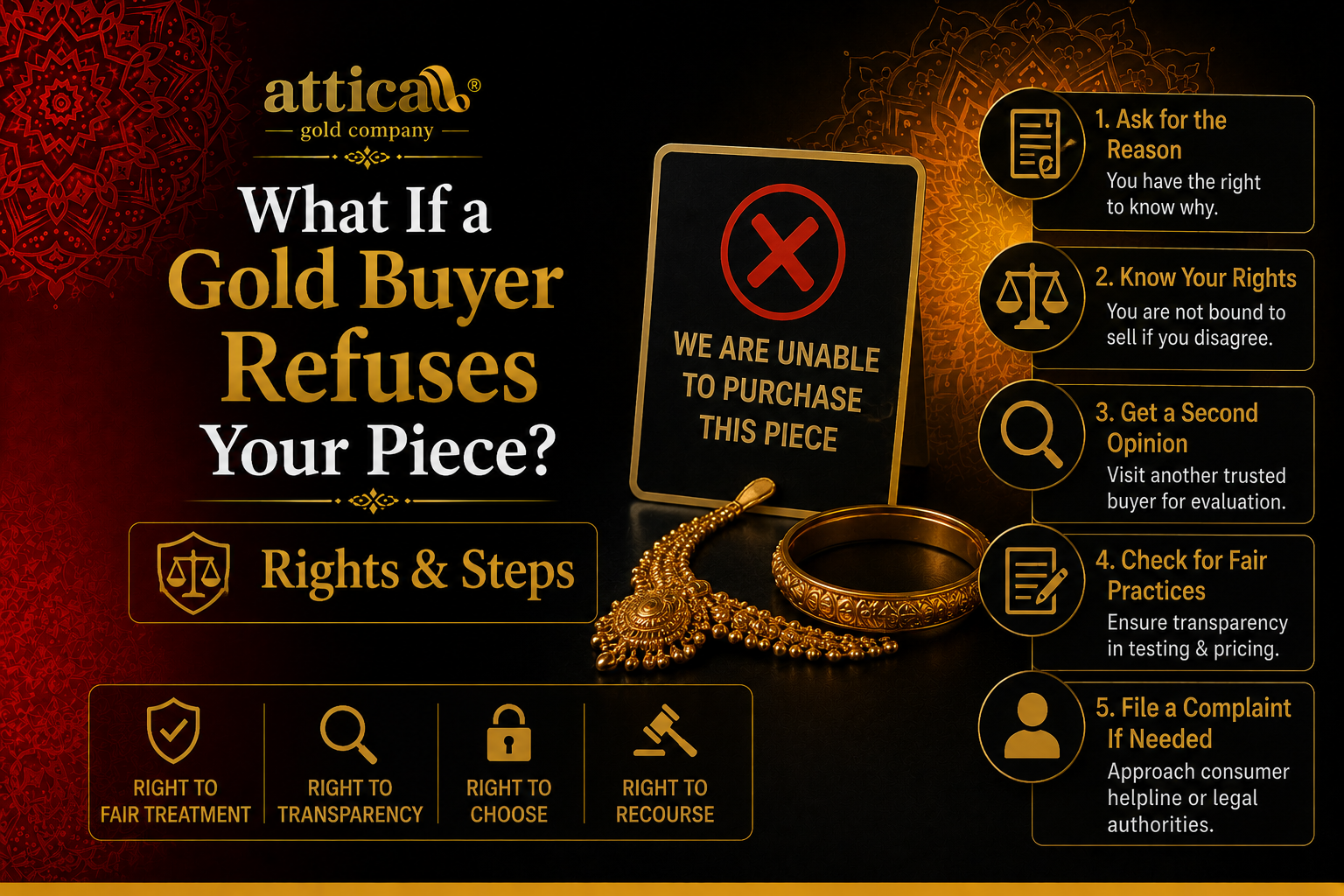
If a cash for gold buyer refuses your piece, you have rights. Common refusal reasons: no bill (sell gold without bill), no hallmark (sell non hallmark gold), suspicious purity, very low purity (under 14K), or foreign gold sale india complications. You can: (1) demand a written refusal reason, (2) approach a different trusted gold buyer who may have different policies, (3) get an independent BIS hallmark assay to prove purity, (4) provide alternate provenance (gift deed, family affidavit, prior bank receipts), and (5) escalate to the buyer’s GSTIN-based grievance system. Refusal isn’t the end – it’s just one buyer’s policy.
📌 Key Facts At A Glance
- No law requires a cash for gold buyer to purchase any specific piece – refusal is the buyer’s commercial choice.
- Common refusal triggers: missing bill, no hallmark, very low purity, suspected stolen goods, complex foreign gold.
- You can sell gold without bill if you provide alternate proof: family affidavit, gift deed, or prior bank-vault statements.
- Sell non hallmark gold is fully legal; many trusted gold buyers like Attica accept non-hallmarked gold after XRF verification.
- Foreign gold sale india: requires customs declaration proof if brought in legally; otherwise treated as ‘undisclosed gold’.
- Buyer refusal is NOT an indication that the gold is fake – it’s often risk-aversion or compliance preference.
- Independent BIS-licensed assayer can certify purity for ₹500–1,500 per piece – useful before approaching another buyer.
Why Cash for Gold Buyers Sometimes Refuse
You walk into a cash for gold counter, present your gold, and the buyer politely declines. It’s frustrating – especially if you need cash quickly – and it raises immediate questions: Is something wrong with my gold? Was that buyer trying to lowball me? Should I try elsewhere? In most cases, refusal isn’t about your gold being fake or worthless. It’s about the specific buyer’s risk tolerance, internal policy, or the documentation you presented. Different buyers have different thresholds.
This guide covers the most common reasons a cash for gold buyer refuses a piece, what your rights are, what alternative paths exist (sell gold without bill, sell non hallmark gold, foreign gold sale india), and how to approach a second buyer with stronger paperwork. If you’ve searched sell gold near me and the first buyer refused, the next steps below will move you forward – most refusals are reversible with the right alternate buyer or paperwork.
The Six Most Common Reasons for Refusal
- No purchase bill or invoice – buyer can’t establish provenance, fears PMLA / source-of-funds questions.
- No BIS hallmark and the buyer’s policy requires hallmarked gold only – common at some bank gold-loan branches.
- Very low purity (below 14K / 585 fineness) – refining margin doesn’t justify the buyer’s processing cost.
- Solder-heavy or stone-heavy ornament – buyer estimates net gold weight is too low after deductions.
- Suspected mismatched documentation – your KYC name doesn’t match the original purchase invoice.
- Foreign-origin gold without customs clearance – buyer can’t verify legal import; refuses to take risk.
Your Rights as a Seller
Indian law gives any private buyer the right to refuse a transaction – you can’t compel a cash for gold buyer to purchase. But you do have related rights that protect you in the refusal scenario:
- Right to a written refusal reason – if the buyer claims regulatory or compliance grounds, ask them to put it in writing on letterhead. This becomes useful if you escalate to GSTIN-based grievance or consumer forum.
- Right to your gold back unmolested – the buyer cannot withhold your gold during the refusal. They must return all pieces in the same condition you brought them.
- Right to free re-weigh and XRF if testing was started – if the buyer began the assay before refusing, they should let you see the test results. You can take those results to another buyer.
- Right to verify the buyer’s GSTIN and grievance contact – every registered cash for gold establishment has a GSTIN; you can file complaints via the GST portal.
- Right to seek an independent assay – go to a BIS-licensed assaying centre for a third-party purity certificate (₹500–1,500 per piece).
Path 1: Sell Gold Without Bill (No Original Invoice)
Many sellers hit refusal because the original purchase bill is lost – common with inherited or 30-year-old jewellery. Sell gold without bill is fully legal in India; you just need to satisfy the buyer’s KYC and source-of-funds requirements via alternate documentation:
- Family affidavit – a notarised statement from a family elder declaring the gold’s origin (gifted, inherited, purchased decades ago).
- Gift deed – if the gold was gifted to you, a registered gift deed serves as provenance.
- Will / inheritance documents – if inherited, the will or succession certificate covers it.
- Bank locker statements – if the gold was previously stored in a bank vault, the locker entry log (back to ~10 years) is excellent evidence.
- Prior insurance valuation – if you ever insured the gold, the valuer’s certificate doubles as purity evidence.
Established trusted gold buyer chains like Attica Gold accept these alternate documents alongside standard KYC (PAN + Aadhaar). The transaction proceeds normally with proper invoicing on the buyer’s side.
- Also Read: Live Gold Price Today
Path 2: Sell Non Hallmark Gold
BIS hallmarking became mandatory for retail gold jewellery from June 2021, but the rule applies prospectively – to NEW jewellery sold by retailers. You can absolutely sell non hallmark gold from before that date. Old family jewellery, hand-made artisanal pieces, foreign gold, and pre-2021 retail purchases are all legitimate non-hallmarked categories.
The seller’s challenge: without a hallmark, the buyer must do their own purity testing (XRF or fire-assay). Some buyers prefer hallmarked gold to avoid this step. Solution: approach a buyer that does in-branch XRF testing as standard process – they handle non-hallmarked gold daily and price it at the assayed purity, not at a discount for being non-hallmarked.
Path 3: Foreign Gold Sale India (Brought In from Abroad)
If your gold was brought from abroad – by you returning from Gulf countries, gift from NRI relative, foreign-origin coin – you have specific compliance obligations. Foreign gold sale india requires:
- Customs declaration / TR (Transfer of Residence) certificate if brought in within the legal personal allowance.
- Customs duty payment receipt if the quantity exceeded the duty-free allowance (₹50,000 for men, ₹1 lakh for women on return after 1+ year abroad).
- Source country’s purchase invoice (translated if not in English).
- FEMA declaration if the value exceeds equivalent of USD 10,000 at any point in the chain.
If you have these documents, foreign gold sale india proceeds normally. If you don’t, the buyer is effectively asking you to prove the gold isn’t smuggled – most refuse rather than take that risk. The fix: regularise the import retroactively if possible, or sell to a buyer with a robust compliance process that can handle the documentation gap (typically by treating it as ‘undisclosed gold’ with appropriate ITR declaration).
💰 Get the Best Price for Your Gold Today
Instant valuation • Transparent pricing • 100% secure & trusted
Path 4: Get an Independent Assay
If the refusal is purity-related – buyer suspects your gold is below the claimed karat – an independent BIS-licensed assayer settles the question. Take your gold to an authorised assaying centre (find via the BIS website); they perform fire-assay or XRF testing and issue a certificate stating the exact gold percentage. Cost: ₹500–1,500 per piece, results in 1–2 days. Armed with the certificate, approach a different cash for gold buyer – most accept independent BIS assay results as definitive.
Path 5: Try a Different Buyer Type
Different buyer types have different acceptance thresholds. Match your situation to the right buyer:
| Your situation | Best buyer type | Why |
| Old, no bill, ornaments | Specialist chain (Attica) | XRF + alternate KYC accepted |
| No hallmark, recent piece | Specialist chain or refinery | XRF assay handles this |
| Foreign gold, no customs proof | Refinery with PMLA team | Has compliance bandwidth |
| Antique / rare jewellery | Auction house or specialist | Numismatic / craft premium |
| Bank-vault stored 10+ years | Bank’s gold-loan division | Bank chain-of-custody |
| MMTC coin | MMTC buyback only | Original-issuer rate |
What NOT to Do After Refusal
- Don’t accept a heavily discounted offer from the same buyer who initially refused – that’s a manipulation tactic to lower your reservation price.
- Don’t try to sell to an unverified informal buyer just because they say yes – risk of lowball, fraud, and PMLA exposure.
- Don’t melt the gold yourself thinking it’ll bypass the issue – it makes assay-based provenance impossible.
- Don’t sell to multiple small unconnected buyers to break up the lot under reporting thresholds – that’s PMLA structuring, illegal.
- Don’t get discouraged after one refusal – it’s almost always a buyer-policy issue, not a gold-quality issue.
Why Choose Attica Gold When Others Have Refused – Your Wait Is Over
Refusal at one cash for gold counter doesn’t mean your gold is unsaleable. It usually means that specific buyer’s policy on bills, hallmarks, foreign origin, or low purity didn’t match your specific piece. A different trusted gold buyer with a more flexible compliance framework and proper XRF testing can almost always close the deal – when you sell gold for cash, the right buyer matters more than persistence with the wrong one.
Attica Gold has built its process exactly for these situations: ISO 9001:2015-certified, free in-branch XRF testing for ALL pieces (hallmarked or not), accepts alternate KYC documentation when the original bill is lost, can guide you through foreign gold sale india paperwork, and offers IBJA-linked rates regardless of buyer-side complications. ~200+ branches across South India, transparent line-by-line deductions, full GSTIN-stamped invoices, NEFT/RTGS payment within 24 hours. If another buyer turned you away, bring your gold to Attica and let our compliance team work through the paperwork. Your wait is over.
Frequently Asked Questions
Is it legal for a cash for gold buyer to refuse my piece?
Yes. Indian law allows any private buyer to decline any specific transaction; there’s no obligation to purchase. The buyer must, however, return your gold unharmed and unaltered, and (on request) provide a written reason if you intend to escalate.
Can I sell gold without bill anywhere in India?
Yes – sell gold without bill is fully legal. You’ll need to provide alternate KYC and source documentation: family affidavit, gift deed, prior bank locker statements, or a notarised origin declaration. Established trusted gold buyer chains accept these. Standalone informal counters tend to refuse.
Is sell non hallmark gold restricted?
No. The mandatory hallmarking rule (June 2021) applies prospectively to NEW retail jewellery sold by jewellers. Old non-hallmarked gold, family jewellery, and foreign-origin pieces are fully legal to sell. The seller may face buyer-side preference for hallmarked gold, but that’s a buyer policy issue, not a legal one.
What customs documents are needed for foreign gold sale india?
If brought in legally: TR (Transfer of Residence) certificate, customs duty payment receipt if applicable, and source country’s purchase invoice. If brought in informally without declaration, the gold is technically ‘undisclosed’ and may need ITR declaration with self-assessed value before sale. Talk to a CA before selling foreign gold without customs proof.
How much does an independent BIS assay cost?
Typically ₹500–1,500 per piece, depending on the assaying centre and the test method (XRF is cheaper and faster; fire-assay is more accurate but destroys a sample). Find authorised centres on the BIS website. Results in 1–2 days; the certificate is accepted by any reputable cash for gold buyer.
Can I sue a buyer for refusing my piece?
No – refusal of a private commercial transaction isn’t actionable. You can file complaints if the buyer damaged your gold, withheld it, or misrepresented test results, but a simple ‘no, we won’t buy’ is within their rights. Move on to a more flexible buyer.
Why would a trusted gold buyer refuse hallmarked gold?
Even hallmarked gold can be refused if the buyer suspects: (1) the hallmark is forged, (2) the seller’s KYC doesn’t match documentation, (3) the gold is part of a known lost/stolen registry, or (4) the lot size is below the buyer’s minimum economic threshold. The hallmark itself is rarely the issue – context around it usually is.
Sources & References
This page references and is informed by the following authoritative sources. Last verified: May 2026.
[1] BIS-Authorised Assaying & Hallmarking Centres – Bureau of Indian Standards. https://www.bis.gov.in/
[2] Customs Duty on Gold for Returning Indians – Central Board of Indirect Taxes & Customs (CBIC). https://www.cbic.gov.in/
[3] FEMA Regulations on Gold Imports – Reserve Bank of India (RBI). https://www.rbi.org.in/
[4] Mandatory Hallmarking Order – Implementation – Ministry of Consumer Affairs. https://consumeraffairs.nic.in/
[5] GSTIN Verification & Grievance Filing – Goods and Services Tax Network. https://services.gst.gov.in/
Got refused elsewhere?
Attica accepts non-hallmark gold, alternate KYC, foreign gold (with compliance support). Free XRF testing, IBJA rates, NEFT payment same day.