⚡ Quick Answer
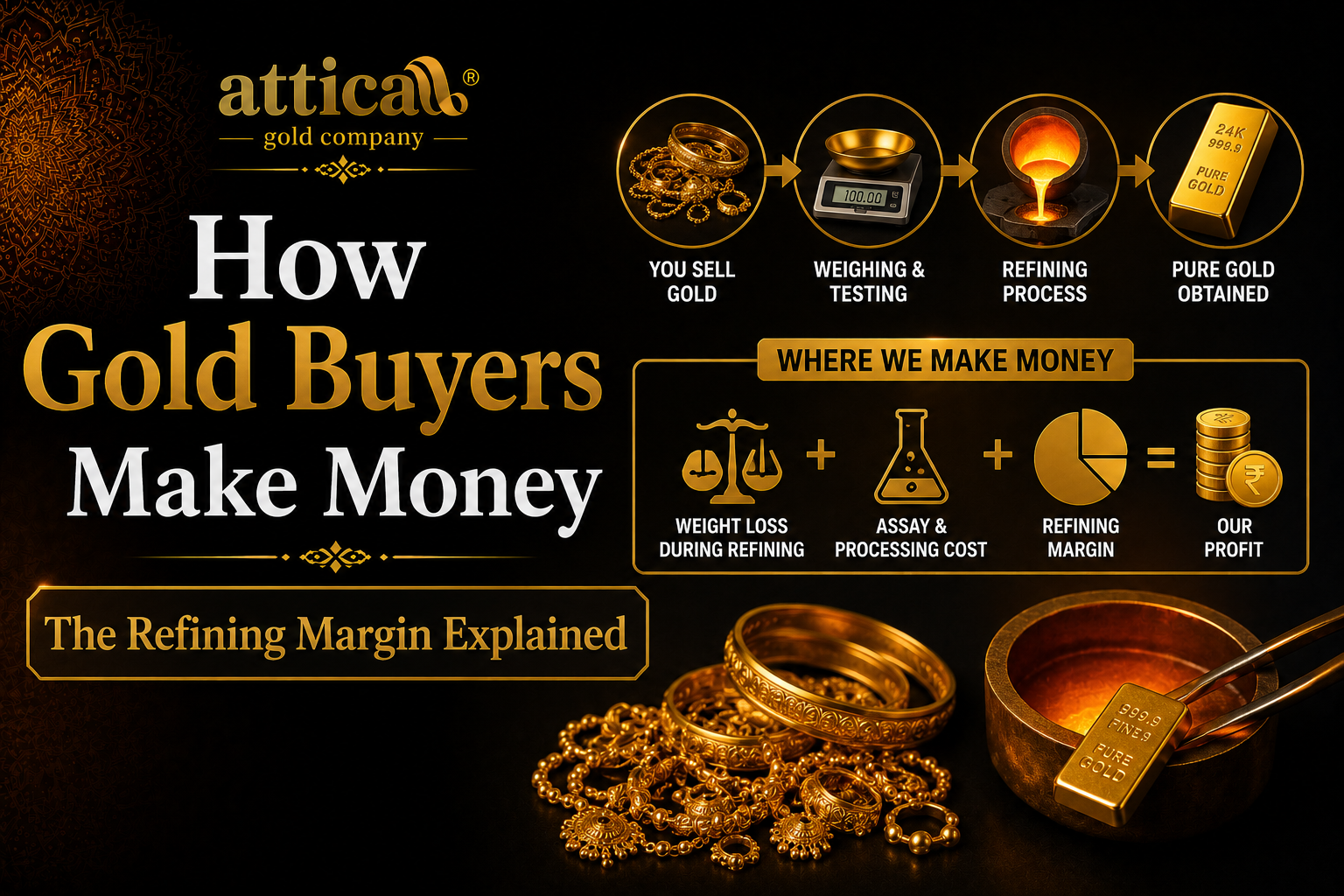
Cash for gold buyers earn through the refining margin – typically 1–2% of the IBJA rate. They pay you the IBJA rate minus this margin (e.g., if IBJA 22K rate is ₹7,200/g, they pay ~₹7,050/g and aggregate gold to send to a refinery). Gold buyer margin covers: XRF testing equipment, branch operating cost (rent, staff, utilities), aggregation logistics, refinery’s own margin, working capital, and a small profit. The gold refining process converts mixed-purity old gold into 99.5%+ bullion bars sold to jewellers and banks at near-spot rate. The buyer’s margin isn’t a scam – it’s the cost of converting your random ornament into bullion. Trusted gold buyer transparency: a clear breakdown means honest pricing.
📌 Key Facts At A Glance
- Gold buyer margin: typically 1–2% of IBJA rate; sometimes 0.5–1% at high-volume chain buyers like Attica.
- How gold buyers work: buy from individual sellers → aggregate to 5–50 kg lots → send to BIS-licensed refinery → receive 99.5%+ bullion → sell to jewellers/banks.
- Gold refining process: melt → sample assay → chemical refining (acid wash, electro-refining) → cast into bars → BIS hallmark certification.
- Refining margin captured by refinery itself: 0.3–0.8%; the local buyer’s 1–2% includes branch operating cost above this.
- Trusted gold buyer chains spend 0.5–0.8% of margin on fixed cost (rent, staff, utilities, XRF equipment).
- Working capital cost: buyers pay sellers immediately but realise refinery payment in 7–14 days – finance cost ~0.3%.
- Net buyer profit: 0.3–0.7% per gram on a transparent operation; below this, the business isn’t viable.
Demystifying the Cash for Gold Business Model
When you sell gold to a chain buyer, you receive an amount slightly below the IBJA rate published that morning. This gap – the gold buyer margin – leads many sellers to suspect they’re being shortchanged. The reality is more mundane: the buyer is running a real business with real costs, and the margin is what keeps the lights on while still paying you a fair, IBJA-linked price. Whether you searched sell gold near me or sell gold for cash, understanding how gold buyers work removes the mystery and helps you tell honest operators from genuinely shady ones.
This guide breaks down the cash for gold business: the gold refining process from your old chain to a 99.5% bullion bar, where the margin goes (operating cost, finance cost, refinery’s own cut), and how to read a buyer’s margin to spot legitimate vs predatory pricing.
How Gold Buyers Work: The Full Chain
Your old gold chain doesn’t stay as a chain. It enters a refining chain that converts it back to investment-grade bullion. The chain has five major links:
- Individual seller (you) – sells 10–500g of mixed-purity ornaments.
- Local buyer (chain branch like Attica Gold or local jeweller) – XRF-tests, weighs, deducts for stones/solder, pays you the IBJA rate minus their margin.
- Buyer’s central aggregation hub – collects gold from 50+ branches, sorts by purity, prepares for refinery shipment.
- BIS-licensed refinery (MMTC-PAMP, Rajesh Exports, etc.) – melts the aggregated lot, fire-assays, refines via chemical process to 99.5%+ purity, casts into 100g/1kg bars.
- End buyers – jewellers (to make new ornaments), banks (for SGB programme), MMTC (for retail bullion sale).
Each step adds value (XRF testing, aggregation, refining, hallmarking) and takes a small margin. The system works because each link specialises in one part of the chain – no single party tries to do all of it.
- Also Read: Live Gold Price Today
Gold Refining Process: From Old Chain to 99.5% Bar
The gold refining process typically uses one of two methods: aqua regia chemical refining or Miller / Wohlwill electrolytic refining. Both achieve 99.5%+ purity (often 99.9% for electrolytic). Steps:
- Aggregate input: refinery receives 5–50 kg lot from local buyers, sorted approximately by purity tier.
- Initial melt: gold is melted in a graphite or ceramic crucible at ~1,200°C; non-gold metals like copper float as dross.
- Sampling: a small amount is poured off, cooled, and fire-assayed to determine exact purity.
- Chemical refining: gold dissolved in aqua regia (nitric + hydrochloric acid mix); silver and base metals filtered out; gold precipitated using sulfur dioxide or sodium metabisulfite.
- Electrolytic refining (alternative): gold cast as anode, refined via electric current in chloroauric acid bath; pure gold deposits on cathode.
- Final melt and casting: refined gold (99.5%+) cast into 100g, 250g, 500g, 1kg bars; cooled, cleaned.
- Hallmarking: BIS-licensed assayer samples and stamps each bar with the refinery’s mark, BIS hallmark, weight, and purity.
The refining itself takes 24–48 hours per batch. Including aggregation and shipping, a piece of jewellery you sell today may become a finished bullion bar within 2–3 weeks.
Where the Gold Buyer Margin Actually Goes
On a typical 1–1.5% gold buyer margin, here’s the rough breakdown for an ISO-certified chain operator:
| Cost component | % of margin | What it covers |
| Branch operating cost | 0.4–0.6% | Rent, electricity, staff salaries |
| XRF equipment depreciation | 0.05–0.10% | ₹3–5 lakh device, 5-year life |
| Refinery margin (paid to refinery) | 0.3–0.5% | Refining + BIS hallmark |
| Working capital cost | 0.20–0.30% | Buyer pays you immediately; refinery takes 7–14 days to pay buyer |
| Insurance, security, transport | 0.05–0.10% | Vault insurance, armoured transport to refinery |
| Compliance + KYC tech | 0.05–0.10% | PMLA software, audit cost |
| Net profit margin | 0.10–0.30% | Buyer’s actual earning |
| Total | 1.0–1.5% |
The buyer’s net profit is small – typically 10–30 paise per ₹100 of gold value. This is why scale matters: a chain that processes 50 kg/month at 0.2% net margin earns about ₹70 lakh/month gross profit; a single-branch operator at the same margin can’t sustain operations.
Why the Refining Margin Isn’t a Scam
The refining margin reflects real economic value: testing, aggregation, refining, hallmarking, and risk management. To prove it’s legitimate, ask any reputable cash for gold buyer to walk through their cost structure transparently. Specific signals:
- ISO 9001:2015 certification – process audit by third party.
- Published IBJA-linked rate displayed at the branch and online.
- In-branch XRF testing where you watch the result on the screen.
- Line-item GST invoice showing weight, purity, rate, deductions, net.
- GSTIN visible on bills and verifiable on gst.gov.in.
- Multi-year operating history, branch network, employee count.
Compare this with the alternative: a buyer who quotes ‘we pay 80% of market rate’ (= 20% margin), uses opaque touchstone testing, gives a hand-written slip, and offers no GSTIN. That’s a 20-percentage-point gap captured as pure profit. THAT’s the scam.
💰 Get the Best Price for Your Gold Today
Instant valuation • Transparent pricing • 100% secure & trusted
How to Tell Honest Buyer Margin from Predatory Margin
| Margin range | Buyer type | Red flag level |
| 0.5–2.0% | Chain buyer (Attica, etc.) | ✓ Normal |
| 2.0–4.0% | Mid-tier local jeweller | ⚠ Acceptable if other factors strong |
| 4.0–8.0% | Standalone informal counter | ⚠⚠ Negotiate or walk |
| 8.0–20.0% | Pop-up / mall counter / desperate buyer | ✗ Walk away |
| 20.0%+ | Predatory operator | ✗✗ Almost certainly a scam |
The honest range – 0.5–2% – covers all the legitimate operating cost. Anything significantly above this is the buyer extracting consumer surplus, not covering real cost. A trusted gold buyer chain with a national footprint sits in the lower half of this range; informal counters at the higher end justify themselves with convenience or speed but at meaningful price cost to you.
Why Chain Buyers Can Offer Tighter Margins
- Volume buying power: a chain processing 500 kg/year negotiates better refinery rates than a single shop processing 5 kg/year.
- Operational leverage: the same XRF machine and trained assayer service 100 sellers/day instead of 10.
- Faster refinery cycle: chains have prepaid refinery accounts, reducing working capital cost.
- Lower fraud risk: standardised KYC and ISO processes reduce regulatory and theft cost.
- Brand credibility: customers come to chains by reputation, lowering the marketing cost per acquisition.
Net effect: chain buyers can profitably operate at 0.8–1.5% margin where a single-shop operator needs 3–5% margin to break even. This is why national chains pay closer to IBJA rate than local jewellers.
Why Choose Attica Gold for the Tightest Honest Margin – Your Wait Is Over
Cash for gold isn’t magic – it’s a real business with real cost structures. The gold refining process turns your old jewellery into investment-grade bullion through XRF testing, aggregation, chemical refining, and hallmarking. Each link in the chain takes a small margin; the total from individual seller to final bullion is typically 1.5–2.5%. A chain buyer occupies the first link with the tightest possible margin (0.8–1.5%); informal counters and standalone shops add 2–8% on top. Understanding how gold buyers work helps you spot the difference between a honest operating margin and predatory extraction.
Attica Gold operates at the tight end of the honest range: ISO 9001:2015 certified, ~200+ branches across South India achieving operational scale, IBJA-linked rates published daily, free in-branch XRF testing, transparent line-item invoices, full GSTIN compliance, NEFT/RTGS payment within 24 hours. We earn a fair refining margin, you receive close to the published IBJA rate, and the gold goes through a properly licensed refinery to become investment-grade bullion. Your wait is over.
Frequently Asked Questions
What’s a typical gold buyer margin in India?
For ISO-certified chain buyers like Attica Gold, the gold buyer margin is typically 0.8–1.5% of the IBJA rate. Mid-tier local jewellers often charge 2–4%; informal counters and pop-up stalls 4–10%. Anything above 8% is predatory and should be refused. The honest range covers branch operating cost, refinery margin, working capital, insurance, and a small net profit.
How does the gold refining process work after a cash for gold sale?
The buyer aggregates 5–50 kg lots from multiple branches, ships to a BIS-licensed refinery. The refinery melts the lot, fire-assays a sample, chemically refines (aqua regia or electrolytic) to 99.5%+ purity, casts into 100g/1kg bullion bars, and applies BIS hallmark stamps. The bars then go to jewellers, banks, or retail bullion outlets. End-to-end takes 1–3 weeks.
Is the refining margin a hidden charge or a scam?
Neither. It’s a transparent operating cost reflected in the gap between the IBJA published rate and the rate the buyer pays you. A trusted gold buyer will explicitly itemise it on the invoice (e.g., ‘Refining margin: 1.2%’). Compare this with predatory buyers who quote a flat ‘discounted rate’ without breakdown – that’s where actual scams hide.
Why don’t gold buyers pay me the full IBJA rate?
Because the IBJA rate is the END price for refined 99.5% bullion. Your old jewellery isn’t 99.5% bullion – it’s mixed-purity, with stones and solder, requiring testing, refining, hallmarking, and aggregation. The buyer captures the cost of that conversion as a margin. After the chain, the IBJA rate is the price the FINAL refined bullion fetches, not the price for raw old jewellery.
How gold buyers work for very small lots (under 5g)?
Some chain buyers have a minimum economic threshold (₹5,000 or 1g) below which the testing and processing cost exceeds the gross value. For very small lots, you may face slightly higher percentage margins or be redirected to a specific counter. Attica Gold accepts small lots without a minimum, but margins for small lots may be 1–2% higher than for larger lots due to fixed processing cost.
Can I avoid the refining margin by selling directly to a refinery?
Sometimes. Direct refinery sale can save 0.5–1% on the buyer-side margin, but adds: minimum lot requirements (usually 100g+), enhanced PMLA documentation, travel to refinery cities, and 3–7 day settlement instead of same-day cash. For most retail sellers, the chain buyer’s faster service and convenience outweigh the small price gap. See our separate refinery vs local buyer comparison.
How do I verify a buyer’s margin claim is honest?
Ask: (1) Is your rate IBJA-linked? Show me today’s IBJA rate. (2) What’s your stated refining margin %? (3) Show me a line-item invoice from a recent transaction. (4) Is your GSTIN active and matching the brand? (5) Are you ISO certified? An honest trusted gold buyer answers all five with documents on hand. Evasive answers = move on.
Sources & References
This page references and is informed by the following authoritative sources. Last verified: May 2026.
[1] BIS-Licensed Gold Refineries – Public Directory – Bureau of Indian Standards. https://www.bis.gov.in/
[2] Daily Gold Reference Rate – India Bullion and Jewellers Association (IBJA). https://ibja.co/
[3] Gold Refining Standards & Best Practices – World Gold Council. https://www.gold.org/
[4] MMTC-PAMP Refinery – Process Documentation – MMTC-PAMP India. https://www.mmtcpamp.com/
[5] GST Compliance for Gold Trade – Central Board of Indirect Taxes & Customs (CBIC). https://www.cbic.gov.in/
Want a transparent gold buyer margin?
Attica Gold – IBJA rate, ISO 9001:2015, line-item invoice, NEFT same-day.