⚡ Quick Answer
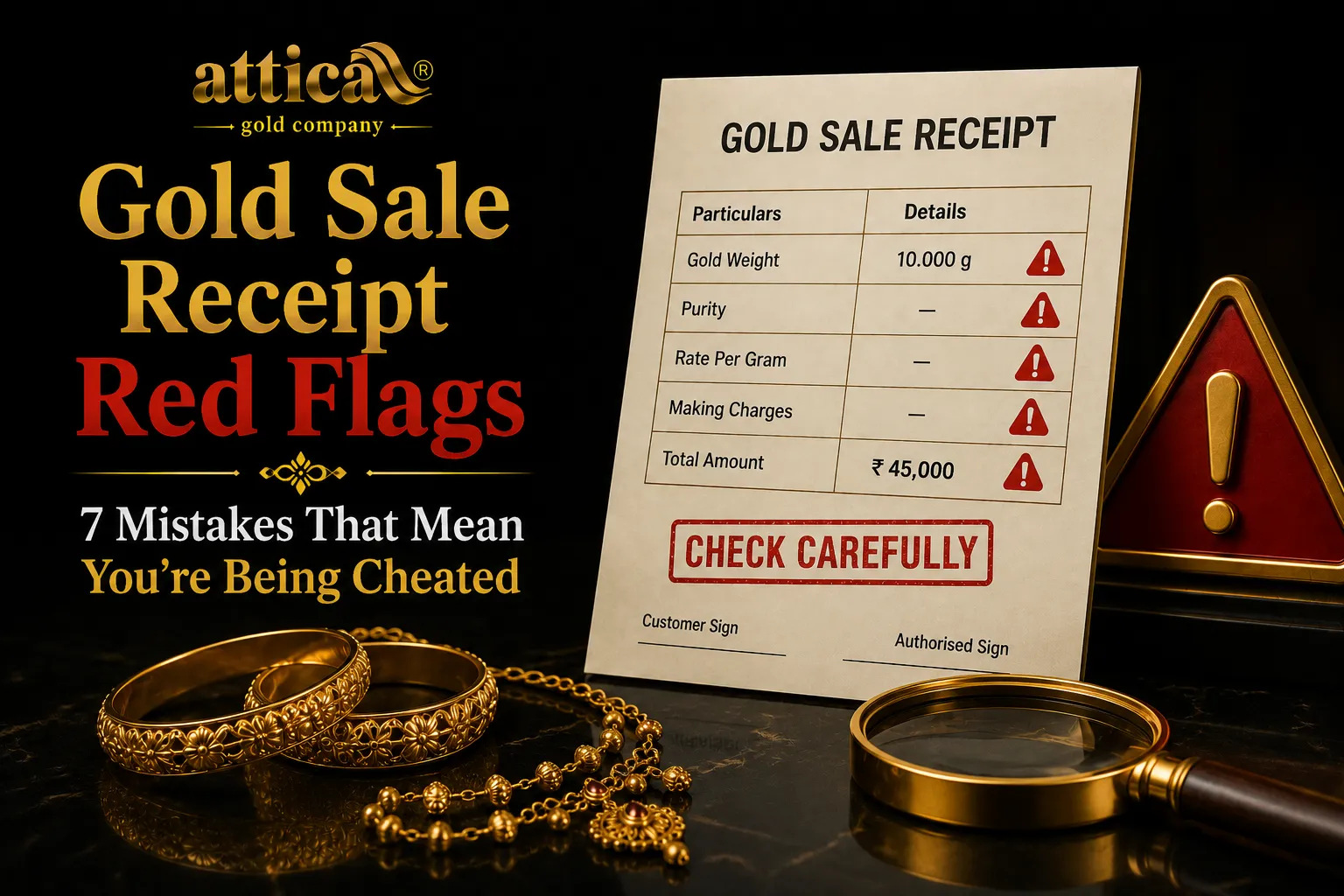
A legitimate gold sale invoice must show: gross weight, tested purity, today’s IBJA rate per gram, line-by-line stone/solder deductions, net payable, GST on gold sale (if applicable), buyer’s GSTIN and registered address, and your KYC details. Red flags: missing weight, no purity %, flat ‘making charge’ deduction, no buyer GSTIN, hand-written informal slip, no signature/stamp. If 2+ red flags appear, the buyer is hiding something – refuse to sign and walk away.
📌 Key Facts At A Glance
- Legitimate receipt shows: weight, purity, rate, deductions, net amount, GSTIN, signature, date.
- GST on gold sale: typically not separately charged for individual selling to buyer (GST is for buyer→customer side); but a 0.25% GST may apply on dealer transactions.
- Buyer’s GSTIN must be visible on the gold buyer receipt – verify it on the GST portal if suspicious.
- Hand-written slip without letterhead = automatic red flag.
- Missing tested purity % on receipt = likely XRF wasn’t done; renegotiate.
- Line-by-line breakdown is standard at trusted gold buyer; flat percentages are red flag.
- Always photograph the receipt before leaving the buyer; keep digital copy.
Why Your Gold Buyer Receipt Matters After Cash for Gold
After a cash for gold transaction, the receipt is the only documentary proof you have of what was sold, at what rate, with what deductions, and for how much. A clean, complete receipt protects you in three ways: tax filing (declaring the gain in your ITR), source-of-funds questions (proving where the cash came from), and dispute resolution (if you later realise something was wrong). A vague or incomplete receipt does the opposite – it leaves you with no protection.
This guide walks through the 7 most common gold buyer receipt red flags that signal you’re being cheated, what a legitimate gold sale invoice should contain, and how to verify a buyer’s authenticity using their GSTIN and registered details. Read this before any cash for gold transaction; verify the receipt before leaving the counter.
What a Legitimate Gold Sale Invoice Must Contain
| Field | Required? | Verification |
| Buyer’s name + GSTIN | Mandatory | Verify GSTIN on gst.gov.in |
| Buyer’s registered address | Mandatory | Should match Google Maps address |
| Receipt number + date | Mandatory | Sequential numbering = legitimate |
| Your name + Aadhaar/PAN | Mandatory | Match your KYC documents |
| Gross weight (each piece) | Mandatory | Per piece, not just total |
| Tested purity % (XRF) | Mandatory | 22K, 24K, 18K specified |
| Today’s IBJA rate per gram | Mandatory | Verify against ibja.co |
| Stone weight + solder estimate | If applicable | Itemised, not flat % |
| Net payable amount | Mandatory | Calculated transparently |
| Payment mode + reference | Mandatory | UPI ID, NEFT ref, etc. |
| Buyer’s signature + stamp | Mandatory | Official signature |
Anything missing from this list is a yellow flag. Two or more missing = red flag. The buyer’s GSTIN is the easiest single verification – paste it into the GST portal’s search and confirm the registered name matches the buyer’s signage. If GSTIN doesn’t verify, walk away.
- Also Read: Live Gold Price Today
Red Flag #1: No Buyer GSTIN or Hand-Written Slip
A trusted gold buyer issues invoices on company letterhead with printed GSTIN, business address, and sequential receipt numbering. Hand-written slips on plain paper, no letterhead, and no GSTIN are the single clearest sign of an unregulated operation. Even small jewellers issue printed receipts; if a buyer can’t produce one, they’re either operating informally (tax non-compliance) or deliberately keeping transactions off-record (which exposes you to questions later).
Special case: roadside or door-to-door buyers almost never have proper invoices. They may offer to write a ‘simple receipt’ on a pad – this has zero legal value and provides no protection if questioned by tax authorities later.
Red Flag #2: Missing Weight or Purity on Receipt
If the gold sale invoice does not specify the gross weight (per piece, in grams) and the tested purity (% from XRF), the receipt is incomplete – and likely deliberately so. The buyer’s calculated amount cannot be verified without these two numbers. Walk back to the counter and demand they re-write the receipt with weight and purity included.
Multiple-piece transactions: each piece’s weight and purity should be listed separately on the receipt, not just the bundle total. This protects you if you later discover a discrepancy with one specific piece – you can identify exactly which piece had the issue.
Red Flag #3: Flat ‘Making Charge’ or Percentage Deduction
Making charges have nothing to do with selling gold – they’re a buying-side cost. Any line item on the receipt labelled ‘making charge’, ‘wastage’, or ‘flat 5% deduction’ is a margin grab. The legitimate deductions are: stone weight (in grams, removed and weighed separately), solder weight estimate (in grams, 1–3% of total), and GST on gold sale if applicable. Anything else is opaque and should be challenged.
Watch out for combined line items: ‘making + stone deduction = 8%’. Even if 8% sounds reasonable in absolute terms, the combination conflates two different things – making charges (which shouldn’t exist on selling) and stone deductions (which should be itemised in grams). Demand separation; if refused, walk away.
Red Flag #4: Rate Quoted Below IBJA Without Justification
The receipt must show the per-gram rate the buyer used. Verify this against today’s IBJA rate (ibja.co) – for 22K, the buyer’s rate should be within ₹50–₹100/g of IBJA’s published 22K morning or evening rate. If the gap is larger than ₹100/g and the buyer cannot explain why (e.g., ‘we apply 1% local handling charge’), the rate is suspiciously low and the buyer is likely taking unusual margin.
City-to-city variation in IBJA rate is small (₹10–₹50/g for handling). A ₹200–₹300/g gap is not normal and not justifiable through ‘handling’. Push back and demand the IBJA-aligned rate; if refused, take your gold elsewhere.
💰 Get the Best Price for Your Gold Today
Instant valuation • Transparent pricing • 100% secure & trusted
Red Flag #5: GST on Gold Sale Confusion
GST on gold sale rules are widely misunderstood. The clean rule: when an individual sells gold to a registered buyer, GST is NOT charged to the seller (the buyer can’t claim input credit on a non-GST seller). However, if the buyer is unregistered for GST or is operating outside the formal system, they may add a ‘GST 3%’ line on the receipt and pocket it without remitting to the government. This is fraud – there’s no legitimate 3% GST on individual selling gold.
What you may legitimately see: 0.25% inter-dealer transactions (rare; doesn’t affect retail sellers), or applicable state-level taxes for very specific jurisdictions. If the receipt shows ‘3% GST’ added to your sale value (reducing your payout), question it. If the buyer can’t produce a clear regulatory reference, the deduction is invalid.
Red Flag #6: No Itemised Stones, No Stone Return
If your gold piece had stones, the gold sale invoice must show: stone weight (in grams, separately weighed), and confirmation that stones were returned to you. If the receipt shows ‘1g stones’ but you walked out without the stones in hand, the buyer kept your stones – that’s stealing. Even cubic zirconia and synthetic stones are your property by default; the buyer must explicitly ask if you want them disposed of (and most sellers want them returned).
Even more concerning: receipts that estimate stones in percentage rather than grams. ‘5% stone deduction’ on a ₹1L sale = ₹5,000 lost without any verification of actual stone weight. The legitimate format: ‘1.5g stones removed and returned to seller’.
Red Flag #7: No Sequential Receipt Number or Buyer Signature
Legitimate businesses issue invoices with sequential numbering – receipt #4521 on one day, #4522 on the next, etc. Skipping numbers, randomly-generated numbers, or no number at all suggest the buyer is keeping informal records or fabricating receipts as needed. Combined with no signature/stamp from an authorised representative, the receipt has no legal weight.
How to verify on the spot: ask to see the previous customer’s receipt number (with their personal details masked) or the buyer’s daily sales register. Reputable buyers won’t object; informal buyers will refuse or change the topic. The GSTIN on the receipt should also match what’s on the buyer’s GST portal listing – check this within 5 minutes on your phone.
Why Choose Attica Gold for Verifiable Cash for Gold Receipts
Your gold buyer receipt is the only thing standing between you and questions from tax authorities, family members, or future buyers asking about the sale. A clean, complete receipt with all the elements above protects you for years; a vague or hand-written slip provides no protection at all. The 7 red flags in this guide are the most common signals that the receipt – and likely the entire transaction – is not what it should be.
Attica Gold issues fully-formatted gold sale invoices on company letterhead at every branch: GSTIN, registered address, sequential receipt number, your KYC details, per-piece weight and purity, today’s IBJA rate, line-by-line stone/solder deductions, net payable, payment mode reference, and authorised signature with stamp. ISO 9001:2015 certified processes ensure the same standard at all 200+ branches across South India. If you’ve been hesitating to sell because you weren’t sure what a legitimate receipt looks like, your wait is over. Walk into your nearest Attica Gold branch today – the receipt you receive will pass every check in this guide.
Frequently Asked Questions
What must a legitimate gold sale invoice contain?
A legitimate gold sale invoice contains: buyer’s name + GSTIN, registered address, sequential receipt number + date, your name + Aadhaar/PAN, gross weight per piece, tested purity %, IBJA rate per gram, itemised stone/solder deductions, net payable, payment mode reference, buyer’s signature and stamp. Missing any of these is a red flag.
Is GST on gold sale charged when individual sells gold?
No – when an individual sells gold to a buyer, GST on gold sale is NOT charged to the seller. GST applies on the buyer-to-customer side (3% on jewellery purchase). If a receipt shows ‘3% GST’ deducted from your sale value, question it – there’s no legitimate basis for that deduction on individual selling gold.
How do I verify a trusted gold buyer’s GSTIN on the receipt?
Visit gst.gov.in, click ‘Search Taxpayer’, paste the GSTIN from the receipt, and confirm the business name and address match the buyer’s signage and the receipt header. Mismatch = red flag. A trusted gold buyer’s GSTIN registers immediately and matches their advertised business name.
What’s a typical gold buyer receipt red flag for stone deductions?
Gold buyer receipt red flag for stones: shown as percentage rather than grams (e.g., ‘5% stone deduction’ instead of ‘1.5g stones removed’). Legitimate deduction is the actual physical weight of stones, not a percentage of total weight. Also red flag: receipt shows stone deduction but you didn’t receive stones back – that’s the buyer keeping your property.
Should the gold sale invoice show the IBJA rate used?
Yes – the gold sale invoice should show the per-gram rate applied (whether labelled ‘IBJA rate’, ’24K rate’, or ‘today’s rate’). Verify this rate against ibja.co’s published morning or evening rate. Reputable buyers price within ₹50–₹100/g of IBJA. If the receipt rate is more than ₹100/g below IBJA, ask why.
Can I trust a hand-written cash for gold receipt?
Hand-written cash for gold receipts on plain paper without buyer letterhead, GSTIN, or signature have no legal weight. Use them only as personal records for very small transactions where the buyer is informal but otherwise verifiable. For any meaningful sale, demand a proper printed receipt – if the buyer can’t produce one, walk away.
What if the receipt shows different weight than what I brought?
Stop the transaction immediately and demand a re-weigh on a calibrated, certified scale. Calibrate the scale by tare-zeroing first. Also weigh a known reference object (a coin) for sanity check. If the weight discrepancy persists, take photos of the receipt and the scale, and walk away with your gold – the buyer is using a tampered scale.
Is sell gold for cash receipt different from sell gold via NEFT?
Format-wise, no. Both should contain the same fields (weight, purity, rate, deductions, net, payment mode, signatures). The only difference is the ‘payment mode’ field: ‘cash’ for sell gold for cash, or NEFT/RTGS reference for bank transfer. The receipt’s content and legal validity are equivalent regardless of payment mode.
What happens if I lose my cash for gold receipt?
Contact the buyer’s branch and request a duplicate (most reputable chains can re-issue from their database). Without the receipt, your tax filing for the gold sale becomes harder – you’ll need bank statements and other circumstantial evidence to prove the sale value. Always photograph the receipt immediately after the sale; store a digital copy in your email or cloud drive.
Can I use a sell gold near me receipt for ITR filing?
Yes – a sell gold near me receipt with weight, purity, rate, net amount, and buyer’s GSTIN is the primary document for filing capital gains on gold in your ITR. Attach it (or its details) when filing Schedule CG of your ITR. Reputable buyers’ receipts are accepted by tax authorities without question.
Sources & References
This page references and is informed by the following authoritative sources. Last verified: May 2026.
[1] GSTIN Verification & Search – Goods and Services Tax Network (GSTN). https://services.gst.gov.in/
[2] Daily Gold Reference Rate – India Bullion and Jewellers Association (IBJA). https://ibja.co/
[3] GST Rates on Gold & Bullion – Central Board of Indirect Taxes & Customs (CBIC). https://www.cbic.gov.in/
[4] BIS Hallmarking Standards & HUID System – Bureau of Indian Standards. https://www.bis.gov.in/
[5] Capital Gains Schedule CG – ITR Filing Guide – Income Tax Department, Government of India. https://www.incometax.gov.in/
Want a verifiable, complete cash for gold receipt?
Visit your nearest Attica Gold branch – full GSTIN-stamped invoices, per-piece weight and purity, IBJA-linked rate, line-by-line deductions, sequential receipt numbering.