
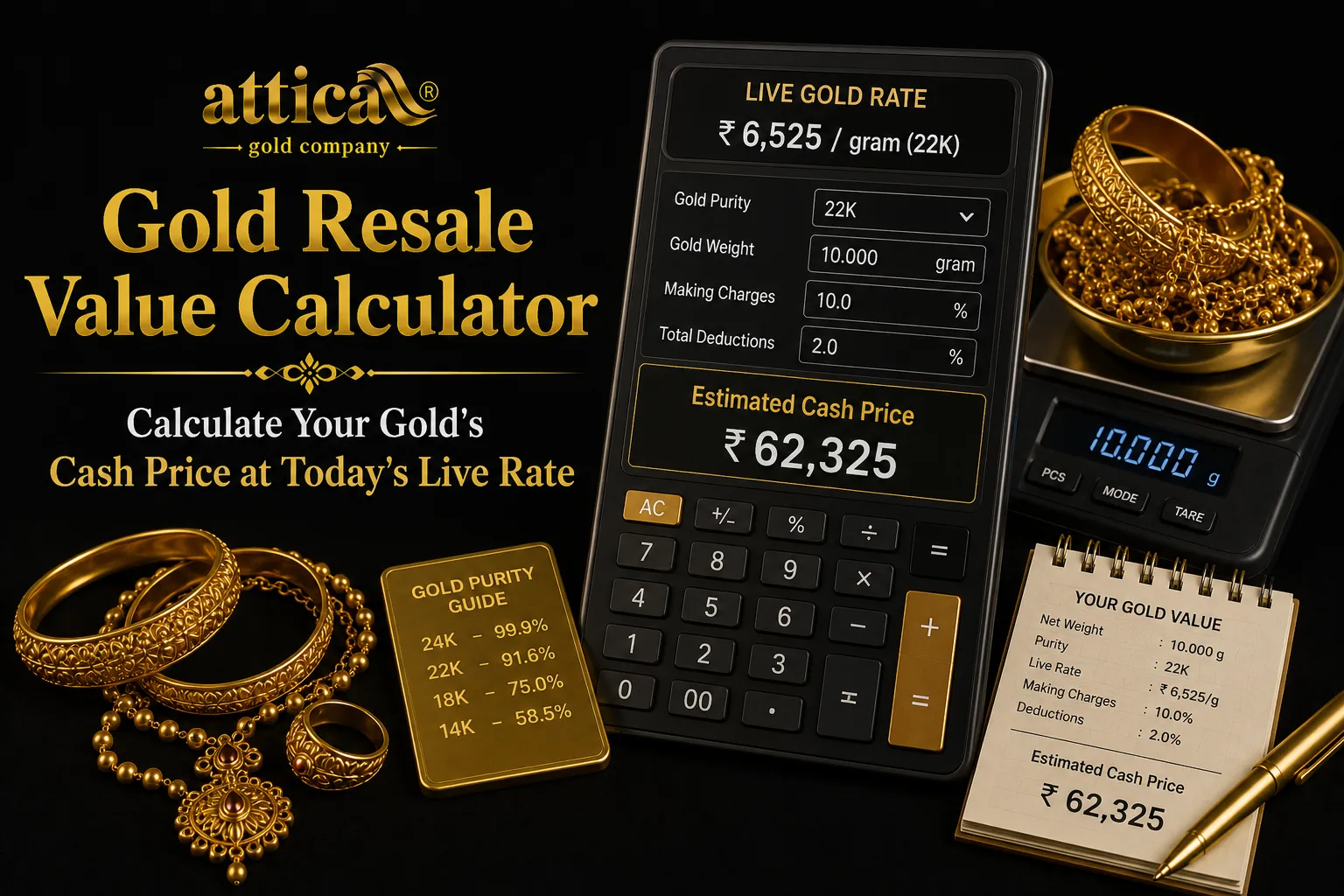
Why Every Gold Seller Needs a Resale Value Calculator
The single biggest source of confusion among first-time gold sellers is the gap between what they paid for the piece originally and what it fetches when sold. A wedding chain bought at ₹2 lakh ten years ago might fetch ₹3 lakh today, or a 10g coin bought at ₹50,000 a few years ago might fetch ₹1.5 lakh – and the difference between expectation and reality often surprises sellers. A gold value calculator removes the surprise: enter your gold’s weight and purity, and the formula tells you exactly what cash value to expect at today’s IBJA rate. The math is the same one every reputable buyer uses: Weight × Tested Purity × Today’s 24K Rate − Fair Deductions.
This guide explains the gold resale value calculator: how the formula works, what each variable means, the four standard purity multipliers, what counts as ‘fair deductions’, and worked examples for the most common gold piece types. It also includes a placeholder for the live calculator widget that does the math instantly. By the end, you will be able to estimate the resale value of any gold piece in your possession before you walk into a buyer’s branch.
Gold Value Calculator at a Glance
| Variable | Source | How It Affects Value |
| Weight (in grams) | Buyer’s digital scale (your XRF reading) | Direct multiplier – every gram counts |
| Tested Purity (in %) | XRF machine reading at the buyer’s branch | Direct multiplier – accuracy matters |
| Today’s 24K Rate | IBJA twice-daily benchmark + MCX intraday | Per-gram price the formula multiplies against |
| Stone Weight | Removed and weighed separately | Subtracted from gross weight |
| Solder Weight | Estimated 1-10% based on design | Effective deduction via XRF reading |
Today’s Live Gold Rate: The Calculator Input
The single most important input into any gold resale value calculator is today’s live 24K rate per gram – the IBJA benchmark from which all other purities are derived. As of today’s reference, 24K trades at approximately ₹15,250 per gram in India. From this, 22K = ₹13,965/g (91.6% × ₹15,250), 18K = ₹11,438/g (75% × ₹15,250), and 14K = ₹8,921/g (58.5% × ₹15,250). Your calculator must use the live rate at the moment of calculation; using yesterday’s rate or last week’s rate produces inaccurate estimates.
- Also Read: Live Gold Price Today
Use the widget below to verify today’s live 24K rate before running any resale calculation. Reputable buyers reference the IBJA twice-daily benchmark plus live MCX intraday moves, so the rate you see in the widget is the same one a buyer applies at the branch.
The Gold Resale Value Formula Explained
Every reputable buyer in India calculates gold resale value using the same formula, broken down into five steps:
- Step 1: Weigh the piece on a calibrated digital scale to two decimal places. This is the gross weight.
- Step 2: Remove and separately weigh any stones, beads, enamel, or non-gold elements. Subtract this from the gross weight to get the net gold weight.
- Step 3: Test purity using XRF (X-ray fluorescence) – this measures the actual gold content as a percentage. For example, 91.6% for 22K, 75% for 18K, 99.9% for 24K. Solder content reduces the overall percentage below the design’s nominal purity.
- Step 4: Multiply: Net Gold Weight × Tested Purity × Today’s 24K Rate. This gives the gross resale value.
- Step 5: Subtract any fair deductions (1-2% refining margin on bullion; less on jewellery). The result is your final cash payout.
This formula has no hidden variables. Every input is measurable, every multiplication is straightforward, and every step should appear on your written receipt. If a buyer’s calculation includes anything beyond these five steps, ask them to explain – there is no legitimate reason for additional deductions on standard gold transactions.
Live Calculator: Enter Your Gold’s Details
Worked Examples: Common Gold Pieces at Today’s Rate
Here are worked resale calculations for the most common gold piece types Indian families own, all at today’s reference rate (24K = ₹15,250/g):
- 1g of 24K coin: 1 × 0.999 × ₹15,250 = ₹15,235 (less small refining margin of 1-2%, so net ₹14,950–₹15,100).
- 5g of 22K plain ring: 5 × 0.916 × ₹15,250 = ₹69,845 gross.
- 10g of 22K daily-wear chain: 10 × 0.916 × ₹15,250 = ₹1,39,690 gross.
- 20g of 22K bangle (one piece): 20 × 0.916 × ₹15,250 = ₹2,79,380 gross.
- 30g of 22K mangalsutra: 30 × 0.916 × ₹15,250 = ₹4,19,070 gross.
- 50g of 22K wedding chain: 50 × 0.916 × ₹15,250 = ₹6,98,450 gross.
- 100g of 22K wedding set (with 5g stones removed): 95 × 0.916 × ₹15,250 = ₹13,27,055 gross.
- 10g of 18K diamond ring (gold portion only, stones removed): 10 × 0.75 × ₹15,250 = ₹1,14,375 gross.
- 10g of 14K men’s chain: 10 × 0.585 × ₹15,250 = ₹89,213 gross.
These figures are gross – the gross before any fair deductions for solder weight in ornate pieces (typically 1-5% on plain pieces, 5-10% on temple jewellery and KDM-style designs). For a clean piece with minimal solder, expect to receive close to the gross figure. For ornate pieces with heavy solder, the XRF reading naturally accounts for solder by showing slightly lower overall purity.
💰 Get the Best Price for Your Gold Today
Instant valuation • Transparent pricing • 100% secure & trusted
What ‘Fair Deductions’ Actually Mean
Fair deductions in a gold resale calculation include only two categories of clearly non-gold elements:
- Stones – diamonds, rubies, emeralds, sapphires, polki, kundan, beads, glass. Always insist that stones be removed and returned to you before the gold is weighed. Stones have separate resale markets (often much lower than retail) and should be valued in a separate transaction.
- Solder weight – the metal used to join intricate jewellery components. Plain pieces (chains, bangles, rings) typically have 1–3% solder by weight; ornate temple jewellery, kasu malas, and KDM pieces can have 5–10% solder. The solder itself contains less gold than the body, so the XRF reading naturally reflects the average purity of body and solder combined.
What is NOT a fair deduction: making charges, wastage, age of the piece, design type, BIS hallmark absence (XRF testing accommodates this), ‘low purity’ surcharges on hallmarked pieces, refining margins above 1-2% on jewellery, or any flat percentage cut without explanation. If a buyer applies any of these, walk away. The math should be transparent: gross weight, stone weight, net gold weight, tested purity, today’s per-gram rate, gross amount, fair deductions, final amount.
Common Calculator Mistakes That Lead to Underpayment
Three calculation mistakes are common and often go unnoticed by first-time sellers, leading to silent underpayment:
- Using nominal purity instead of XRF-tested purity – if the buyer assumes your piece is exactly 91.6% (22K) without XRF testing, but the actual XRF reading would show 90% (due to solder), you might be slightly overpaid (their loss). More commonly, if the XRF shows 91.6% but the buyer rounds it down to 90%, you are silently underpaid. Always insist on the exact XRF reading printed on your receipt.
- Using yesterday’s rate or weekly average – if today’s rate is ₹15,250/g but the buyer applies last week’s average of ₹15,100/g, the difference of ₹150/g multiplied by your piece weight is silent underpayment. Always check the live IBJA rate at the time of your transaction.
- Flat percentage cuts without breakdown – phrases like ‘we deduct 5% for our process’ or ‘standard 3% refining’ on standard hallmarked jewellery are warning signs. Reputable buyers itemise every deduction (stones, solder reduction, etc.); flat cuts are a way to disguise margins.
How to Cross-Check a Buyer’s Quote Against the Calculator
Before accepting any gold resale quote, run the math yourself using these three checks. First, verify the per-gram rate the buyer is using against today’s IBJA rate (publicly available at ibja.co or any major financial news site). The rate should match within ₹50–₹100/g; anything more than ₹200/g below is a warning. Second, verify the XRF-tested purity figure printed on your receipt – it should be a specific number to one decimal place (e.g., 91.4%), not a rounded ‘approximately 22K’. Third, multiply weight × purity × rate yourself; the result should match the gross figure on the receipt within rounding.
If all three checks pass and the only deductions are stones (separately weighed and listed) and any small refining margin (1-2% on bullion only), the deal is fair. If any check fails, ask the buyer to explain – and if the explanation involves vague terms like ‘market adjustment’ or ‘old gold processing’, walk away. The right buyer will be happy to walk you through the math line by line.
Why Choose Attica Gold for the Most Accurate Calculator-Based Quote
A gold resale calculator is only as accurate as the rate, purity, and deduction inputs feeding it – and the buyer who applies these inputs determines whether the calculator’s output matches what you actually receive. The right buyer uses today’s live IBJA rate, runs XRF testing in your presence with the reading visible to you, deducts only stones and solder transparently, and prints the exact math on your written receipt. There is no scope for hidden margins or ‘process surcharges’ that quietly reduce your payment below what the calculator predicted.
Attica Gold’s calculation matches the public formula at every branch across Karnataka, Tamil Nadu, Andhra Pradesh, Telangana and Pondicherry. Free XRF purity testing in your presence, today’s IBJA rate displayed openly, transparent line-by-line written quotes, and instant payment in cash, UPI, NEFT, RTGS, or IMPS – your choice. ISO 9001:2015 certification means the same calculation standard at every branch, every day. Your wait is over – walk into your nearest Attica Gold branch with your gold weight and purity in mind, and verify with your own eyes that the calculator output matches the cash you receive.
Frequently Asked Questions
How do I calculate the resale value of my gold?
The formula is: Net Gold Weight × Tested Purity × Today’s 24K Rate − Fair Deductions. Net gold weight = total weight minus stones; tested purity = XRF reading at the buyer’s branch (e.g., 91.6% for 22K); today’s 24K rate = IBJA live benchmark. For 10g of 22K at ₹15,250/g 24K rate, the calculation is 10 × 0.916 × ₹15,250 = ₹1,39,690 gross. Fair deductions include only stones and solder weight, not making charges or age.
What is today’s gold value calculator rate for 22K?
Today’s 22K rate per gram is approximately ₹13,965 (= 91.6% × today’s 24K rate of ₹15,250). For 22K resale calculations: weight × ₹13,965/g = gross value before deductions. Use the live rate widget above for the exact figure right now – IBJA updates the benchmark twice daily and intraday based on MCX moves.
Does the gold resale calculator account for making charges?
No – making charges and wastage are sunk costs from your original purchase and are NOT recovered when you sell. The resale calculator only considers actual gold content (weight × tested purity × today’s rate). This is why selling jewellery typically nets less than what you originally paid: the metal value has appreciated, but the making/wastage component is non-refundable.
How does the calculator handle stones in jewellery?
Stones (diamonds, rubies, emeralds, sapphires, polki, kundan, beads, glass) are always removed and weighed separately before the gold is calculated. The gold weight used in the formula is net weight (gross weight minus stone weight). Stones have a separate resale market and should be valued separately – diamonds in particular have wide retail-to-resale spreads, so they are best handled in a different transaction from the gold.
Why is the calculator output less than what I expected?
Three common reasons. First, you may be remembering the original retail price (which included making charges, wastage, GST, and jeweller’s margin) and comparing it to today’s metal-only resale value. Second, the gold price moves daily – yesterday’s rate is not today’s rate. Third, your piece’s actual XRF-tested purity may be slightly below the nominal grade (e.g., 90% vs 91.6%) due to solder content. The calculator uses real inputs; your expectation may have been based on retail-style thinking.
Is the gold value calculator the same as what a buyer will pay?
It should be – within 1-2% for refining margins on bullion or trace solder adjustments on jewellery. If a buyer’s quote is more than 2-3% below the calculator output, ask them to explain the gap. Reputable buyers like Attica Gold show the exact math on the receipt; the calculator and the buyer’s quote should match closely. If they do not, ask why.
Can I use the gold value calculator for old gold without a hallmark?
Yes – the formula works the same way regardless of hallmark status. The only difference is that you may not know the exact purity in advance for non-hallmarked pieces. Reputable buyers run XRF testing on every piece (hallmarked or not), so the calculator output adjusts naturally based on the actual tested purity. Old non-hallmarked gold often tests at 88-91% (slightly below modern 22K hallmark standards) due to inconsistent pre-2021 manufacturing.
How accurate is a gold resale value calculator?
Very accurate when the inputs are correct: (1) today’s live IBJA rate (varies twice daily, intraday), (2) actual tested purity (varies piece to piece), and (3) net gold weight (after stones removed). With accurate inputs, the calculator output matches the buyer’s gross quote within 1-2%. Inaccurate inputs (yesterday’s rate, assumed purity, gross weight including stones) produce inaccurate estimates. Always use live data and weigh stones separately.
Want to verify your gold value calculator estimate at a real buyer?
Visit your nearest Attica Gold branch for free XRF testing, transparent calculation in your presence, and instant cash at today’s live IBJA rate.