What 22-carat Gold Is and Why It Dominates Indian Jewellery
22-carat gold is the most widely owned form of gold in Indian households – and the single most important fact about it is this: 22-carat gold contains exactly 91.6% pure gold and 8.4% other metals (alloys like copper, silver, and zinc). The Bureau of Indian Standards fixes this 91.6% figure and appears as the ‘916’ hallmark on every authentic piece of 22-carat gold sold today. From temple jewellery in Tamil Nadu to wedding sets in Hyderabad, from family bangles in Bangalore to coin collections across India, 22K has been the default for generations because it carries the highest practical pure gold content while still being durable enough for everyday wear.
This guide covers everything you need to know about 22-carat gold: today’s live rate, how the 916 hallmark works, where 22K sits versus 18K and 24K, why it dominates Indian jewellery, and exactly how much cash to expect when selling. By the end, you will know precisely how to value any 22-carat gold piece in your possession – and how to spot a buyer who is trying to underprice it.
22 Karat Gold at a Glance
| Attribute | 22K Gold |
| Pure Gold Content (22-carat gold purity) | 91.6% (= 916 / 1000 fineness) |
| Other Metals (alloys) | 8.4% – copper, silver, zinc |
| BIS Hallmark | 916 (also ’22K’) |
| Common Use | Traditional Indian jewellery – chains, bangles, rings, wedding sets, mangalsutras, coins |
| Today’s Rate | See live rate widget below |
| Resale Value | 91.6% of today’s 24K rate per gram, less a small refining margin |
Today’s Live 22-carat Gold Rate
The 22-carat gold rate today is calculated as 91.6% of today’s 24K rate per gram. So if 24K is trading at ₹15,250/g, the 22-carat gold rate works out to roughly ₹13,965/g. This proportion stays constant – it reflects pure gold content, not market mood. The 22k gold rate moves with the international gold spot, the rupee–dollar exchange rate, and Indian import duty, exactly like 18K and 24K.
- Also Read: Live Gold Price Today
Use the widget below to verify the 22-carat gold price today across India. Reputable buyers reference the IBJA twice-daily benchmark plus live MCX intraday moves. The 22-carat gold price in India is largely uniform city-to-city, with only minor handling variations between metros (typically ₹10–₹50/g).
What is 22 Karat Gold? Composition and Properties
22-carat gold is gold mixed with a small proportion of other metals – about 91.6% pure gold and 8.4% alloy. The low alloy content keeps the colour distinctively ‘gold yellow’ and preserves nearly all of the per-gram resale value of pure gold, while still being just hard enough to hold the shape of a chain, bangle, or ring. The trade-off compared to 18K: 22-carat gold is softer, so it scratches more easily and is less suitable for diamond-set pieces where the stone needs a firmer grip.
Like 18K, 22-carat gold can be alloyed with different metals to produce small colour variations. Still, the overwhelming majority of 22K jewellery in India is yellow, with copper and silver added in roughly equal parts. White and rose 22K exist but are uncommon. The 8.4% alloy mix is largely invisible to the eye; what matters for value is that 91.6% pure gold content, which any reputable buyer will verify by XRF in seconds.
How to Identify 22-carat Gold: The 916 Hallmark
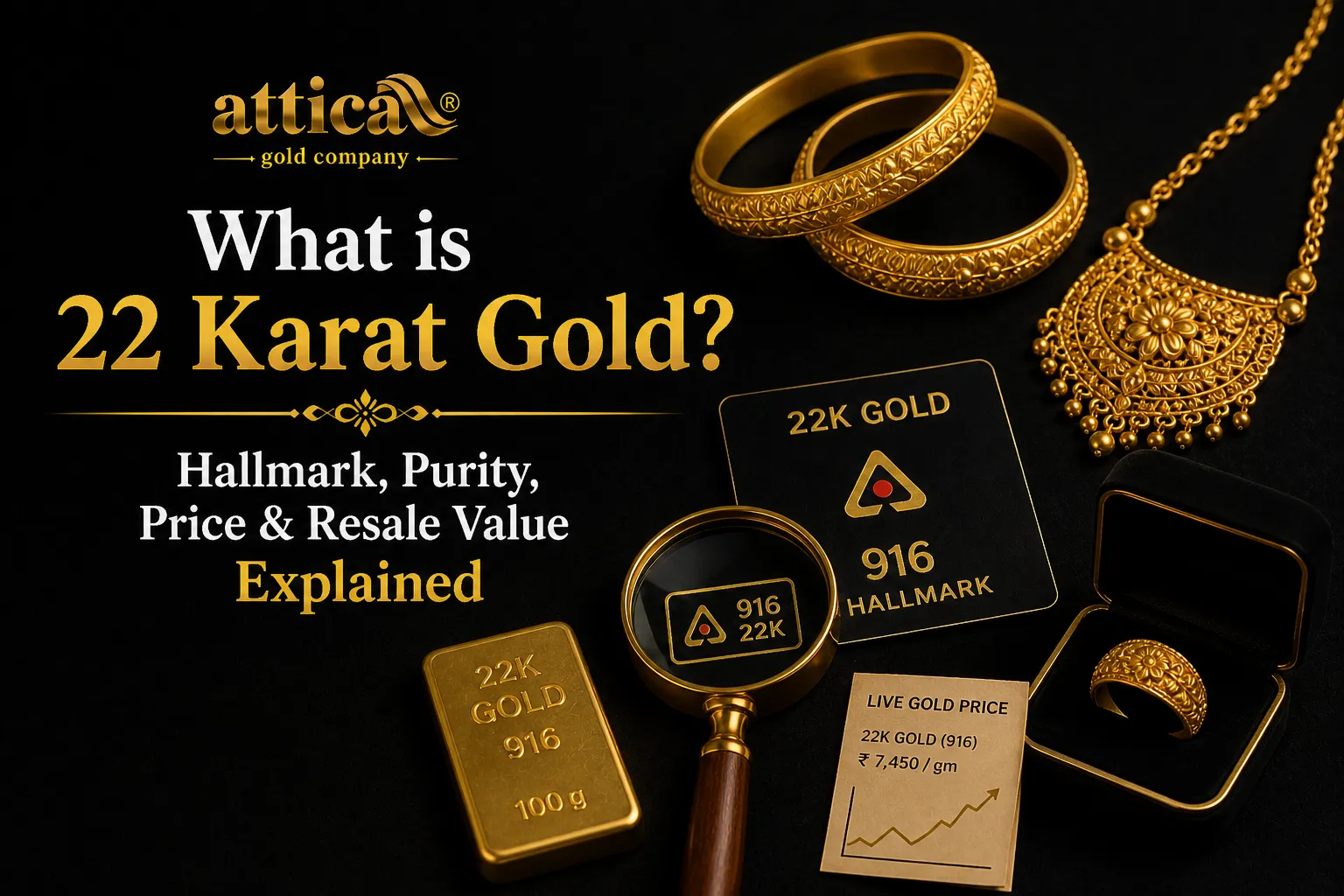
The Indian BIS hallmark for 22-carat gold is ‘916’ – meaning 916 parts pure gold per 1000, or 91.6% purity. Hallmarking became mandatory for new gold sales in June 2021. A genuine hallmarked 22K piece carries four distinct elements:
- BIS triangular logo with ‘BIS’ text inside.
- Purity grade – ‘916’ for 22-carat gold (others: 585 for 14K, 750 for 18K, 999 for 24K).
- Six-digit Hallmark Unique ID (HUID) – alphanumeric, traceable on the BIS Care app.
- Jeweller’s identification mark.
Older 22-carat gold pieces from before June 2021 may not carry the HUID. They typically still bear the 916 mark and BIS triangle, and they are still genuine. To verify any piece – old or new, hallmarked or not – any reputable buyer can run an XRF test that measures actual gold content (~91.6% for genuine 22K) in seconds, without melting or damaging the jewellery. The price applied is based on the tested purity, not on whether the piece is hallmarked.
22-carat Gold vs 24 Carat vs 18 Carat: How to Choose
22-carat gold sits in the sweet spot between investment-grade 24K and durability-led 18K. Each purity has clear strengths:
| Purity | Pure Gold % | Strengths | Considerations |
| 22K (22-carat gold) | 91.6% (916 hallmark) | Best resale value among jewellery; traditional Indian standard | Softer than 18K – not ideal for diamond settings |
| 24K (24 carat gold) | 99.9% (999 hallmark) | Maximum purity; investment-grade | Too soft for daily-wear jewellery |
| 18K (18 carat gold) | 75% (750 hallmark) | Hard, holds stones securely, good for diamonds | Lower resale per gram; less ‘gold yellow’ colour |
Most Indian buyers default to 22K for traditional jewellery and 18K for diamond-set pieces. 24K is reserved for coins, bars, and biscuits intended purely as investments. 22-carat gold is the right choice when (1) you want the highest pure gold content possible in a wearable piece, (2) you want strong resale value if you ever sell, or (3) the design is a traditional ornament – chain, bangle, mangalsutra, kasu mala, or wedding set.
💰 Get the Best Price for Your Gold Today
Instant valuation • Transparent pricing • 100% secure & trusted
Where 22-carat Gold Is Commonly Used
22k gold dominates almost every category of traditional Indian jewellery:
- Chains and necklaces – 22K is the default for plain gold chains, kasu malas, and ornate temple-style necklaces.
- Bangles and kadas – daily-wear bangles, wedding sets, and ceremonial pieces are almost always 22K.
- Rings – plain gold rings, signet rings, and most non-diamond rings are 22K.
- Wedding jewellery – Indian wedding gold sets are traditionally 22K because of resale value and cultural preference for high-purity gold.
- Mangalsutra and thali chains – traditional and culturally significant pieces are nearly always 22K.
- Gold coins for festivals – Akshaya Tritiya and Diwali coins from jewellers are typically 22K (24K coins exist too, sold mainly for investment).
Resale Value: How Much Will You Get for 22-carat Gold?
The 22-carat gold price in india for resale is direct: 91.6% of today’s 24K rate per gram, multiplied by piece weight, minus fair deductions for stones, solder, or any non-gold elements. So 10g of 22K with ₹15,250/g 24K rate = 10 × 0.916 × ₹15,250 = ₹1,39,690 gross. Compare that to 10g of 18K = ₹1,14,375, or 10g of 14K = ₹89,213 – the 22K piece nets significantly more than equivalent weights of lower purities, simply because it contains more pure gold.
Reputable buyers like Attica Gold use XRF purity testing to verify the 91.6% content; if the piece tests slightly higher or lower, the price is adjusted accordingly. The 22k gold price in India for resale is uniform across cities; only the buyer’s margin differs (₹50–₹500/g spread between dedicated buyers, jewellers, and pawn shops). For 22-carat gold specifically, this margin tends to be tighter than for lower-purity pieces – because the gold content is high and the piece can be resold or refined easily.
What to Watch For When Selling 22-carat Gold
Two issues are specific to 22k gold sellers. First, many older 22-carat gold pieces – especially those bought before 2017 – may have been advertised as 22K but were actually slightly below 22K (sometimes 20K or 21K) due to inconsistent purity standards before BIS hallmarking became mandatory. Always insist on XRF testing – it removes ambiguity instantly and ensures you are paid only for the actual gold content. Second, many 22-carat gold pieces (especially temple jewellery, antique sets, and wedding necklaces) include stones, beads, or non-gold attachments. Insist that stones be removed and returned to you before the gold is weighed. Diamonds and gemstones are best valued and sold separately, since their resale value depends entirely on quality and varies enormously.
A third common concern: many sellers worry that they will be paid less because their piece is old or ‘used’. The age of 22-carat gold has zero impact on its resale value – only the actual tested purity matters. A 50-year-old 22K bangle and a brand-new 22K chain of equal weight and purity fetch identical per-gram rates. The jeweller’s making charges and wastage that you originally paid are sunk costs and cannot be recovered, but the gold itself retains full market value.
Why Choose Attica Gold to Sell Your 22-carat Gold
22-carat gold is the most valuable form of jewellery gold that most Indian families own – and selling it deserves a buyer who treats it with the transparency it warrants. The 916 hallmark is your guarantee of authenticity; XRF testing is your guarantee that you are paid for the actual 91.6% gold content, not assumed-down. Whether your 22-carat gold piece is a wedding chain, a temple bangle, an inherited mangalsutra, a kasu mala, or a coin collection – it has substantial cash value at today’s live IBJA rate, and the right buyer will pay it without deductions for making charges, age, or ‘old design’ surcharges that some unorganised buyers invent.
Attica Gold accepts 22-carat gold at every branch across Karnataka, Tamil Nadu, Andhra Pradesh, Telangana and Pondicherry – no minimum weight, no maximum, no surcharge for older pieces, no pressure to convert into a 24K exchange. The price is calculated transparently: weight × tested purity × today’s IBJA 24K rate − fair deductions for stones and solder, listed line by line on your written receipt. Payment is instant in your chosen mode – cash, UPI, NEFT, RTGS, or IMPS. ISO 9001:2015 certification means the same standard at every branch, every day. Your wait is over – walk into your nearest Attica Gold branch for a free XRF test and a written quote at today’s rate, and see for yourself.
Frequently Asked Questions
What is 22-carat gold, and how pure is it?
22-carat gold (also called 22K gold) is gold that is 91.6% pure – the remaining 8.4% is alloy metals like copper, silver, and zinc that are added to make the metal hard enough for jewellery. The 22-carat gold purity is fixed by BIS standards at 91.6% (= 916/1000 fineness), and is identified by the ‘916’ hallmark stamp.
What is the 22-carat gold rate today in India?
The 22-carat gold rate today is approximately 91.6% of today’s 24K rate per gram. So if 24K is at ₹15,250/g, the 22k gold rate works out to roughly ₹13,965/g. The rate moves with international spot, the rupee–dollar rate, and Indian import duty. Use the live rate widget above for today’s exact 22-carat gold price.
What does the 916 hallmark on 22-carat gold mean?
The 916 mark is the BIS-certified purity indicator for 22-carat gold – meaning 916 parts pure gold per 1000, or 91.6% purity. It is one of four BIS jewellery purity grades: 585 (14K), 750 (18K), 916 (22K), 999 (24K). The 22-carat gold hallmark also includes the BIS triangular logo, a six-digit HUID, and the jeweller’s identification mark.
Why is 22-carat gold the most popular choice in India?
22-carat gold has been the Indian standard for jewellery for centuries because it strikes the ideal balance between purity and durability. At 91.6% pure, it carries strong resale value as both ornament and investment, while the small alloy content makes it hard enough to hold shape in chains, bangles, and rings. 22K dominates traditional South Indian and North Indian jewellery – wedding sets, mangalsutras, temple jewellery, and family heirlooms are almost always 22K.
Is the 22-carat gold price in India the same across cities?
Largely yes. The 22-carat gold price in India is set by IBJA nationally with minor city-to-city differences (₹10–₹50/g) for local handling. The bigger differences come from buyer-to-buyer margins, not city-to-city changes. Bangalore, Chennai, Hyderabad, Mumbai, and Delhi all trade within a narrow band, and the 22-carat gold rate Hyderabad, Bangalore, and Chennai jewellers display tracks IBJA closely.
Can I sell 22-carat gold without a hallmark?
Yes. Hallmarking became mandatory for new sales only in June 2021, so older 22-carat gold pieces may not have the 916 mark. Reputable buyers test purity using XRF (X-ray fluorescence), which measures actual gold content in seconds – regardless of hallmark status. The price you receive is based on tested purity, not paperwork.
How much will I get if I sell my 22-carat gold?
The 22-carat gold price you receive for resale = weight × 91.6% × today’s 24K rate − fair deductions for stones and solder. For 10g of 22K at today’s ₹15,250/g 24K rate, you receive approximately ₹13,965 × 10 = ₹1,39,650 gross before deductions. Compare this against 10g of 18K (~₹1,14,375) – same weight, but 22K nets significantly more because it contains more pure gold.
What is the difference between 22k gold and 22-carat gold?
There is no difference – they are different ways of writing the same purity. ’22K’ is the international shorthand; ’22-carat’ is the longer form. Both refer to gold that is 91.6% pure, marked with the 916 hallmark in India. The same applies to 18K vs 18 carat, and 24K vs 24 carat.
Want to know exactly what your 22-carat gold is worth today?
Visit your nearest Attica Gold branch for a free XRF purity test and a transparent written quote at today’s live rate.