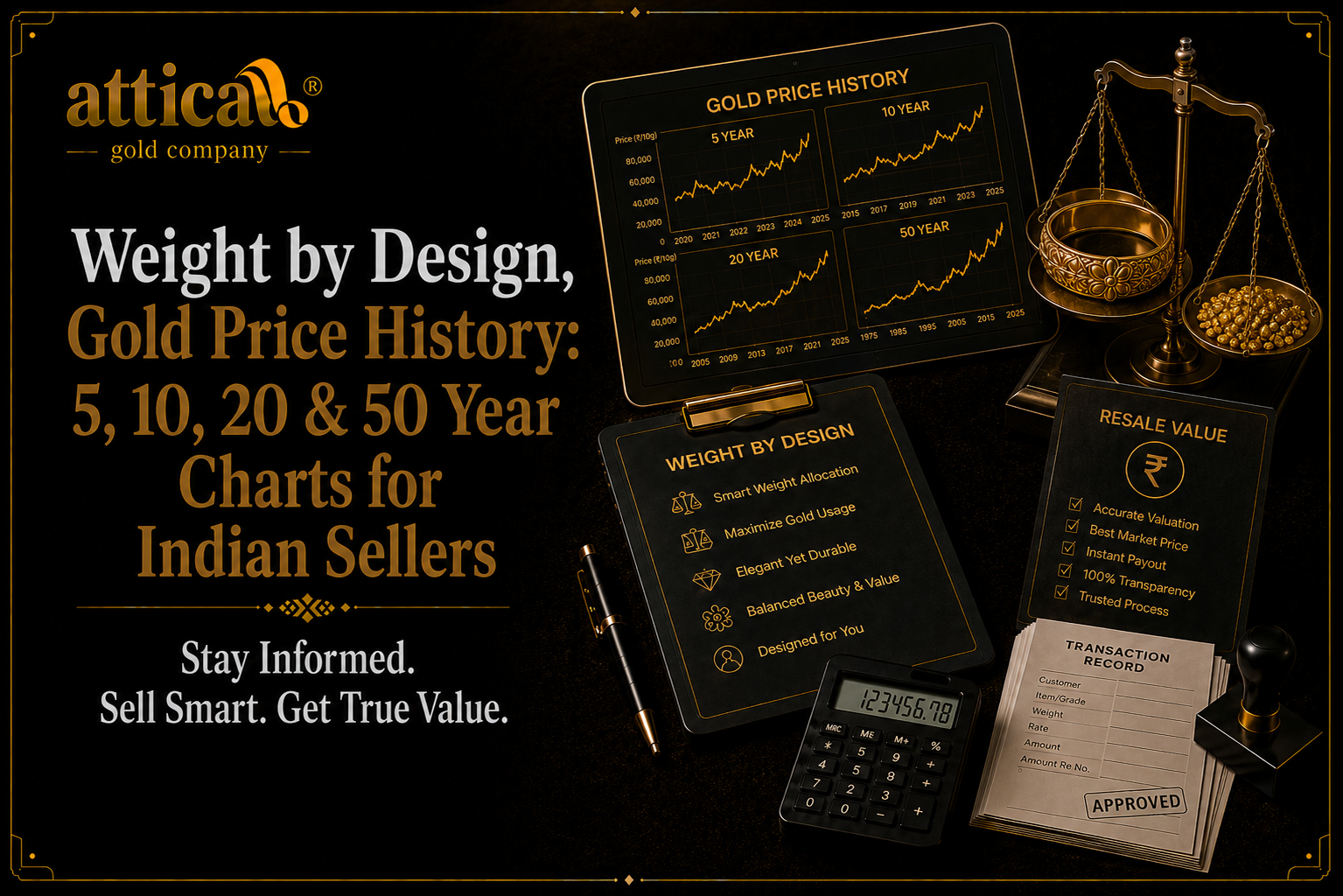
What Half a Century of Gold Price History Tells Us
If you held 1 gram of gold in 1975 and you sold it today in 2026, you would receive approximately ₹15,250 per gram for 24K – compared to roughly ₹540/g in 1975 (the average annual price that year). That’s a 28x nominal return over 50 years. Adjusted for rupee inflation, gold has slightly outperformed the Consumer Price Index over multi-decade periods, validating its centuries-old role as an inflation hedge in India.
This guide walks through 50 years of Indian gold price history – the major rallies, the multi-year corrections, the inflexion points that mattered, and how today’s price (₹15,250/g 24K) compares to historical highs and lows. By the end, you will have context to decide if today is a good time to sell, hold, or convert your gold into other assets.
Indian Gold Price Across the Decades – Key Reference Points
| Year | Approx. 24K Rate (₹/g) | Major Driver |
| 1975 | ₹540 | Post-independence stable era |
| 1985 | ₹2,130 | Rising inflation, USD weakness |
| 1995 | ₹4,680 | Post-liberalisation, currency reforms |
| 2005 | ₹7,000 | Global commodity supercycle begins |
| 2010 | ₹18,500 | Global financial crisis rally |
| 2015 | ₹26,800 | Multi-year correction phase |
| 2020 | ₹49,000 | COVID-19 safe-haven rally |
| 2024 | ₹78,000 | Geopolitical & inflation-led rally |
| 2026 | ₹15,250 per gram (current) | All-time high cycle continues |
Today’s Live Rate in Historical Context
Today’s 24K rate of ₹15,250/g per gram is – when adjusted for the rupee’s depreciation against the USD over 50 years – among the highest gold prices Indian buyers have ever seen. The 5-year compound growth rate has been approximately 14% annually (vs ~6% for Indian equities and ~7% for fixed deposits over the same window), making gold the best-performing major asset class in India over this period.
| 🔧 LIVE RATE WIDGET PLACEHOLDER Embed live IBJA rate widget showing 24K, 22K, 18K rate alongside historical comparison (today vs 1-year ago, 5-year ago, 10-year ago). Last-updated timestamp. |
Major Inflexion Points in Gold’s 50-Year Indian Story
Five distinct periods shaped the gold price story for Indian sellers:
● 1980 – First major spike: Soviet invasion of Afghanistan, US inflation peaking at 14%, gold hit USD 850/oz (then a record); Indian rate roughly tripled from 1975 levels in five years.
● 1991 – Indian gold pledge crisis: India pledged 47 tonnes of gold reserves to the IMF for foreign exchange support; this turning point led to economic liberalisation.
● 2001-2011 – The decade-long bull market: gold rose from $250/oz to $1,900/oz globally; in India, prices went from ~₹4,500/g to ₹18,500/g 24K, a 4x move.
●2013-2018 – The mid-cycle correction: global gold pulled back from $1,900 to $1,200/oz; Indian prices held up better due to rupee depreciation but were broadly sideways.
● 2020-Present – The new bull cycle: COVID-19, persistent inflation, geopolitical tensions and currency debasement concerns have driven gold to new all-time highs; Indian rates have nearly tripled from 2019 levels.
💰 Get the Best Price for Your Gold Today
Instant valuation • Transparent pricing • 100% secure & trusted
Long-Term Returns: Gold vs Other Indian Assets
Over rolling 20-year periods, Indian gold has delivered approximately 11% compound annual returns – roughly matching or slightly underperforming the Sensex over the same window, but with significantly lower volatility and zero credit risk. Over rolling 30-year periods, gold and equities are roughly tied. Where gold consistently outperforms is during inflation spikes, currency crises, and geopolitical shocks – making it the preferred ‘tail risk’ hedge in most Indian portfolio allocations.
For sellers today, the practical implication is: if you bought your gold more than 5 years ago, you are very likely sitting on substantial unrealised gains. The LTCG calculation will apply (12.5% on indexed gain for holdings > 24 months), but the after-tax return is still typically attractive vs holding cash. Gold held over 24 months attracts 12.5% LTCG when sold; held under 24 months, your gain is added to slab income.
Should You Sell at Today’s All-Time-High Prices?
There is no universally right answer, but three considerations help: (1) Do you have an immediate cash need that holding doesn’t address? (2) Have you achieved your originally intended hold period (typically 7–10 years for an inflation hedge)? (3) Are alternative investments (debt, equity, real estate) more attractive than continued gold holding? If yes to any, today’s prices justify selling. If no, particularly if your gold is part of a multi-decade family wealth allocation – holding may still make sense.
What This Means for Today’s Sellers
●If you are selling because of an immediate cash need (medical, education, debt clearance) – today’s prices are excellent; sell with confidence.
● If you are selling because of strategic reallocation – today’s prices give you a strong exit point; consider whether you want to fully exit or partially reduce.
●If you are selling for emotional/legacy reasons (don’t want to manage further) – today’s prices reward your decision; the high allows you to clear gold-related concerns at a profit.
●If you are unsure about timing – sell on a green day where today’s rate is at or above the 30-day moving average; avoid trying to time the absolute peak.
Why Choose Attica Gold for Your Sale
Attica Gold Company has been buying gold from Indian sellers for over a decade through 200+ branches across Karnataka, Tamil Nadu, Andhra Pradesh, Telangana and Pondicherry – and we are India’s first ISO 9001:2015 certified cash-for-gold buyer. Every transaction at Attica is built around three principles: transparent weighing on calibrated electronic scales (visible to you), in-front-of-you XRF purity testing (no back-room work), and rates benchmarked to the live IBJA reference (no hidden refining margins).
When you walk into Attica with your gold, the entire process – weight verification, XRF purity test, today’s rate application, deduction explanation (if any) and final payment – takes under 30 minutes for most pieces. We pay cash up to ₹2,00,000 (the legal limit under Section 269ST) and the balance via instant bank transfer or RTGS for higher-value sales. No deferred payments, no ‘come back tomorrow’, no pressure tactics. Your wait is over
| 📞 CALL TO ACTION Walk into your nearest Attica Gold branch with your gold and a valid Aadhaar (PAN if your sale exceeds ₹2,00,000). Our team will weigh, XRF-test and price your gold transparently in front of you, and pay you cash up to ₹2,00,000 plus bank transfer for any balance – same day. Your wait is over. Call +91 8880 300 300 to schedule your visit, or use the branch locator on atticagoldcompany.com. |
Frequently Asked Questions
What was gold’s price in India 10 years ago?
In May 2016, the 24K gold rate in India was approximately ₹2,860 per gram. Today’s rate of ₹15,250/g represents roughly 5.3x growth in 10 years – a compound annual return of approximately 18%
What was gold’s price 20 years ago?
In 2006, the 24K gold rate was approximately ₹920 per gram. Today’s ₹15,250/g represents 16.5x growth over 20 years (~14.5% CAGR) – among the strongest 20-year asset returns in any major Indian asset class
Has gold beaten Sensex over the long term?
Roughly tied. Over rolling 20-year periods, Indian gold has delivered ~11% CAGR vs Sensex’s ~12-14% CAGR. Gold has lower volatility and acts as a portfolio diversifier; Sensex has higher returns with higher volatility. Most balanced Indian portfolios include both.
What’s the longest gold price has been in a downtrend?
1980-2001 (21 years) – gold peaked at ~$850/oz in 1980 and didn’t reclaim that level until 2007. Indian rupee weakness softened the impact for Indian holders, but in dollar terms, it was a long bear market. Most multi-decade investors who held through that period still came out ahead.
Will gold prices keep rising?
No one can predict with certainty. Long-term gold tends to rise with inflation, currency depreciation and global uncertainty. If those factors persist (and historically they do), gold prices likely continue rising over decades – but with significant short-term volatility. Selling today vs holding longer is a personal decision based on your goals and alternatives.
Is today’s price a ‘bubble’?
Hard to say definitively. Today’s price is at the high end of the historical range, but is supported by real inflation, persistent geopolitical tensions, and currency concerns. A bubble would be characterised by extreme leverage, retail mania, and disconnection from fundamentals – those signals are not strongly present today
If I sell today, can I buy back later cheaper?
Possibly, but you take market timing risk. If gold continues rising, you’ll buy back at higher prices. If gold corrects, you can buy back cheaper. There’s no reliable way to time this. If your goal is simple liquidation, sell today; if your goal is reallocation with re-entry, consider gradual re-entry rather than waiting for one perfect price.