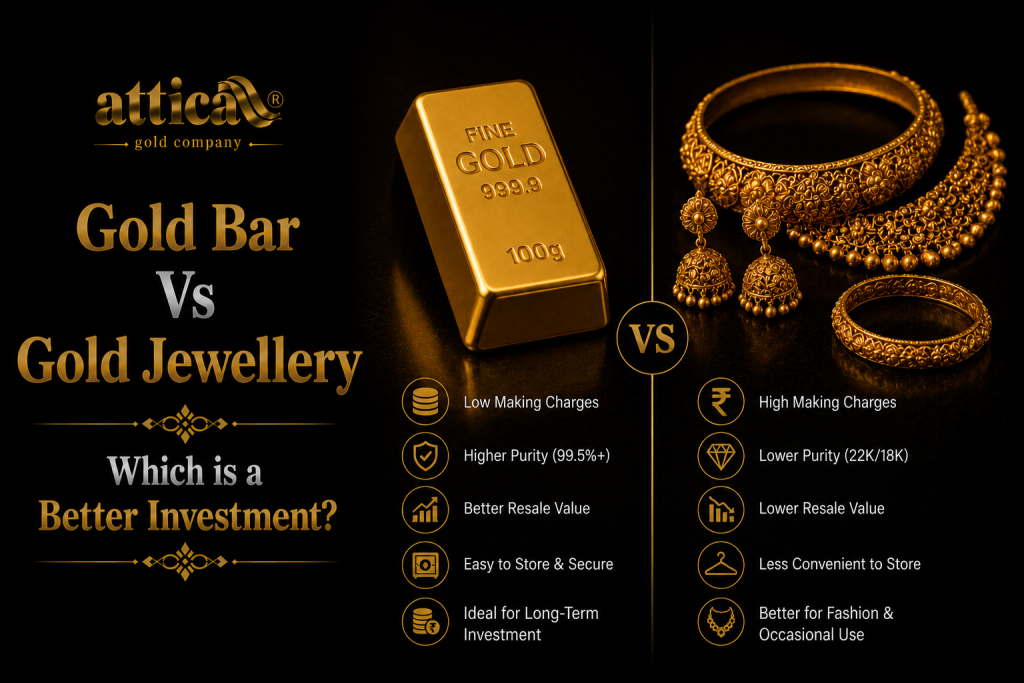
Gold has long been considered one of the safest assets for wealth preservation and financial security. Many buyers compare Gold Jewellery vs Gold Coin to understand which option offers better returns, stronger resale value, and lower additional costs. While jewellery is widely purchased for weddings, gifting, and cultural use, gold coins are generally preferred for investment because of higher purity, lower making charges, and easier liquidity in bullion markets.
Both gold jewellery and gold coins provide physical ownership of gold, but they differ significantly in pricing structure, purity standards, portability, storage convenience, and resale efficiency. Jewellery pricing usually includes making charges, wastage charges, and design premiums, whereas gold coins are commonly priced much closer to the live bullion rate.
Gold jewellery is mainly purchased during weddings, festivals, and family occasions, while gold coins are commonly bought for investment, long-term savings, gifting, and portfolio diversification. In the Gold Jewellery vs Gold Coin comparison, factors such as liquidity, premium costs, resale deductions, and investment efficiency become extremely important for buyers focused on long-term returns.
This detailed guide explains Gold Jewellery vs Gold Coin in depth, including their features, advantages, disadvantages, resale structure, return potential, taxation impact, and which option may be more suitable for different categories of buyers and investors.
Understanding Gold Jewellery vs Gold Coin
Before comparing Gold Jewellery vs Gold Coin, it is important to understand how both forms of gold ownership differ. Although both are linked to gold prices, their purpose, pricing model, and long-term financial utility are not identical. Jewellery combines ornamental and emotional value, whereas gold coins are primarily investment-oriented products designed for wealth preservation and liquidity.
Gold jewellery includes ornaments such as necklaces, bangles, chains, earrings, bracelets, rings, and bridal sets manufactured using gold mixed with alloy metals for durability. Jewellery is commonly available in 18K and 22K purity and includes several additional charges beyond the intrinsic gold value.
- Also Read: Live Gold Price Today
Gold coins, in contrast, are standardized minted products generally manufactured using 24K or 999 purity gold. These coins are available in fixed denominations such as 1 gram, 2 grams, 5 grams, 10 grams, and 20 grams, making them more convenient for investment-focused buyers.
The Gold Jewellery vs Gold Coin comparison becomes highly relevant because the actual returns generated from both products can differ substantially after accounting for making charges, resale deductions, purity variations, and market liquidity.
What Is Gold Jewellery?
Gold jewellery is one of the most commonly owned forms of physical gold in India. Apart from financial value, jewellery carries deep emotional, cultural, and traditional significance. Families often purchase jewellery during weddings, religious ceremonies, festivals, and special occasions as a symbol of prosperity, social status, and generational wealth transfer.
Jewellery is commonly available in different purity levels:
- 18K Gold
- 22K Gold
- 24K Gold (limited ornamental usage)
Since pure 24K gold is soft, jewellers mix alloy metals such as copper, zinc, and silver to improve strength and durability for regular wear.
Unlike bullion-oriented investment products, jewellery pricing usually includes:
- Gold value
- Making charges
- Wastage charges
- GST
- Design premiums
- Brand premiums
Because of these additional costs, jewellery may not always provide the same investment efficiency as coins or bullion products.
How Gold Jewellery Works
Gold jewellery functions as both a wearable asset and a financial reserve. Its market value generally depends on:
- Current gold market price
- Purity level
- Net gold weight
- Design complexity
- Brand pricing
- Craftsmanship quality
Key Features of Gold Jewellery
- Ornamental Utility: Jewellery can be worn during weddings, festivals, social events, and family functions while simultaneously acting as a financial asset.
- Gold Loan Eligibility: Most banks and NBFCs widely accept gold jewellery as collateral for gold loans because of strong resale demand.
- Emotional and Cultural Value: Jewellery often carries sentimental importance and is commonly transferred across generations as inherited family wealth.
- Wide Design Variety: Buyers can choose from bridal, temple, antique, traditional, lightweight, and modern jewellery collections.
- Emergency Financial Backup: Jewellery can provide liquidity during emergencies through resale or gold loans.
Pros of Gold Jewellery
Gold jewellery offers several practical, emotional, and financial advantages.
- Dual-Purpose Ownership: Jewellery functions as both an ornament and a long-term financial asset.
- Strong Cultural Demand: Demand remains consistently high during weddings, festivals, and ceremonial occasions.
- Easy Gold Loan Access: Jewellery can be quickly pledged for secured gold loans at banks and NBFCs.
- Emotional and Family Importance: Jewellery often represents family traditions, inheritance, and emotional attachment.
- Wide Buying Flexibility: Jewellery is available across different budgets, styles, and purity levels.
- High Retail Acceptance: Jewellery can generally be sold or exchanged through jewellers and gold buyers across India.
Cons of Gold Jewellery
Despite its popularity, jewellery also has certain disadvantages from a purely investment perspective.
- High Making Charges: Buyers pay additional labour and craftsmanship costs that may significantly increase purchase prices.
- Lower Resale Recovery: Making charges are often not fully recovered during resale or exchange.
- Purity Variations: Jewellery usually contains alloy metals that reduce pure gold content compared to bullion products.
- Damage and Wear Risk: Daily usage can affect jewellery condition and influence resale valuation.
- Less Cost Efficient: Jewellery is generally more expensive per gram than coins because of wastage and design premiums.
- Higher GST Burden: GST applies on both gold value and making charges, increasing the total acquisition cost.
What Are Gold Coins?
Gold coins are one of the most popular forms of physical gold investment among retail buyers and long-term investors. Unlike jewellery, gold coins are mainly purchased for investment, savings, gifting, and wealth preservation purposes rather than personal ornamentation or daily wear.
Gold coins are usually manufactured by banks, government mints, and certified private refineries. Most investment-grade coins are produced using 24K or 999 purity gold, making them more suitable for buyers focused on investment efficiency and purity.
Gold coins are commonly available in standardized weights such as:
- 1 gram
- 2 grams
- 5 grams
- 10 grams
- 20 grams
In the Gold Jewellery vs Gold Coin comparison, coins are often considered more investment-efficient because they usually involve lower additional costs and provide better pricing transparency.
- Also Read: Which Banks Sell Gold Coins in India
Unlike jewellery, gold coins generally do not include heavy wastage charges or large making charges. This helps investors remain closer to the actual market value of gold.
How Gold Coins Work
Gold coins function as investment-oriented physical gold products. Their market value depends primarily on:
- Current gold market price
- Purity level
- Coin weight
- Mint certification
- Market demand
- Packaging integrity
Since most investment-grade coins are manufactured using high-purity gold, they are generally easier to evaluate and resell compared to jewellery.
Key Features of Gold Coins
- High Purity Gold: Most gold coins are available in 24K or 999 purity with certification.
- Standardized Weight: Coins are sold in fixed denominations for easier pricing and valuation.
- Lower Additional Charges: Coins usually involve lower fabrication costs compared to jewellery.
- Easy Storage: Compact sizing makes coins convenient for lockers and secure storage.
- Investment-Oriented Product: Coins are mainly designed for savings, wealth preservation, and investment accumulation.
- Transparent Pricing Structure: Coin pricing is generally linked closely to prevailing bullion rates.
Pros of Gold Coins
Gold coins provide several advantages for investment-focused buyers.
- Better Investment Efficiency: Lower making charges improve long-term return potential.
- Higher Purity Standards: Most coins contain 24K or 999 purity gold with certification.
- Easy Resale: Coins are widely accepted by jewellers, bullion dealers, and gold buyers.
- Flexible Investment Size: Investors can gradually accumulate gold through smaller denominations.
- Portable and Compact: Coins are easier to store and transport securely.
- Transparent Pricing: Pricing remains closer to the live gold market rate.
- Lower Resale Deductions: Coins generally involve fewer purity deductions compared to jewellery.
Cons of Gold Coins
Despite their investment advantages, gold coins also have certain limitations.
- Higher Premium Than Bars: Coins may still include minting and packaging charges above bullion prices.
- No Ornamental Utility: Unlike jewellery, coins cannot be worn or used decoratively.
- Limited Emotional Value: Coins generally do not carry the same sentimental importance as jewellery.
- Storage Responsibility: Investors must ensure secure custody and protection against theft or loss.
- Bank Resale Restrictions: Some banks may sell gold coins but not repurchase them.
- Lower Cultural Usage: Coins are less commonly used during weddings and ceremonial functions compared to jewellery.
Gold Jewellery vs Gold Coin: Detailed Comparison
Understanding Gold Jewellery vs Gold Coin becomes easier when comparing practical investment factors such as purity, resale value, making charges, liquidity, storage convenience, taxation, and long-term return potential. Although both represent physical ownership of gold, their financial efficiency and overall purpose differ significantly.
Gold Jewellery vs Gold Coin Comparison Table:
| Factor | Gold Jewellery | Gold Coin |
| Purpose | Personal use, weddings, gifting, cultural value | Investment, savings, wealth preservation |
| Purity | Usually 18K or 22K | Mostly 24K or 999 purity |
| Making Charges | High | Lower |
| Wastage Charges | Applicable | Usually minimal |
| Investment Efficiency | Lower | Higher |
| Resale Transparency | May involve deductions | Easier valuation |
| Emotional Value | High | Moderate |
| Liquidity | Good | Very high |
| Storage Convenience | Requires careful storage | Easier to store |
| Gold Loan Eligibility | Widely accepted | Accepted by selected lenders |
| Pricing Transparency | Varies by design and brand | Closer to bullion rates |
| Wear and Tear Risk | Higher | Lower |
| Best For | Cultural and personal usage | Investment-focused buyers |
The Gold Jewellery vs Gold Coin comparison clearly shows that jewellery delivers both emotional and ornamental value, while gold coins generally provide stronger investment efficiency and lower acquisition costs.
💰 Get the Best Price for Your Gold Today
Instant valuation • Transparent pricing • 100% secure & trusted
Gold Jewellery vs Gold Coin: Which Gives Better Returns?
The most important aspect in the Gold Jewellery vs Gold Coin discussion is long-term financial returns. Although both are linked to gold price appreciation, the actual return generated after purchase and resale can vary substantially.
Gold coins generally provide better investment returns because:
- They involve lower making charges
- They are usually manufactured in higher purity
- Resale deductions are lower
- Pricing remains closer to live bullion value
- Investment premiums are relatively transparent
Gold jewellery, on the other hand, often includes:
- High craftsmanship charges
- Design premiums
- Wastage costs
- Lower recovery of making charges during resale
- Potential purity deductions
For example, if two buyers purchase gold worth ₹1 lakh each, the person buying jewellery may effectively receive lower net gold weight because a portion of the payment goes toward making and wastage charges. The coin buyer generally receives a higher percentage of actual gold value.
As a result, gold coins are usually considered more efficient for wealth preservation and investment-oriented returns.
Final Thoughts
The Gold Jewellery vs Gold Coin comparison ultimately depends on whether the buyer prioritises emotional value, personal usage, or investment efficiency. Gold jewellery remains deeply connected to Indian culture, weddings, festivals, and family traditions, making it a meaningful long-term asset beyond financial returns. However, jewellery often involves higher making charges, wastage costs, and resale deductions, which can reduce overall investment efficiency.
Gold coins, on the other hand, are generally considered more suitable for investment-focused buyers because they usually offer higher purity, transparent pricing, lower additional charges, and easier liquidity. Investors looking for wealth preservation, portfolio diversification, and stronger long-term gold returns often prefer coins over jewellery.
Before buying physical gold, buyers should carefully evaluate:
- Purity certification
- Making and wastage charges
- Resale policies
- Liquidity requirements
- Storage convenience
- Long-term investment objectives
When selected wisely, both gold jewellery and gold coins can serve as valuable financial assets while helping investors benefit from long-term gold price appreciation and economic stability.
Sell Your Gold with Attica Gold Company
If you are planning to sell old gold jewellery, coins, or unused ornaments, Attica Gold Company offers transparent valuation, accurate purity testing, and instant payment based on live market rates. Recognised as India’s trusted gold buyer, Attica ensures fair assessment, professional service, and a secure selling experience for customers looking to maximize the value of their gold assets today.
FAQs
Which gives better returns: gold jewellery or gold coins?
In most investment-focused situations, gold coins generally provide better returns because they usually involve lower making charges, higher purity, and fewer resale deductions. Gold jewellery includes additional costs such as craftsmanship and wastage charges, which may reduce the effective return during resale or exchange compared to investment-grade gold coins.
Is gold jewellery a good investment?
Gold jewellery can act as a long-term financial asset, but it is not always the most efficient investment product because buyers pay making charges, design premiums, and GST on labour costs. Jewellery is more suitable for cultural, personal, and family purposes, while investment-focused buyers often prefer coins or bullion for better value retention.
Why are gold coins considered better for investment?
Gold coins are usually manufactured using 24K or 999 purity gold and are priced closer to the live bullion rate. Since they involve lower additional charges and standardized purity certification, they generally offer stronger liquidity, easier valuation, and better investment efficiency compared to jewellery products.
Do gold coins have making charges?
Yes, gold coins may include minting, packaging, and fabrication charges, but these costs are generally much lower than jewellery making charges. As a result, investors purchasing coins usually receive a higher percentage of actual gold value for the amount spent compared to jewellery purchases.
Which is easier to resell: gold jewellery or gold coin?
Gold coins are generally easier to resell because they are standardized investment products with higher purity and transparent valuation. Jewellery resale often involves deductions for impurities, stones, design depreciation, and making charges, which can reduce the final resale amount received by the seller.
Is 24K gold available in jewellery?
Although 24K gold exists, it is rarely used for regular jewellery because pure gold is soft and less durable for daily wear. Most jewellery is manufactured using 18K or 22K gold mixed with alloy metals to improve strength and durability while maintaining attractive appearance and market value.
Are gold coins accepted for gold loans?
Some banks and NBFCs accept certified gold coins as collateral, but gold jewellery is more widely accepted for gold loans across India. Lending institutions generally prefer ornaments because of stronger retail demand and easier liquidation in local gold markets during recovery situations.
Which has higher purity: gold jewellery or gold coin?
Gold coins usually have higher purity levels because most investment-grade coins are manufactured using 24K or 999 purity gold. Jewellery is commonly available in 18K or 22K purity because alloy metals are added to improve durability, strength, and suitability for regular personal usage.
Is jewellery more expensive than gold coins?
Yes, jewellery is generally more expensive per gram because buyers pay making charges, wastage charges, design premiums, and GST on labour costs. Gold coins usually involve lower additional charges, making them more cost-efficient for buyers focused primarily on investment and long-term returns.
Should beginners buy gold jewellery or gold coins?
Beginners focused on investment and savings often prefer gold coins because they are available in smaller denominations, involve transparent pricing, and provide better purity standards. Buyers seeking cultural value, personal usage, or family ornaments may still choose jewellery despite its comparatively higher acquisition costs.