Why the Gold Loan vs Sell Gold Decision Matters
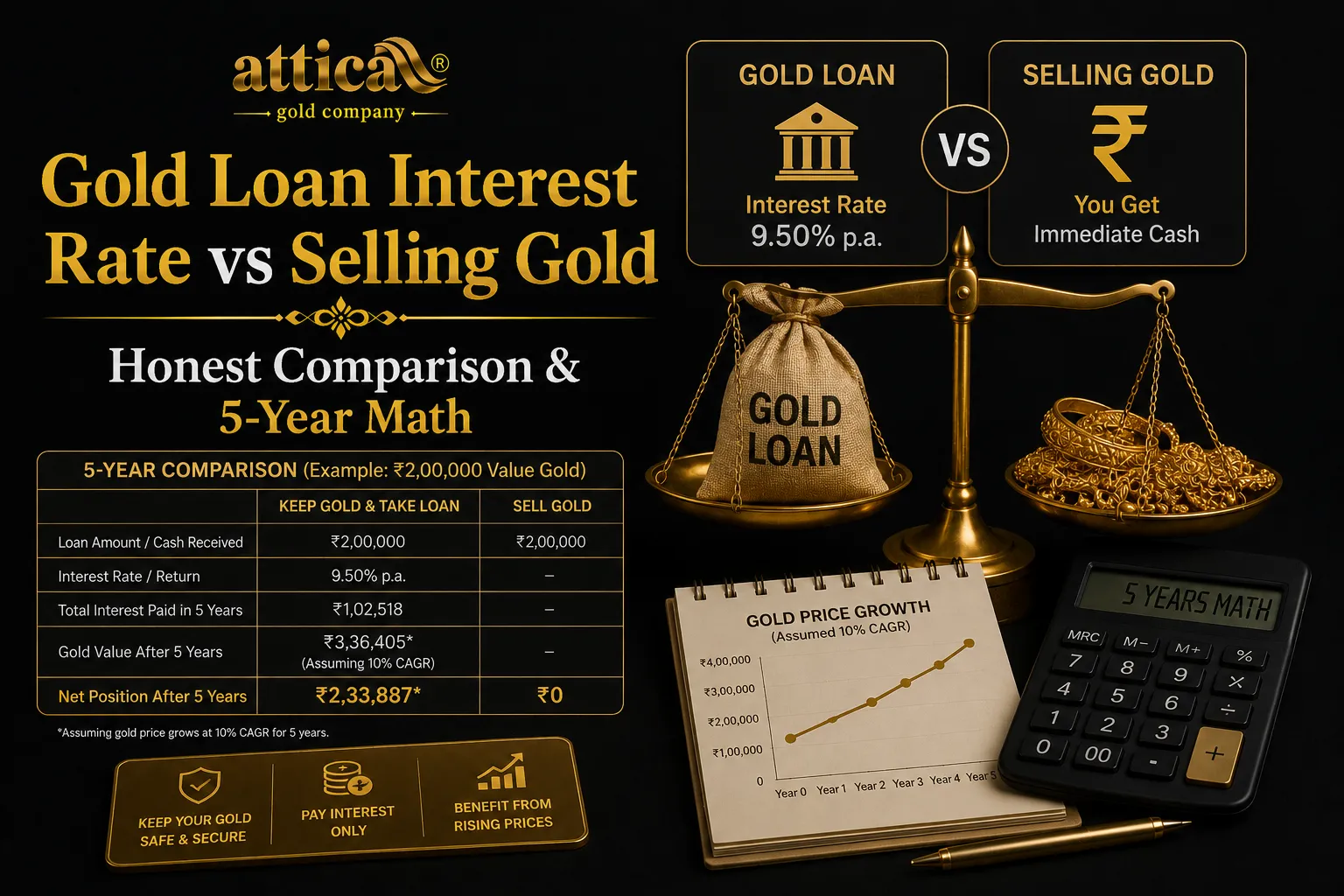
When an Indian household needs cash and gold is the available asset, two paths open up: take a gold loan against the jewellery (keep the gold, pay interest, repay later) or sell the gold outright (lose the gold, get cash, no future obligation). The choice carries long-term financial consequences that most borrowers underestimate. Gold loan interest rates in India range from 7.5% to 18% per annum depending on the lender, the loan-to-value (LTV) ratio, and the tenure – translating to real cash costs of ₹6,000–₹40,000 per year on a ₹2 lakh loan, year after year, until the loan is repaid. This guide walks through the honest math: when a gold loan is the right choice, when selling outright is better, and what the 5-year cost difference looks like for typical Indian borrowers.
This guide covers everything you need to know about the gold loan interest rate versus selling gold decision: today’s typical loan rates from banks and NBFCs, the standard LTV ratios and tenures available, the side-by-side cost math over 1, 3, and 5 years, when emotional attachment justifies the higher cost of a loan, and how to spot the signs that selling is the smarter long-term decision. By the end, you will have a clear framework for choosing the right path for your specific situation.
Gold Loan vs Selling Gold at a Glance
| Factor | Gold Loan | Selling Gold |
| Interest Rate (annual) | 7.5%–18% | 0% (no obligation) |
| Loan Amount | 60-75% of gold value (LTV) | 100% of gold’s resale value |
| Tenure Flexibility | 3 months to 36 months typical | One-time, no tenure |
| Future Cash Outflow | Monthly EMI or bullet repayment | None |
| Gold Ownership | Retained (returned on full repayment) | Transferred to buyer |
| Risk of Loss | Auction if you default on EMI | None (one-time transaction) |
Today’s Gold Loan Interest Rates in India
Gold loan interest rates today vary widely by lender. The major categories:
- Public sector banks (SBI, PNB, Union Bank, Bank of Baroda) – typical rate 8.5%–11% per annum, LTV up to 75%, processing fee 0.25%–1%. Slightly slower disbursal (24-48 hours).
- Private banks (HDFC, ICICI, Axis, Kotak) – typical rate 9%–13% per annum, LTV up to 75%, processing fee 1%–2%. Faster disbursal (4-24 hours).
- Gold loan NBFCs (Muthoot Finance, Manappuram Finance, IIFL Gold Loan) – typical rate 11%–18% per annum, LTV up to 75%, processing fee 0.5%–1.5%. Fastest disbursal (30-60 minutes).
- Cooperative banks and small finance banks – typical rate 9%–13% per annum, LTV up to 70%, processing fee 0.5%–1%. Variable disbursal speed.
The lowest gold loan interest rate today (around 7.5%) is offered by some public sector banks under priority lending schemes. The typical effective rate most borrowers actually pay (after processing fees, GST, and renewal charges) is 11-14% per annum at NBFCs and 9-11% at banks. These are real cash costs that compound over time.
Today’s Gold Sell Rate (Same as IBJA, No Discount)
When you sell gold outright, today’s rate is the IBJA benchmark – for 24K, ₹15,250/g; for 22K, ₹13,965/g; for 18K, ₹11,438/g; for 14K, ₹8,921/g. The buyer pays you the full cash value (less only fair deductions for stones and solder). For 50g of 22K wedding gold, that’s 50 × 0.916 × ₹15,250 = ₹6,98,450 – yours immediately, no future obligation, no interest, no EMI.
Use the widget below to verify today’s exact gold rate for outright sale comparison.
5-Year Cost Math: Gold Loan vs Selling 50 Grams of 22K Gold
Let’s work through a realistic example. Assume you have 50g of 22K gold (current value ₹6,98,450 at today’s rate) and need ₹4 lakh in cash for a major expense. Your two options:
| Path | Year 1 Cost | 3-Year Cost | 5-Year Cost | Gold Status After 5 Years |
| Sell 50g (get full value) | ₹0 interest cost | ₹0 | ₹0 | Sold (gone forever) |
| Gold loan ₹4L at 11% (banks) | ₹44,000 interest | ₹1,32,000 | ₹2,20,000 | Returned (still yours) |
| Gold loan ₹4L at 14% (NBFCs) | ₹56,000 interest | ₹1,68,000 | ₹2,80,000 | Returned (still yours) |
| Gold loan ₹4L at 18% (high-rate) | ₹72,000 interest | ₹2,16,000 | ₹3,60,000 | Returned (still yours) |
The cost of taking a gold loan over 5 years ranges from ₹2,20,000 to ₹3,60,000 in interest alone – that is, you pay back the principal plus 55-90% extra. If the gold’s value stays flat over 5 years (which is unlikely; gold typically appreciates), the loan effectively costs you 2.2-3.6 lakh in cash. If the gold appreciates 50% over 5 years (going from ₹6,98,450 to ₹10,47,675), you keep the appreciation – but you still paid the interest. The math only works in your favour if gold appreciates more than the interest cost over the same period.
When a Gold Loan Makes Sense
Gold loans are the right choice in three specific situations:
- Short-term cash need (3-12 months) – if you need cash for a few months and have a clear repayment source (bonus, FD maturity, business receivable), the interest cost is manageable (₹6,000–₹16,000 on ₹4L for 6 months). Selling jewellery with sentimental value for short-term cash makes less sense than borrowing against it briefly.
- Sentimental jewellery you want to keep – wedding sets, family heirlooms, religious pieces with deep emotional value. Even if a loan costs more long-term, the emotional cost of selling these specific pieces may not be worth saving. A loan lets you access cash without parting with the piece itself.
- Strong belief in gold appreciation – if you’re confident gold will appreciate significantly during the loan tenure (e.g., 15%+ over 1 year), the appreciation can offset the interest cost. This is a market-timing bet, not a guaranteed strategy.
The shorter the loan tenure and the more confident your repayment plan, the better the gold loan economics. Loans dragged out 3-5 years compound dramatically against the borrower.
💰 Get the Best Price for Your Gold Today
Instant valuation • Transparent pricing • 100% secure & trusted
When Selling Gold Makes Sense
Selling gold outright is the smarter long-term choice in five common situations:
- Long-term cash need (over 12 months) – if your cash need will not be repaid within a year, the interest cost on a gold loan accumulates rapidly. Selling outright eliminates the running cost.
- No clear repayment source – if you’re using the loan to bridge to an uncertain future income, the risk of default (and gold auction) is high. Selling locks in the cash without creating future obligation.
- The gold has no sentimental attachment – coins, bullion, broken pieces, mismatched earrings, leftover wedding gold from past generations you do not personally use. Selling these has no emotional cost.
- You expect to need more gold-backed cash later – repeatedly taking gold loans against the same gold compounds interest costs faster than appreciation. One sale resets the cycle.
- Today’s gold rate is historically high – selling near peak captures gains; taking a loan locks in interest cost without capturing the gain. Today’s rates are near all-time highs in rupee terms, making outright sale particularly attractive for non-sentimental pieces.
What Happens If You Default on a Gold Loan
Most borrowers underestimate the auction risk of gold loans. If you default on EMI payments (typically 3 consecutive missed payments), the lender legally has the right to auction your pledged gold to recover the outstanding loan + interest + fees. The auction usually takes place 30-60 days after the default. The gold is sold at whatever price the auction fetches – which can be below today’s IBJA rate, since auctioned gold is often sold to refiners at a discount.
If the auction proceeds exceed your dues, the lender returns the surplus to you. If they fall short (rare but possible if gold prices drop sharply), you remain liable for the difference. Default is reported to credit bureaus (CIBIL), affecting your future borrowing ability. The emotional cost – losing a wedding chain, family heirloom, or religious piece to an auction – is significant.
How to Combine Both Strategies Smartly
Many Indian families have both sentimental jewellery they want to keep and non-sentimental gold (coins, bullion, broken pieces, surplus heirlooms) they would consider selling. The smart strategy: sell the non-sentimental pieces to meet the cash need, and only take a gold loan against sentimental pieces if additional cash is required after the sale. This minimises the gold loan interest cost (smaller principal) while preserving emotional pieces.
Worked example: you need ₹4 lakh and have 50g of 22K gold (₹6,98,450 value). Of the 50g, 30g is sentimental wedding jewellery and 20g is broken/surplus pieces. Sell the 20g for ₹2,79,380 (covers most of the need); take a gold loan of ₹1,20,000 against the remaining sentimental 30g (small loan, faster repayment). The 1-year loan interest at 11% on ₹1,20,000 = ₹13,200, vs ₹44,000 if you’d taken the full ₹4L loan. The strategy saves ₹30,800 in interest in year one alone.
Why Choose Attica Gold for the Right Side of the Decision
Whether you choose a gold loan or outright sale, the right buyer is the one who shows you the math transparently. For a sale, the formula is weight × tested purity × today’s IBJA rate − fair deductions, and the result should match what a public gold value calculator would tell you. For a gold loan, ask the lender to show you the all-in interest cost over your expected tenure (including processing fees, GST, and renewal charges) – not just the headline interest rate. Compare both options on a like-for-like basis before deciding.
Attica Gold offers transparent outright purchase at today’s live IBJA rate at every branch across Karnataka, Tamil Nadu, Andhra Pradesh, Telangana and Pondicherry. Free XRF purity testing in your presence, line-by-line written quotes, and instant payment in cash, UPI, NEFT, RTGS, or IMPS – your choice. ISO 9001:2015 certification means the same standard at every branch, every day. Whatever your decision – sell, loan, or a mix of both – make it based on the real math, not on emotional pressure or vague verbal quotes. Your wait is over – walk into your nearest Attica Gold branch for a free XRF test and a written quote at today’s exact rate.
Frequently Asked Questions
What is the current gold loan interest rate in India?
Gold loan interest rates today range from 7.5% to 18% per annum depending on the lender. Public sector banks offer 8.5%-11%; private banks 9%-13%; gold loan NBFCs 11%-18%; cooperative banks 9%-13%. The lowest rates (around 7.5%) come from priority lending schemes at PSU banks. The effective rate most borrowers actually pay (including processing fees and renewals) is 11-14% at NBFCs and 9-11% at banks.
Should I take a gold loan or sell my gold?
Take a gold loan if: (1) the cash need is short-term (3-12 months) with clear repayment, (2) the gold has sentimental value you want to keep, or (3) you strongly believe gold will appreciate during the loan tenure. Sell gold if: (1) the cash need is long-term (over 12 months), (2) repayment source is uncertain, (3) the gold has no sentimental attachment, or (4) today’s rate is historically high (which it is right now).
How much does a gold loan cost over 5 years?
A 5-year gold loan of ₹4 lakh at 11% (typical bank rate) costs ₹2,20,000 in interest – meaning you repay ₹6.2 lakh on the original ₹4L. At 14% (typical NBFC rate), the 5-year interest cost is ₹2,80,000. At 18%, it is ₹3,60,000. These are simple-interest estimates; actual costs may be slightly higher with compounding and renewal fees.
What is the loan-to-value (LTV) for gold loans in India?
RBI permits gold loans up to 75% LTV. So if your gold is worth ₹4 lakh at today’s market rate, you can borrow up to ₹3 lakh. Some lenders cap LTV at 65-70% for risk management. The remaining 25-35% acts as a margin of safety against price drops during the loan tenure. For higher LTV (above 75%), the loan is typically structured as a personal loan with gold as collateral, attracting higher rates.
What happens if I default on a gold loan?
If you miss EMI payments (typically 3 consecutive months), the lender has the legal right to auction your pledged gold to recover the outstanding loan + interest + fees. The auction usually happens 30-60 days after default. If auction proceeds exceed dues, the surplus is returned to you; if they fall short, you remain liable for the difference. Default is reported to CIBIL, affecting future borrowing ability.
Can I sell gold that is currently pledged in a gold loan?
Yes – but you must first close the gold loan. The process: bring your pledge receipt to a reputable gold buyer, who will accompany you to the loan provider, settle the outstanding loan amount, retrieve your gold, and then purchase it from you at today’s rate. The buyer typically settles the loan from the sale proceeds, so you receive the net amount after loan closure. Attica Gold offers this ‘release pledged gold’ service at every branch.
Is selling gold or taking a loan better tax-wise?
Selling gold attracts Long-Term Capital Gains tax (12.5%) if held over 24 months, or slab-rate tax for short-term sales. Gold loan interest is NOT tax-deductible for personal use loans. So if your gold has appreciated significantly, selling triggers tax (paid once) while a loan avoids tax but adds interest cost (paid annually). For business loans, gold loan interest is tax-deductible as a business expense – making loans more attractive for self-employed borrowers.
What is the EMI on a 5-lakh gold loan?
For a 5-lakh gold loan at 11% over 36 months, the EMI is approximately ₹16,367 per month (total repayment ₹5,89,212; interest cost ₹89,212). At 14%, the EMI rises to ₹17,089 (interest cost ₹1,15,204). At 18%, the EMI is ₹18,076 (interest cost ₹1,50,736). For shorter tenures (12 months at 11%), the EMI is ₹44,153 with much lower interest cost (₹29,836). Shorter tenures cost less but require higher monthly cash flow.
Ready to sell gold near me at today’s live rate?
Whether you are weighing a gold loan against selling, get a transparent valuation first. Visit your nearest Attica Gold branch for a free XRF purity test and today’s live rate quote – then decide.