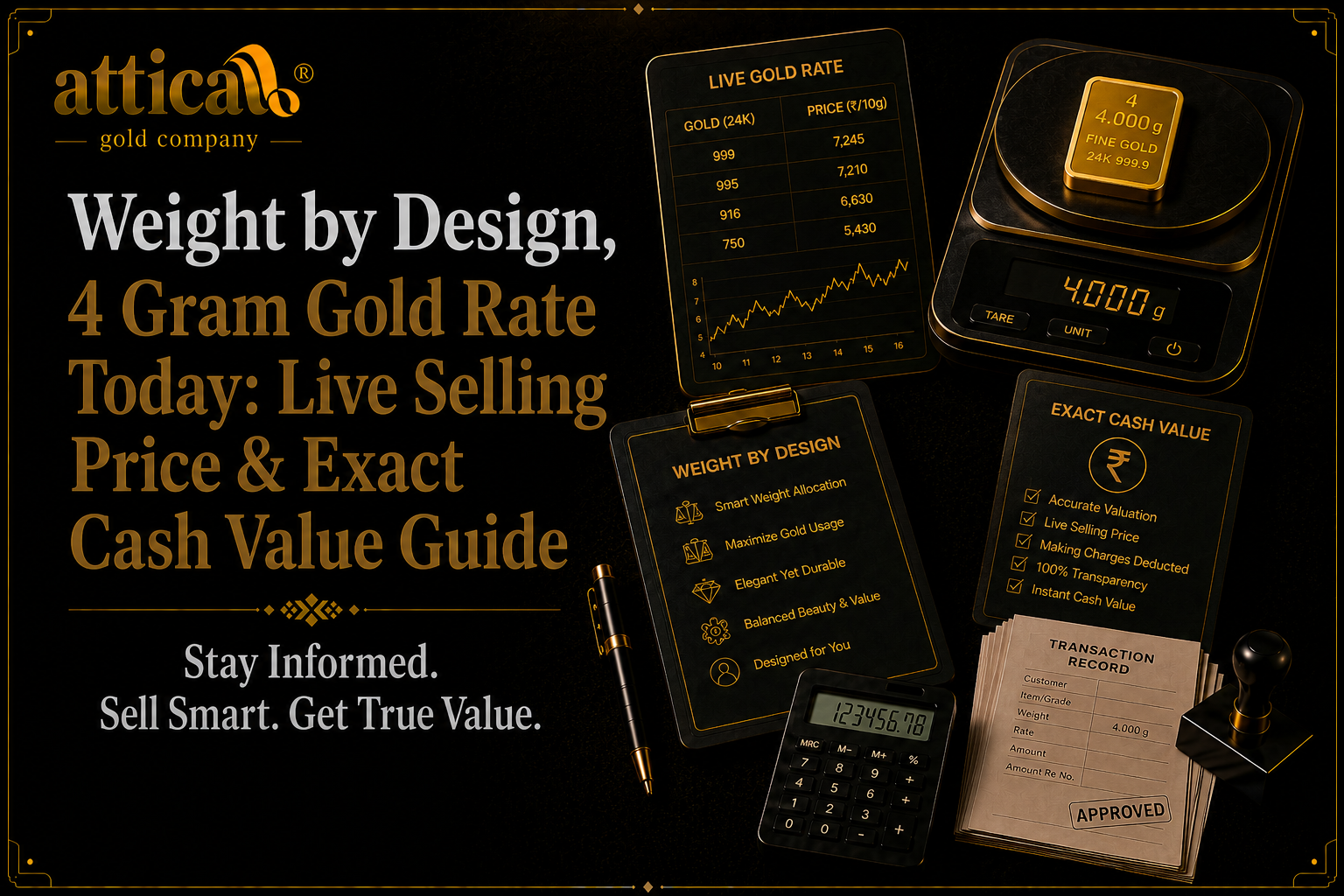
If you own 4 grams of gold and you are thinking about selling it, the single most useful number is what that 4 grams translates to in cash at today’s rate. The honest answer depends on three variables in this order of importance: (1) tested purity – 22K, 24K, 18K or 14K – (2) today’s IBJA reference rate, and (3) the buyer’s refining margin. At today’s reference rates, 4 grams of 22K gold is worth approximately ₹51,168, 4 grams of 24K is approximately ₹60,939, and 4 grams of 18K is around ₹34,314. 4-gram pieces dominate the ‘occasional resale’ market – outgrown baby items, broken rings replaced by wedding rings, and sentimental pieces being downsized.
This guide tells you exactly how to compute the cash value of any 4-gram gold piece you own – without having to trust an opaque jeweller or pawnshop estimate. We cover the live IBJA rate, the math that any reputable buyer will apply in front of you, the typical pieces that fall in this weight band, the tax treatment under the latest 2025 rules, and what to watch out for so that you receive a fair price.
4 grams Gold at a Glance
| Attribute | 4 grams Gold Value |
| 22K Cash Value Today (91.6% pure) | ₹51,168 (= 4g × ₹13,965/g × 0.916) |
| 24K Cash Value Today (99.9% pure) | ₹60,939 (= 4g × ₹15,250/g × 0.999) |
| 18K Cash Value Today (75% pure) | ₹34,314 (= 4g × ₹11,438/g × 0.75) |
| 14K Cash Value Today (58.5% pure) | ₹20,875 (= 4g × ₹8,921/g × 0.585) |
| Typical Pieces in This Weight Band | small rings (typical wedding band, signet ring, single-stone solitaire), one or two pairs of small earrings (small studs, small jhumkas), light pendants, baby items (kids’ rings, kids’ chains), and small individual pieces from larger sets |
| Refining Margin (Reputable Buyers) | 1–2% of gross – visible on receipt |
| Documents Required | Aadhaar mandatory; PAN if total sale > ₹2,00,000 |
Today’s Live 4 grams Gold Rate
The 4 gram gold rate today updates twice daily through the IBJA reference (typically at 12:30 PM and 4:30 PM IST), with intraday MCX moves driving smaller adjustments throughout the day. The live rate widget below shows the current per-gram rate for 24K, 22K, 18K and 14K – multiply by 4 to get your gross value before any deduction. Reputable buyers like Attica reference the same IBJA benchmark that you can verify on the IBJA website (ibjarates.com), so there should be no rate disagreement between you and the buyer at the start of the transaction.
Across India, pieces of this weight are priced almost identically city-to-city – the rate variance between Bangalore, Chennai, Hyderabad and Pondicherry is typically less than ₹10/gram. The bigger swing comes from buyer-to-buyer differences in refining margin, which is why comparing two or three reputable buyers before selling can sometimes save you 1–2% of gross value.
| 🔧 LIVE RATE WIDGET PLACEHOLDER Embed live gold rate widget showing 24K, 22K, 18K and 14K per-gram rate, with auto-calculation for 4 grams input. Last-updated timestamp from IBJA. Disclaimer: ‘Indicative rate; final price depends on actual purity test at branch.’ Pulls from /api/gold-rate. |
What Pieces Typically Weigh 4 grams
In Indian households, 4 grams of gold most commonly takes the form of: small rings (typical wedding band, signet ring, single-stone solitaire), one or two pairs of small earrings (small studs, small jhumkas), light pendants, baby items (kids’ rings, kids’ chains), and small individual pieces from larger sets. 4 grams is one of the most commonly resold weight bands in India because it covers the typical wedding band, the small daily-wear ring, and the matched baby rings or chains often gifted at first birthdays. Sellers in this band are usually liquidating one or two pieces, not entire collections, and want fast cash without paperwork hassle.
If your piece weighs slightly more or less than 4 grams, the math scales linearly – for every additional gram of 22K, add about ₹12,792 to your gross. Reputable buyers always verify weight on calibrated scales certified by the Department of Legal Metrology, in your full view, before applying the rate. If a buyer asks to weigh your piece in a back room or out of your sight, that is a serious red flag – walk away.
💰 Get the Best Price for Your Gold Today
Instant valuation • Transparent pricing • 100% secure & trusted
How Buyers Calculate Your 4-gram Cash Value: The Exact Math
The formula every reputable Indian gold buyer applies is straightforward and identical across the industry: Cash Value = Weight × Tested Purity × Today’s IBJA Rate − Refining Margin. For 4 grams of 22K gold, this becomes: 4g × 0.916 × ₹13,965 = ₹51,168 gross. From this, a 1–2% refining margin (₹512 – ₹1,023) is the typical deduction at organised buyers. Net cash to you on 4 grams of 22K: roughly ₹50,400 – ₹50,656.
Three deductions sometimes apply on top of this base math: (1) stone weight on stone-set pieces (cubic zirconia, real diamonds, gemstones, polki, kundan), which is excluded from gold weight; (2) solder and joint material on chains and bangles, typically 1–3% deducted from gross weight on heavily worked pieces; and (3) wastage on pieces requiring refining, which most buyers absorb in their 1–2% margin and do not double-charge. Any deduction beyond these three on plain, unmarked gold is unusual and worth questioning.
Tax Treatment When You Sell This Piece
Gold held over 24 months attracts 12.5% LTCG when sold; held under 24 months, your gain is added to slab income. For gold valued in this band, the practical implication is: if your purchase records (original bill or jeweller’s receipt) are available, the buyer will apply the LTCG vs STCG distinction based on holding period. If records are not available, the IT department will treat the cost basis using indexation or the actual sale value, with the seller carrying the burden of proof on the holding period. At 4 grams (gross around ₹51,168), your sale is below the ₹2,00,000 cash threshold – but PAN is still mandatory if your aggregated annual gold sales cross that limit.
What to Watch For When Selling 4 Grams of Gold
● Visible weighing – the calibration certificate of the scale should be visible on the counter, and the weight number should be visible to you while the piece is on the pan.
●XRF testing in front of you – modern X-ray fluorescence testers measure pure-gold percentage in seconds without melting; a buyer who refuses to use XRF or insists on acid-only testing is suspicious.
●Rate disclosure – the buyer should write down the IBJA reference rate they are applying, and ideally show you the IBJA source on their screen.
● Itemised receipt – every deduction (stone weight, solder, refining margin) should appear as a separate line on the final receipt, not bundled into a vague ‘discount’.
●Aadhaar is mandatory; PAN is required if your sale exceeds ₹2,00,000. A reputable buyer will not bypass KYC for any sale.
Why Choose Attica Gold for Your Sale
Attica Gold Company has been buying gold from Indian sellers for over a decade through 200+ branches across Karnataka, Tamil Nadu, Andhra Pradesh, Telangana and Pondicherry – and we are India’s first ISO 9001:2015 certified cash-for-gold buyer. Every transaction at Attica is built around three principles: transparent weighing on calibrated electronic scales (visible to you), in-front-of-you XRF purity testing (no back-room work), and rates benchmarked to the live IBJA reference (no hidden refining margins).
When you walk into Attica with your gold, the entire process – weight verification, XRF purity test, today’s rate application, deduction explanation (if any) and final payment – takes under 30 minutes for most pieces. We pay cash up to ₹2,00,000 (the legal limit under Section 269ST) and the balance via instant bank transfer or RTGS for higher-value sales. No deferred payments, no ‘come back tomorrow’, no pressure tactics. Your wait is over.
Frequently Asked Questions
What is the 4-gram gold rate today?
At today’s IBJA reference rate, 4 grams of 22K gold is worth approximately ₹51,168, 4 grams of 24K is approximately ₹60,939, and 4 grams of 18K is around ₹34,314. The exact cash you receive depends on the tested purity and the buyer’s refining margin (typically 1–2% at reputable buyers).
What documents do I need to sell 4 grams of gold?
Aadhaar is mandatory; PAN is required if your sales exceed ₹2,00,000. At this weight band, you may be below the PAN threshold, but Attica will still record your Aadhaar and PAN if available for KYC compliance.
Will I get the full IBJA rate or less?
Reputable buyers apply the IBJA rate visibly, then deduct a 1–2% refining margin to cover smelting and recasting costs. Your net is typically 98–99% of the IBJA gross. Buyers offering “100% rate” usually recover their margin elsewhere through hidden weight deductions or stone-weight tricks – be cautious of such offers.
Can I sell 4 grams of gold without a hallmark?
Yes. Hallmarking became mandatory only for new gold sales after June 2021. Older unmarked pieces are sold every day to reputable buyers – XRF testing measures actual gold content in seconds, and the buyer applies the rate based on tested purity, not on whether the piece carries a stamp.
How long does selling 4 grams of gold take?
At Attica Gold, the entire process – weight verification, XRF purity test, rate application, deduction explanation and final payment – takes under 30 minutes for most pieces of this weight. Cash payment is immediate within the ₹2,00,000 limit under Section 269ST.
Is it safer to sell at a city branch or to a touring buyer?
Always sell at an established branch. Touring ‘gold buyers’ who visit homes or hotels operate without ISO certification, calibrated scales, or XRF testing – and often without proper KYC. The Reserve Bank of India and BIS both advise against selling to unverified mobile buyers
Will the rate be the same in Bangalore, Chennai, Hyderabad and other cities?
Yes – 4 grams of gold is priced almost identically across all 200+ Attica branches in Karnataka, Tamil Nadu, Andhra Pradesh, Telangana and Pondicherry. The IBJA reference is national, and Attica applies the same per-gram rate everywhere with only minor handling adjustments (typically under ₹10/g) between metros.
Get Instant Valuation
Free evaluation · No obligation · Instant offer
🔒 Your details are safe and confidential