Gold Price History in India: Trends, Historical Rates & Chart (1964 – February 2026)
Gold has always played a powerful and emotional role in India’s economic and cultural landscape. Beyond jewellery, gold functions as a financial safeguard, long-term investment, inflation hedge, and family security asset. For decades, Indian households have trusted gold as a reliable store of value during uncertain economic periods. Because of this deep-rooted importance, analysing gold price history in India helps us understand how global events, inflation trends, currency movements, and investment behaviour have shaped long-term price growth.
- Also Read: Live Gold Price Today
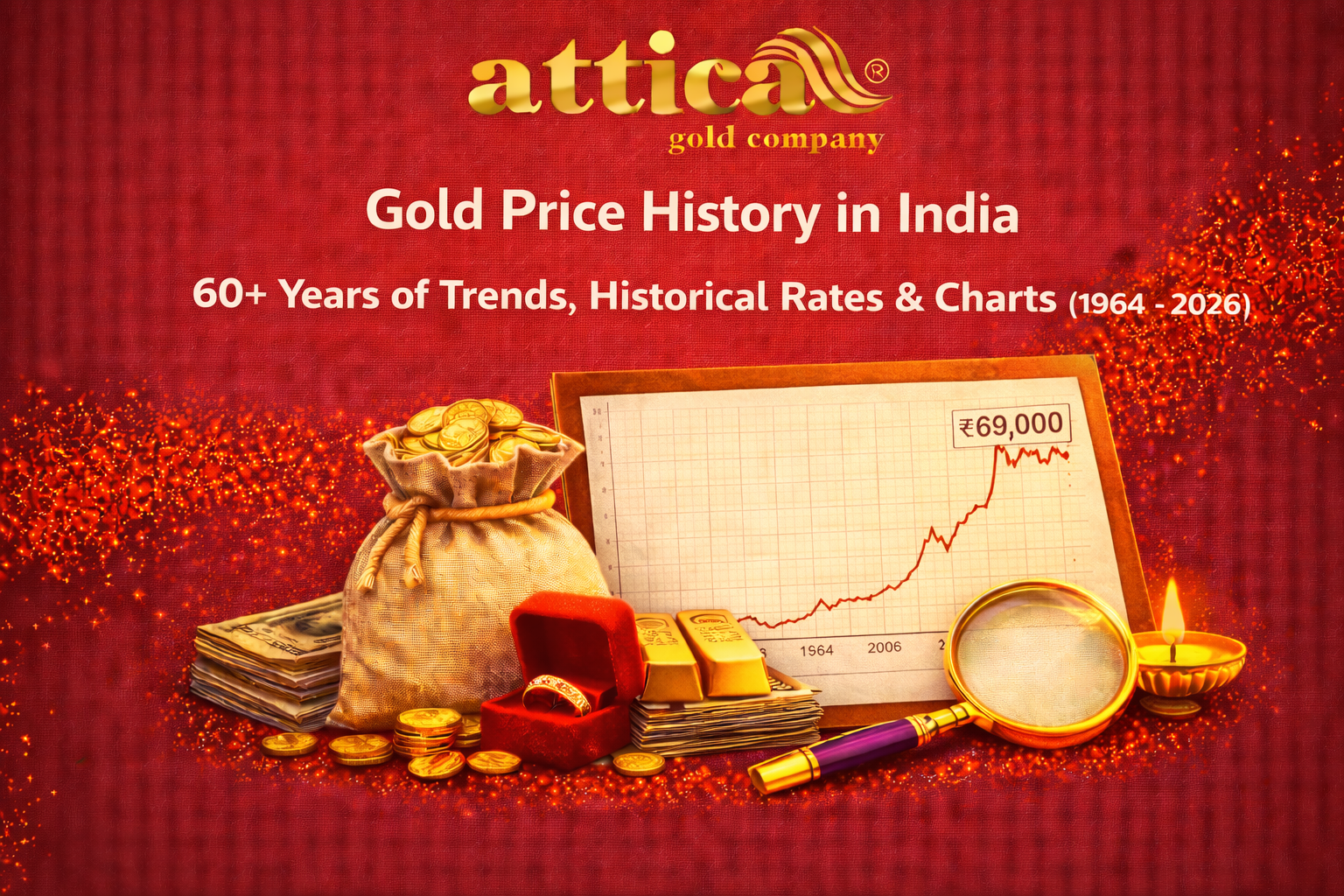
From a modest price of ₹63.25 per 10 grams in 1964 to ₹1,50,000 per 10 grams in February 2026, gold has experienced enormous appreciation. This rise was not sudden; it reflects six decades of economic transformation, including oil crises, inflation shocks, policy reforms, global financial crises, pandemic uncertainty, and rising investment participation.
This article rewrites and expands all sections while strictly using the values provided in the Gold Rate History in India (1964–2026) table. The goal is to offer readers a detailed, structured, and data-driven understanding of how gold evolved into one of India’s most trusted long-term assets.
Key Highlights
- 24K Gold Rate (Feb 2026): ₹1,50,000 per 10 grams
- 1964 Price Comparison: ₹63.25 per 10 grams
- Long-Term Growth: Gold prices increased over 2,300 times since 1964
- Major Drivers: Inflation, rupee depreciation, global uncertainty, import duties, and investment demand
- Recent Momentum: Strong acceleration between 2025 and early 2026
- Long-Term View: Gold historically performs strongly during economic stress and currency weakness
Gold Price Trend in India: Key Insights
India’s gold price movement over decades clearly shows that gold responds directly to macroeconomic factors. While short-term volatility exists, the long-term direction remains upward.
- Long-term growth: Prices moved from ₹63.25 (1964) to ₹1,50,000 (Feb 2026), reflecting sustained multi-decade appreciation.
- Crisis-driven surges: Oil shocks, financial crises, and global instability historically triggered sharp upward moves.
- Inflation protection: Gold maintained purchasing power when inflation reduced currency value.
- Temporary corrections: Declines in some years were short-lived and followed by recovery phases.
- Changing demand: Investment avenues like ETFs, SGBs, and digital gold strengthened overall demand beyond jewellery consumption.
This pattern confirms that gold should be viewed as a long-term wealth protection asset rather than a short-term speculative commodity.
Gold Rate History in India (1964 – 2026)
The table below contains the historical average prices of 24-carat gold per 10 grams, and all analysis in this article is based strictly on this data.
| Year | Price (24 Carat per 10g) |
| 1964 | ₹63.25 |
| 1965 | ₹71.75 |
| 1966 | ₹83.75 |
| 1967 | ₹102.50 |
| 1968 | ₹162.00 |
| 1969 | ₹176.00 |
| 1970 | ₹184.00 |
| 1971 | ₹193.00 |
| 1972 | ₹202.00 |
| 1973 | ₹278.50 |
| 1974 | ₹506.00 |
| 1975 | ₹540.00 |
| 1976 | ₹432.00 |
| 1977 | ₹486.00 |
| 1978 | ₹685.00 |
| 1979 | ₹937.00 |
| 1980 | ₹1,330.00 |
| 1981 | ₹1,670.00 |
| 1982 | ₹1,645.00 |
| 1983 | ₹1,800.00 |
| 1984 | ₹1,970.00 |
| 1985 | ₹2,130.00 |
| 1986 | ₹2,140.00 |
| 1987 | ₹2,570.00 |
| 1988 | ₹3,130.00 |
| 1989 | ₹3,140.00 |
| 1990 | ₹3,200.00 |
| 1991 | ₹3,466.00 |
| 1992 | ₹4,334.00 |
| 1993 | ₹4,140.00 |
| 1994 | ₹4,598.00 |
| 1995 | ₹4,680.00 |
| 1996 | ₹5,160.00 |
| 1997 | ₹4,725.00 |
| 1998 | ₹4,045.00 |
| 1999 | ₹4,234.00 |
| 2000 | ₹4,400.00 |
| 2001 | ₹4,300.00 |
| 2002 | ₹4,990.00 |
| 2003 | ₹5,600.00 |
| 2004 | ₹5,850.00 |
| 2005 | ₹7,000.00 |
| 2007 | ₹10,800.00 |
| 2008 | ₹12,500.00 |
| 2009 | ₹14,500.00 |
| 2010 | ₹18,500.00 |
| 2015 | ₹26,343.00 |
| 2020 | ₹48,651.00 |
| 2021 | ₹48,720.00 |
| 2022 | ₹52,670.00 |
| 2023 | ₹65,330.00 |
| 2024 | ₹77,913.00 |
| 2025 | ₹1,23,000.00 |
| Feb 2026 | ₹1,50,000.00 |
Note: Jewellery is usually sold in 22K purity, which trades below 24K rates.
Gold Price History vs Current Rates
| Period | Avg Price/10g | % Change | Primary Driver |
| 1964–1974 | ₹63.25 → ₹506 | ~+700% | Inflation, currency controls |
| 1980–1990 | ₹1,330 → ₹3,200 | +141% | Oil shocks, inflation |
| 2000–2010 | ₹4,400 → ₹18,500 | +320% | Global financial crisis |
| 2010–2020 | ₹18,500 → ₹48,651 | +163% | Monetary easing |
| 2020–2026 | ₹48,651 → ₹1,50,000 | +208% | Pandemic recovery, inflation |
Gold Price History in India: Decade Breakdown
Understanding gold price history decade by decade provides deeper clarity on how economic reforms, inflation cycles, global crises, and investor behaviour have shaped long-term gold valuation in India. Each decade reflects a unique economic environment, showing how gold consistently responded to uncertainty, currency movements, and changing financial policies.
- 1960s–1970s: Gold prices rose from ₹63.25 (1964) to ₹506 (1974), driven by inflation, currency controls, and global monetary changes that increased investor interest in gold.
- 1980s: Prices climbed from ₹1,330 (1980) to above ₹3,000 levels due to oil shocks, rising inflation, and global economic uncertainty supporting safe-haven demand.
- 1990s: Gold moved gradually from ₹3,200 to around ₹5,160 as India’s economic liberalisation improved imports, market access, and price transparency.
- 2000s: Strong rally from ₹4,400 (2000) to ₹18,500 (2010) fueled by global financial crisis fears and strong investment demand worldwide.
- 2010s: Prices increased steadily, reaching ₹26,343 as central banks maintained easy monetary policies and investors sought protection against global debt concerns.
- 2020s: Gold surged from ₹48,651 (2020) to ₹1,50,000 (Feb 2026) due to pandemic recovery, inflation fears, geopolitical tensions, and currency weakness.
Significance of Gold in Indian Culture
Gold has deep cultural, religious, and financial importance in India. Beyond investment value, it represents prosperity, tradition, and emotional security, making it a timeless and trusted asset for families.
- Symbol of Prosperity and Purity: Gold represents wealth, purity, and long-term security in Indian culture, symbolising success and positive energy across traditions, festivals, and important life celebrations.
- Religious Importance: Gold is considered sacred in Indian traditions and is commonly used in temple offerings, rituals, and festivals, reflecting spiritual purity, blessings, and prosperity.
- Wedding Traditions: Gold jewellery plays an important role in Indian weddings, symbolising blessings, financial stability, and security for the bride while reflecting family tradition and cultural values.
- Family Legacy: Gold ornaments are often passed down through generations, preserving sentimental value while serving as a long-term family asset that protects wealth and tradition.
- Symbol of Wealth and Status: Owning and gifting gold represents social status, prosperity, and respect, especially during festivals, family gatherings, and major life milestones in India.
- Financial Backup: Gold acts as a reliable emergency asset because it can be quickly pledged, sold, or exchanged, helping families manage unexpected financial needs or crises.
Gold Prices in India: Before & After Independence
Gold price trends in India changed significantly after Independence due to economic reforms, inflation, and growing integration with global markets. While gold remained culturally and financially important in both periods, the factors influencing pricing evolved substantially over time.
Before Independence (Pre-1947)
Before 1947, gold mainly functioned as a store of value and informal currency. Pricing remained relatively stable because India had limited exposure to international markets, controlled trade flows, and lower currency volatility compared to later decades.
- Limited Global Influence: Gold prices were less affected by global market fluctuations due to restricted international trade and colonial-era economic controls.
- Stable Pricing Environment: Lower inflation and limited speculation contributed to relatively stable gold prices during this period.
- Store of Wealth: Gold was primarily used for savings and wealth preservation rather than investment or trading purposes.
After Independence (Post-1947)
After Independence, India’s economy gradually opened and became connected to global financial systems. Inflation, policy reforms, currency depreciation, and rising consumer demand contributed to a long-term rise in gold prices, which reached around ₹1,50,000 per 10 grams in 2026.
- Economic Reforms & Global Integration: Liberalisation and international trade increased gold’s exposure to global price movements.
- Inflation & Rupee Depreciation: Rising inflation and currency value changes pushed domestic gold prices higher over time.
- Growing Investment Demand: Gold increasingly became both an investment asset and financial safety tool for Indian households.
Factors that Influence Gold Prices in India
Gold prices in India change due to global economic activity, currency movements, inflation, and domestic demand patterns. Understanding these factors helps readers connect historical price growth with real-world economic conditions and investment behaviour.
- USD to INR Exchange Rate: Gold is largely imported and priced in US dollars. A weaker Indian rupee increases import costs, which directly raises domestic gold prices even when global rates remain unchanged.
- International Gold Prices: Indian gold rates closely follow global bullion markets. Geopolitical tensions, central bank buying, and global investment demand strongly impact domestic prices.
- Inflation and Interest Rates: During high inflation, investors prefer gold as a hedge against declining currency value. Lower interest rates also make gold more attractive compared to fixed-income investments.
- Government Policies and Import Duties: Changes in import duties, GST, and other regulations influence gold affordability, affecting both jewellery demand and overall market pricing in India.
- Seasonal and Cultural Demand: Festivals and wedding seasons increase gold purchases across India, often pushing prices higher due to temporary demand surges.
- Global Economic Uncertainty: Economic slowdowns, financial crises, or geopolitical risks increase safe-haven demand for gold, leading to price appreciation worldwide and in Indian markets.
- Central Bank Gold Reserves: Purchases or sales by global central banks influence market sentiment and supply-demand balance, which can impact international and Indian gold prices.
- Investment Demand and Market Sentiment: Demand through ETFs, digital gold, and physical investments rises during uncertain periods, influencing price trends and long-term growth patterns.
Why is Gold Getting More Expensive Over Time?
Gold prices have increased consistently over decades because economic expansion, currency depreciation, inflation, and rising demand continuously support valuation growth. Historical data clearly shows that long-term wealth preservation drives sustained gold appreciation.
- Also Read: Lowest Gold Loan Interest Rate in India
Limited Supply, Growing Demand
Gold production grows slowly while global demand continues expanding from investors, central banks, and jewellery buyers. This supply-demand imbalance supports long-term price increases across decades and economic cycles.
- Mining Growth Limits: New gold discoveries are limited, restricting supply expansion and naturally supporting price appreciation as demand continues to rise globally.
- Rising Investor Participation: More investors use gold for portfolio diversification, increasing demand beyond traditional jewellery purchasing patterns.
- Central Bank Buying: Central banks increase reserves using gold, strengthening long-term demand and influencing price trends.
Safe Haven During Uncertainty
Whenever economic uncertainty rises, investors shift capital toward safe assets. Gold historically benefits from this behaviour, explaining major price surges during global crises shown throughout historical price records.
- Crisis Reaction: Financial instability increases gold demand as investors seek stability against falling markets.
- Pandemic Impact: COVID-19 uncertainty accelerated demand, pushing prices sharply higher after 2020.
- Geopolitical Risks: Wars and international tensions increase risk aversion, strengthening gold prices.
Currency Value Decline
Currency depreciation over time increases nominal gold prices because gold maintains purchasing power. This long-term monetary effect explains why prices moved from ₹63.25 in 1964 to ₹1,50,000 in 2026.
- Rupee Weakness: Long-term currency decline increases import costs and domestic gold valuation.
- Inflation Adjustment: Gold adjusts upward as paper currency loses value over decades.
- Global Dollar Pricing: Gold pricing in dollars amplifies local currency impact on Indian buyers.
Digital Investment Access
Technology has simplified gold investment, attracting younger investors and small-ticket buyers. Wider participation strengthens overall demand and supports strong price momentum visible especially after 2020.
- Digital Platforms: Apps allow fractional investment, increasing accessibility for new investors.
- ETF Popularity: Gold ETFs expanded investment-driven demand in urban markets.
- Ease of Investing: Simple online access encourages regular accumulation behaviour.
When to Buy Gold Based on Historical Trends?
Historical gold price analysis shows that disciplined buying strategies tend to perform better than emotional, short-term decisions. While exact market timing is not possible, long-term data provides useful guidance for smarter entry planning.
- Buy During Price Consolidation: Periods where gold prices move sideways or correct moderately have historically offered better entry opportunities before the next upward cycle begins.
- Avoid Buying at Sharp Peaks: Purchasing during sudden rallies driven by panic or speculation can increase acquisition cost and reduce potential returns over time.
- Invest During Economic Stability: Stable macroeconomic phases often provide balanced pricing conditions compared to crisis-driven spikes in demand.
- Use Market Corrections Strategically: Temporary price declines caused by global policy shifts or profit booking can create disciplined accumulation opportunities.
- Consider Off-Season Buying: Purchasing gold outside peak wedding and festival seasons may provide relatively better pricing flexibility and lower retail premiums.
- Adopt a Systematic Investment Approach: Regular purchases over time help average out volatility and reduce the risk of poor timing decisions.
- Monitor Interest Rate Cycles: Gold historically performs differently across interest rate environments; buying during high-rate phases may offer long-term positioning benefits.
- Focus on Long-Term Allocation: Historical trends show that gold rewards patient investors who treat it as a portfolio hedge rather than a short-term trading asset.
What are the Best Gold Investment Options in India?
Modern investors can choose from multiple regulated gold investment options depending on goals, liquidity needs, and risk preference. Each option offers different advantages compared to traditional physical gold ownership.
Sovereign Gold Bonds (SGBs)
SGBs are government-backed securities linked to gold prices. They allow investors to benefit from price appreciation while also earning interest, making them suitable for disciplined long-term investment strategies.
- Government Security: Backed by RBI, offering safety and credibility.
- Interest Income: Investors earn fixed annual interest along with price gains.
- No Storage Issues: Eliminates physical storage or theft concerns.
Gold ETFs
Gold ETFs track gold prices and trade like stocks, offering flexibility and liquidity for investors who want market-linked exposure without physically purchasing gold.
- Exchange Traded: Easily bought or sold on stock exchanges anytime.
- Transparent Pricing: Market-linked valuation ensures fair pricing visibility.
- High Liquidity: Quick transaction capability for active investors.
Digital Gold
Digital gold enables investors to buy small quantities online with ease. It is suitable for beginners looking to start gradual accumulation without large upfront investments.
- Small Investment Start: Allows low-value purchases for new investors.
- Online Convenience: Purchase and redemption available digitally anytime.
- Storage Managed: Gold stored securely by providers.
Gold Rate Prediction for the Next 5 Years in India
Gold price forecasting depends on inflation, currency trends, global risk sentiment, and demand growth. Historical trends suggest continued long-term strength, although short-term volatility may occur due to changing global economic conditions.
| Year | Expected Price Range | Key Drivers |
| 2026 | ₹1,50,000 – ₹1,60,000 | Inflation, uncertainty |
| 2027 | ₹1,58,000 – ₹1,72,000 | Central bank demand |
| 2028 | ₹1,68,000 – ₹1,85,000 | Investment demand |
| 2029 | ₹1,80,000 – ₹2,00,000 | Currency risk |
| 2030 | ₹1,95,000 – ₹2,20,000 | Long-term inflation |
Things to Keep in Mind While Buying Gold in India
Careful planning before purchasing gold helps reduce unnecessary costs and ensures better long-term value. Buyers should verify quality standards, compare pricing sources, and understand resale conditions before making final decisions.
- Check BIS Hallmark Certification: Always verify BIS hallmarking to confirm gold purity and authenticity, which protects buyers from fraud and ensures better resale value.
- Understand Making Charges: Jewellery prices include making and labour charges that vary widely and can significantly reduce resale returns compared to pure gold value.
- Compare Gold Rates: Check current market prices across reliable sources and jewellers before purchasing to avoid overpaying during temporary price differences.
- Know the Buy-Back Policy: Different jewellers follow different resale and exchange rules, so understanding buy-back terms helps avoid losses later.
- Define Your Buying Purpose: Investment-focused buyers should prefer coins or bars, while jewellery purchases may involve higher additional costs.
- Check Purity Level Carefully: Understand the difference between 24K, 22K, and 18K gold to ensure the product matches your financial or jewellery needs.
- Ask for Proper Invoice: A detailed bill mentioning purity, weight, and charges ensures transparency and helps during resale or future disputes.
- Avoid Emotional or Impulsive Buying: Plan purchases based on budget and long-term goals rather than seasonal hype or short-term market excitement.
Final Thoughts
The updated Gold Price History in India clearly shows a strong long-term upward trend driven by inflation, currency depreciation, global uncertainty, and consistent domestic demand. From ₹63.25 per 10 grams in 1964 to ₹1,50,000 per 10 grams in February 2026, gold has proven its ability to preserve wealth across generations. Historical patterns highlight gold’s role as a reliable financial safeguard during economic volatility, making it one of the most dependable long-term assets for Indian households seeking stability, security, and value protection.
Sell Your Gold at the Best Price At Attica Gold Company
If you are planning to sell your gold and want the highest value based on live Gold Price in India and current market rates, Attica Gold Company is your trusted and transparent gold-buying partner.
Why choose Attica Gold Company?
- Accurate gold evaluation: Advanced German purity testing ensures precise and scientific valuation of your gold without guesswork or estimation errors.
- Highest market price: Gold rates aligned with real-time Gold Price in India for maximum customer benefit.
- Immediate payment: Instant bank transfer or secure payment immediately after valuation and customer approval.
- No hidden charges: Complete transparency throughout the process with clear explanation of weight, purity, and pricing.
- Trusted brand: India’s leading gold buyer with thousands of satisfied customers and a proven record of reliable service.
Don’t let your old gold remain unused. Convert your gold into instant cash at the best value. Contact Attica Gold Company today!
FAQs
What does Gold Price History in India tell us about long-term investment trends?
Gold Price History in India shows that gold has consistently appreciated over decades despite short-term fluctuations. Historical data reflects how inflation, economic crises, and currency depreciation supported long-term growth. From ₹63.25 per 10 grams in 1964 to much higher levels today, gold has acted as a reliable store of value, helping investors preserve purchasing power and protect wealth during uncertain economic periods. This long-term pattern makes gold a trusted asset in Indian financial planning.
Why has Gold Price History in India shown steady growth over decades?
The Gold Price History in India reflects continuous growth because of rising inflation, rupee depreciation, global uncertainty, and increasing demand from both investors and jewellery buyers. Gold supply grows slowly while demand expands, creating long-term upward pressure on prices. Historical data also shows that during financial crises or geopolitical tensions, gold demand increases sharply, supporting sustained price appreciation over time and reinforcing its role as a safe-haven asset.
How do historical gold prices help investors make better decisions?
Historical gold price data helps investors understand long-term trends rather than reacting to short-term volatility. By studying price cycles, investors can identify periods of consolidation, avoid emotional buying at peaks, and plan systematic purchases. Long-term history also shows that gold performs strongly during economic uncertainty, helping investors balance risk within diversified portfolios and improve long-term financial planning strategies.
What major events influenced Gold Price History in India?
Several major global and domestic events shaped Gold Price History in India, including oil crises, inflation periods, currency depreciation, financial recessions, the 2008 global crisis, and the COVID-19 pandemic. Each event increased demand for safe assets, pushing prices higher. Economic reforms, import duties, and changing investment behaviour also contributed to long-term price movement, making gold closely linked with global macroeconomic cycles.
Is Gold Price History in India proof that gold is a safe investment?
While no investment is completely risk-free, Gold Price History in India demonstrates that gold has maintained long-term value despite economic shocks. Although short-term corrections occur, prices have historically recovered and moved upward over time. This consistency makes gold suitable for wealth preservation, portfolio diversification, and protection against inflation, especially for investors who focus on long-term financial security rather than short-term speculation.
How often should investors review Gold Price History in India?
Investors do not need to track historical data daily, but reviewing Gold Price History in India periodically helps understand long-term trends and market cycles. Analysing historical performance before buying or selling gold provides better perspective on pricing levels and prevents impulsive decisions. Long-term historical awareness allows investors to plan systematic investments, manage risk effectively, and align gold purchases with broader financial goals.